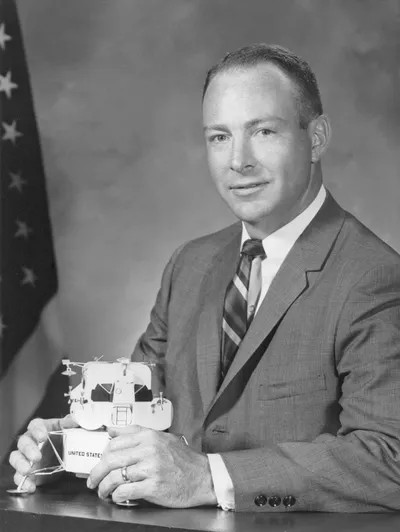
Edgar Mitchell was more than just a pilot and scientist. He was a man who stared into space and came back with a different view of reality. Born on September 17, 1930 in Hereford, Texas, his life bridged the gap between cold design and deep spiritual inquiry. He died on February 4, 2016 in West Palm Beach, Florida. But his influence did not end there.
His most famous moment happened during the Apollo 14 mission. This is more than just a flight. In early 1971, this was a high-stakes gamble for NASA. The crew consisted of Commander Alan Shepard and Stuart Roosa. From January 31 to February 9, Mitchell and Shepard walked on the moon. They explored the highlands north of Fra Mauro Crater. It’s a rugged, difficult landscape. They encountered technical problems. They face physical fatigue. But they succeeded.
Before he could stare at the moon from space, Mitchell had to climb the academic ladder. He first attended the Carnegie Institute of Technology in Pittsburgh. He graduated in 1952 with a B.S. in industrial management. A background in systems thinking can help cope with disruptions in spaceflight.
He then joined the US Navy. The military needs pilots who know flying machines. Mitchell delivered. He received his B.S. in aeronautics from the US Naval Postgraduate School in 1961. However, he wasn’t done. He pushed further. He wanted to understand the deeper mechanics of flight and space travel.
He received his doctorate in aeronautics and astronautics from the Massachusetts Institute of Technology in 1964. MIT is at the center of the space race. Being there means being at the center of innovation. That means working with some of the sharpest minds in the industry.
This educational path is not random. This was a deliberate construction. Industrial management taught him logistics. Aviation taught him physics. Astronautics taught him orbital mechanics. Each degree added a layer of competence. When he donned his astronaut wings, he was overqualified for many of his peers. This precision served him well during the Apollo 14 mission.
But why is this important today?
Many people remember Apollo 14 for its golf shots and technical glitches. They don’t remember the human element. Mitchell is one of them. He didn’t stop at technology. The experience of seeing the Earth from space, the Overview Effect, changed him. This changed his view of consciousness. This changed his view of the universe.
He didn’t just study lunar craters. He explores the limits of human perception. This change makes his story more than a biography. This is a case study where perspective makes all the difference.
The Apollo 14 mission was a triumph of American technology. But Mitchell’s later work is a triumph of the human spirit. He didn’t just want to know how to get to the Moon. He wanted to know why we were there. And what it might be like when we get back.
This is just the beginning of his story. Such is the journey from Texas to the Massachusetts Institute of Technology (MIT) and on to the moon. The real intrigue begins when he returns.
The Apollo 13 explosion wasn’t just a mechanical failure. It was a crisis that demanded improvisation from people who haven’t rehearsed for this particular nightmare. Mitchell was at the Lyndon B. Johnson Space Center in Houston. He wasn’t on the ship. He was in the lunar module simulator. His job was to figure a way to get the three people home using only the tools they left behind.
The oxygen tank exploded. Power was gone. The cabin was freezing. But Mitchell and his team developed procedures that works. They used the lunar module as a rescue boat. It was a desperate fix saved the crew. For his efforts, he received the Presidential Medal of Freedom in 1970. It was a high note. The public saw him as a hero who helped them survive this difficult time.
Then along came Apollo 14. This is where the record was really broken.
Mitchell was accompanied by Alan Shepard and Stuart Roosa. They spent 33 hours on the lunar surface. This set a record at the time. They also achieved the longest distance ever traveled by humans outside of Earth’s orbit. They didn’t just walk around. They brought back 42.6 kilograms of rocks and soil. Ninety-four pounds of moon dirt. Scientists are still studying these samples.
By then, Mitchell’s mind was elsewhere.
He retired from the Navy and the space program in 1972. The silence of space changed him. He was not satisfied with just collecting rocks. He wanted to understand what happened to his consciousness during those quiet moments above the Earth. “Overview Effect” is not just a metaphor for him. It felt like a real shift in perception.
So in 1973, he founded the Institute of Noetic Sciences in Palo Alto, California. Although it sounds like a science fiction novel, it is a serious attempt to explore human potential. He called it parapsychology at the time. He wanted to study the relationship between mind and matter.
A few years later, in 1996, he wrote The Way of the Explorer This is not a technical manual. It is about his spiritual journey. He described the experience of viewing the Earth from space as a moment of profound unity. It’s not just science. Something deeper.
Did he find answers? Or just better questions? The institute continues to operate. Samples from Apollo 14 remain in the laboratory. The medal is in a drawer. But what about the idea that consciousness could be more than just brain chemistry? That’s still out there.