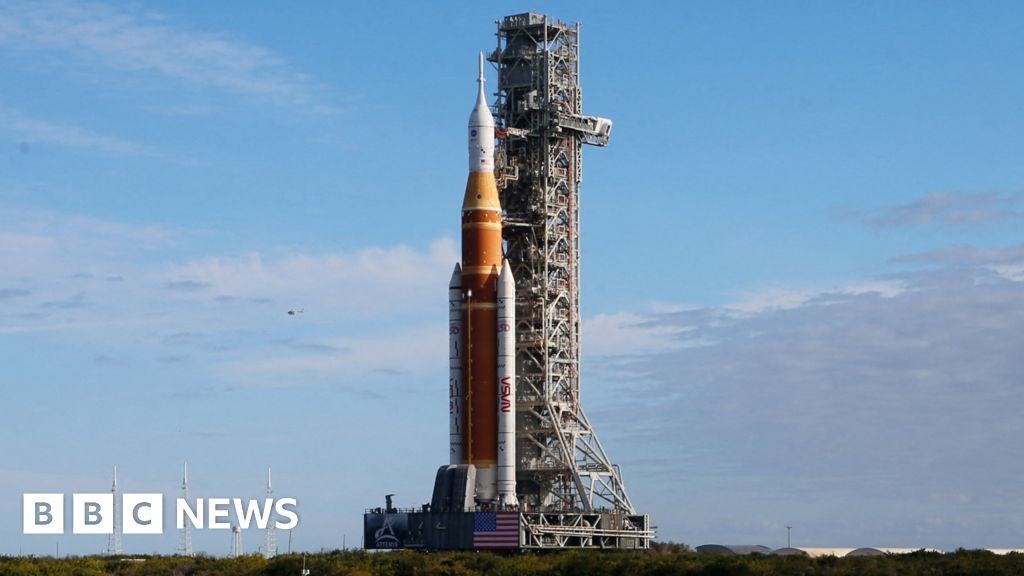
NASA’s Space Launch System (SLS) rocket – the agency’s mega-rocket designed for deep space missions – has reached Launch Pad 39B at the Kennedy Space Center in Florida. This marks a critical step forward in preparations for Artemis II, the first crewed mission to orbit the Moon in over half a century. The 98-meter-tall rocket was transported over nearly 12 hours on a massive crawler-transporter, moving at a slow but steady pace of 1.3 kilometers per hour.
Historic Mission on the Horizon
The Artemis II mission, slated for launch no earlier than February 6th, will carry four astronauts – Reid Wiseman, Victor Glover, Christina Koch, and Canadian astronaut Jeremy Hansen – on a 10-day flight around the Moon. While this mission won’t involve a lunar landing, it serves as a crucial test flight for NASA’s next-generation deep space exploration program. This is the first human mission to the Moon since Apollo 17 in 1972, signaling a renewed commitment to lunar exploration and beyond.
Why This Matters
The Artemis program isn’t just about revisiting the Moon; it’s about establishing a sustainable presence there and using it as a stepping stone for future missions to Mars. The delays in the program highlight the inherent challenges of deep space travel, but NASA insists safety remains the top priority. This mission will test critical systems, including Orion spacecraft life support, radiation shielding, and long-duration crew performance in deep space.
International Collaboration
The Artemis II mission relies heavily on international collaboration, with key components built by partners across the globe. Airbus in Bremen, Germany, is responsible for manufacturing the European Service Module (ESM), a vital component of the Orion spacecraft. The ESM provides essential propulsion, power, and life support for the crew. As engineer Sian Cleaver emphasized, “We basically can’t get to the Moon without it.” The ESM’s complex design and assembly take roughly 18 months per module, underscoring the intricate engineering behind deep space exploration.
Preparing for Launch
Over the next few weeks, NASA will conduct a “wet dress rehearsal” – a full simulation of fueling and launch procedures – to ensure all systems are functioning correctly. The Artemis II crew was present at the Kennedy Space Center to witness the rocket’s arrival, expressing excitement and readiness for the mission. Astronaut Christina Koch described the feeling as “amazing” and noted that the crew is “just so ready to fulfil the mission.”
The Artemis II crew will spend the first two days of their mission in Earth orbit before embarking on a quarter-million-mile journey to the Moon. They will use this time to study the Earth from a unique perspective, 40,000 miles out, and to conduct scientific observations of the lunar surface in preparation for future landings.
Artemis III, currently scheduled for no earlier than 2027 (though experts suggest 2028 is more realistic), will be the mission to actually land humans on the Moon once again. The success of Artemis II is pivotal in ensuring the safety and viability of this historic endeavor.
The arrival of the SLS rocket on the launchpad signifies that humanity is once again on the cusp of a new era in space exploration. The mission’s success depends on rigorous testing, meticulous preparation, and an unwavering commitment to crew safety.