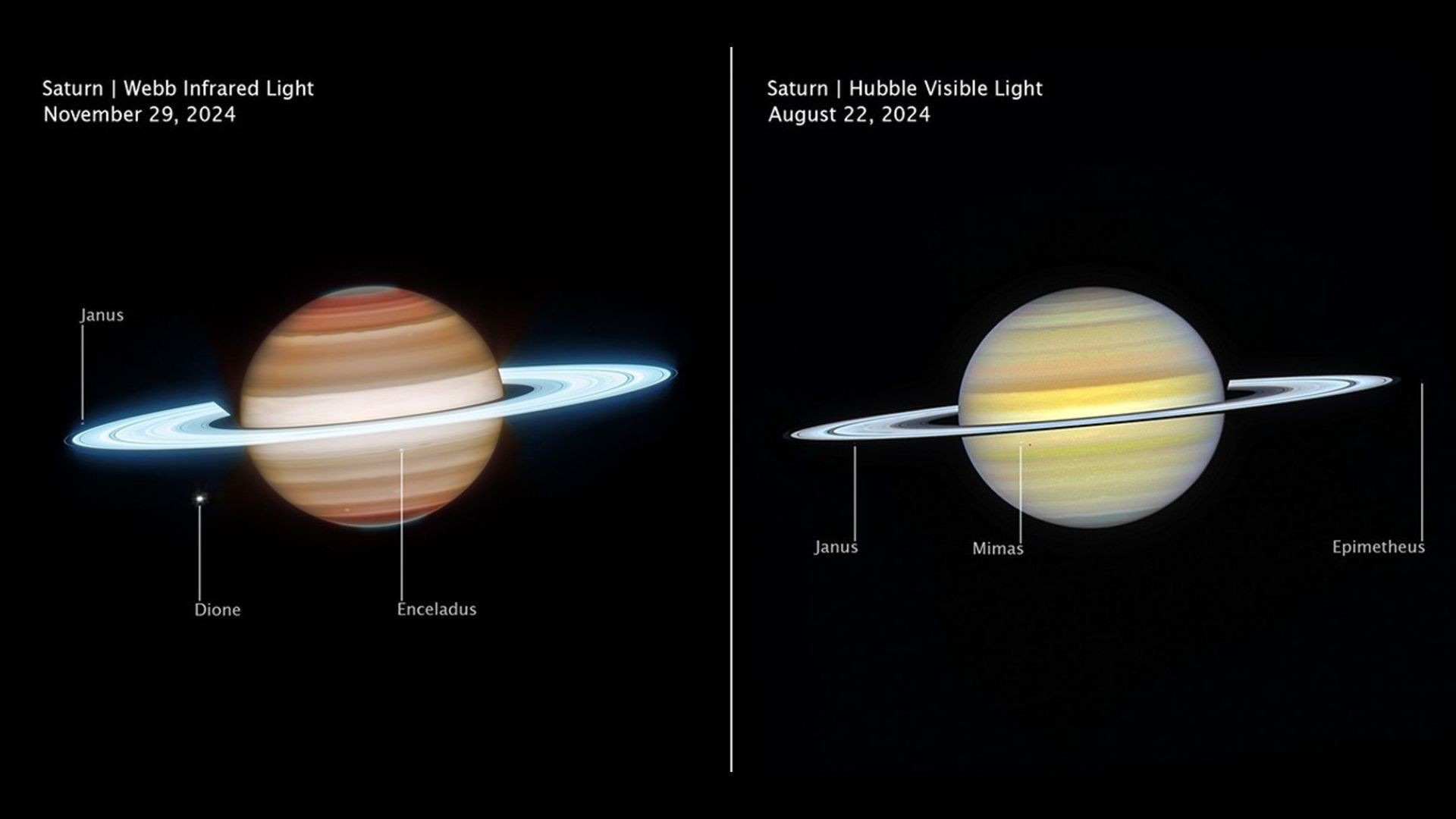
New observations from the James Webb and Hubble space telescopes have provided the most comprehensive view yet of Saturn’s chaotic atmosphere, revealing striking details about its winds, storms, and weather patterns. These combined images allow scientists to study the planet’s atmospheric layers at different altitudes, offering insights into its formation and evolution.
A Rare Look at Saturn’s Hexagon
One of the most intriguing features captured is Saturn’s persistent hexagonal jet stream at its north pole. This six-sided storm, visible in both infrared and visible light, is a long-standing mystery to researchers. What makes this observation particularly valuable is its timing: Saturn’s north pole is about to enter a 15-year period of darkness as it tilts away from the sun, meaning high-resolution views like these may not be possible again until the 2040s.
Two Telescopes, Two Views
The images come from separate but complementary observations. Hubble, as part of its decade-long Outer Planet Atmospheres Legacy program, took a visible-light picture in August 2024. Webb followed with an infrared image in November 2024. The 14-week gap between the shots shows Saturn shifting toward its equinox, revealing dynamic changes in the planet’s atmosphere.
The difference in how the two telescopes perceive Saturn is remarkable. Hubble shows pale-yellow bands and bright-white rings, while Webb’s infrared view transforms the rings into glowing blue due to their high water-ice content. Saturn’s poles emit a strange gray-green light, potentially from either aerosols or auroras, similar to those recently observed on Uranus.
Why This Matters
Studying Saturn’s atmosphere isn’t just about understanding weather on another planet. It also sheds light on the physics of large-scale storms and provides clues about the planet’s formation billions of years ago. The continuous monitoring by Hubble and Webb will help scientists track these changes and reveal more secrets hidden within Saturn’s clouds.
The combined power of these two telescopes gives us a unique opportunity to study Saturn’s atmosphere in a way that wasn’t possible before, unlocking secrets about its dynamics and evolution.
Saturn remains an active area of research, and scientists will continue to monitor it as it moves into its southern springtime, hoping to uncover further insights into its mysterious weather patterns.