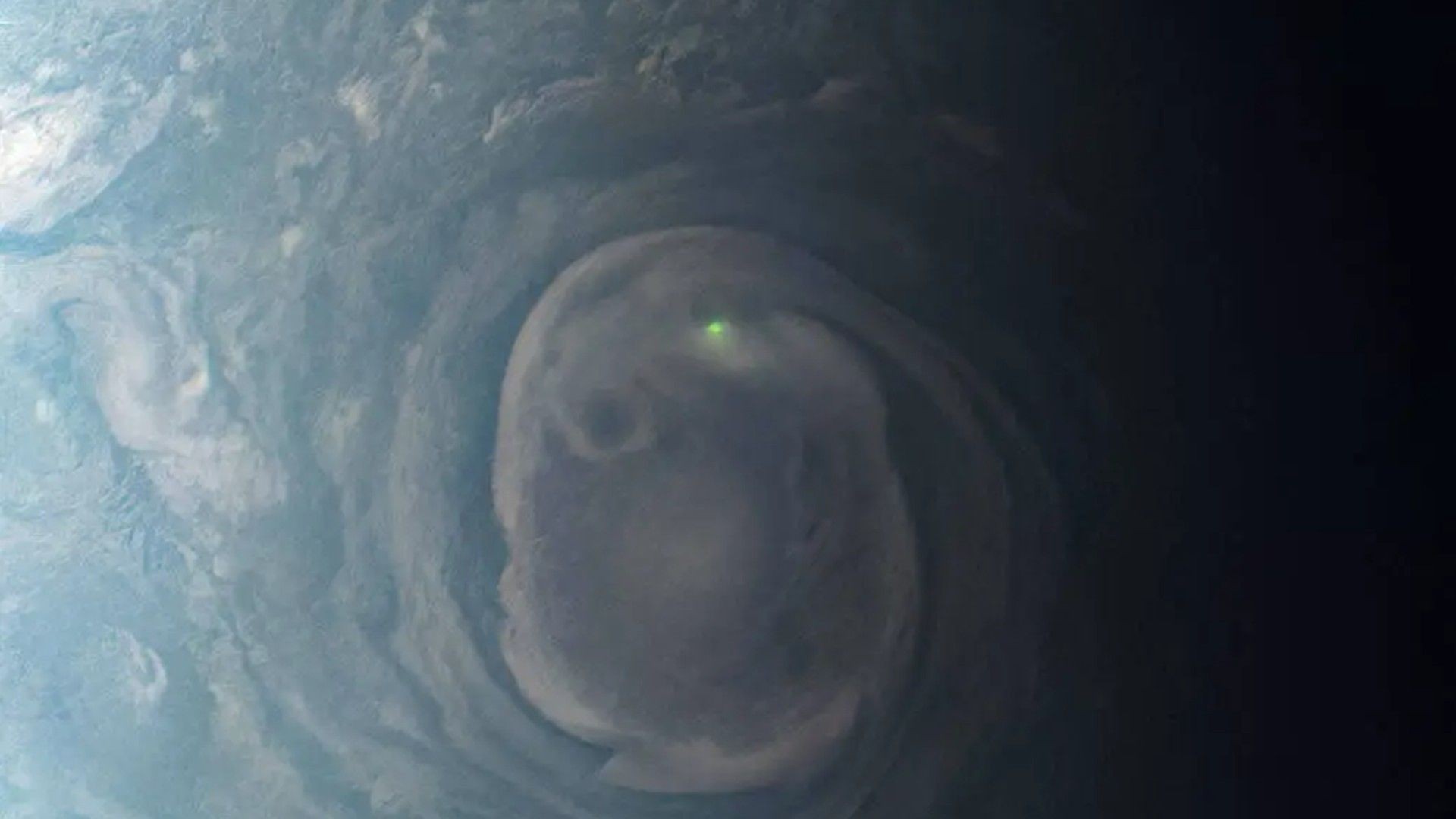
Jupiter’s storms are legendary, lasting centuries and dwarfing anything seen on Earth. Recent research confirms that the lightning within these storms is similarly extreme, potentially reaching intensities one million times greater than terrestrial lightning. This discovery isn’t just about bigger bolts; it sheds light on the fundamental differences between planetary atmospheres and how energy behaves on a massive scale.
The Puzzle of Jupiter’s Lightning
For decades, scientists knew Jupiter hosted lightning. Early observations relied on detecting the brightest flashes on the planet’s dark side, suggesting similar energy levels to Earth’s rare “superbolts.” However, data from NASA’s Juno mission, beginning in 2016, presented a contradiction: Juno detected frequent, weaker flashes resembling typical Earth lightning. The issue was cloud cover obscuring the true power of the bolts, making accurate measurement difficult.
The breakthrough came from analyzing radio emissions detected by Juno’s core instrument. Unlike visual observations, radio waves penetrate clouds, offering a clearer picture of lightning intensity. This approach revealed a far more powerful phenomenon than previously thought.
Stealth Superstorms and Radio Wave Analysis
Researchers faced a challenge: Jupiter often has multiple storms raging simultaneously, making it hard to link specific lightning to its source. The team overcame this by focusing on periods with reduced storm activity in Jupiter’s north equatorial belt (dubbed “stealth superstorms”). By combining data from Juno, NASA’s Hubble Space Telescope, and amateur astronomers, they pinpointed the origin of lightning within these isolated storms.
Analysis of 613 lightning pulses detected an average of three flashes per second, ranging from Earth-level energy to bolts 100 times stronger. The team acknowledges that due to differing measurement wavelengths between Earth and Jupiter, the actual power could be even greater – up to a million times more intense.
Why Jupiter’s Lightning Is So Extreme
The key difference lies in atmospheric composition. Earth’s air is mostly nitrogen, making moist air buoyant. Jupiter’s atmosphere is dominated by hydrogen, meaning moist air is heavier and harder to lift. This requires significantly more energy to create storms, resulting in higher wind speeds and more intense lightning when they do erupt.
Similar to Earth, convection drives Jupiter’s storms – the process of heat transfer from below. However, the higher energy barrier means that when a storm does rise, it unleashes tremendous power.
“Could the key difference be hydrogen versus nitrogen atmospheres, or could it be that the storms are taller on Jupiter and so there’s greater distances involved?” – Michael Wong, planetary scientist at UC Berkeley.
Jupiter’s storms reach over 62 miles high, compared to Earth’s 6.2 miles. This greater altitude may contribute to the extreme energy discharge. The exact cause remains uncertain, but the findings highlight how fundamentally different energy dynamics operate on gas giants compared to rocky planets.
The study reinforces that lightning on Jupiter is likely generated through similar mechanisms as on Earth: condensing water vapor creating electrically charged particles. However, the sheer scale and atmospheric conditions amplify the effect, resulting in bolts of unimaginable power.