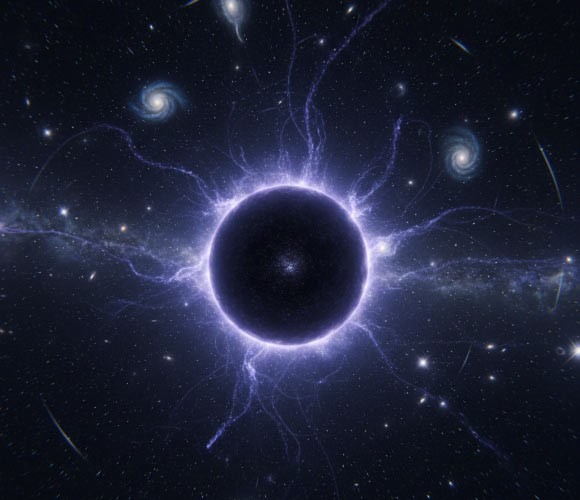
For decades, scientists believed a supermassive black hole, Sagittarius A, sat at the heart of the Milky Way, responsible for the rapid orbits of nearby stars. However, new research suggests an alternative: a super-dense core composed of fermionic dark matter * could explain the same observed stellar movements, potentially reshaping our understanding of galactic centers.
The Alternative to Black Holes
The study, led by Dr. Valentina Crespi from the Institute of Astrophysics La Plata, proposes that instead of a black hole, a unique cosmic structure formed by self-gravitating fermionic dark matter could mimic the gravitational effects seen at the Milky Way’s center. This means the high-speed orbits of the S-stars — stars that whip around Sagittarius A* at thousands of kilometers per second — could be explained without invoking a singularity.
The model suggests this dark matter core would be exceptionally compact and massive, exerting a gravitational pull indistinguishable from a black hole. This isn’t just speculation; the team’s calculations also account for the orbits of dust-shrouded objects known as G-sources, which also cluster near the galactic center.
Bridging Scales: From Galactic Core to Outer Halo
What sets this research apart is its ability to connect observations across vastly different scales. Recent data from the European Space Agency’s Gaia DR3 mission mapped the Milky Way’s outer halo, revealing a slowdown in its rotation curve (the Keplerian decline). The team’s fermionic dark matter model accurately reproduces this behavior, unlike traditional dark matter models.
This is critical because conventional dark matter halos are predicted to spread out in a long, extended tail. Fermionic dark matter, however, forms a tighter structure, resulting in a more compact halo, which aligns with observations.
“This is the first time a dark matter model has successfully bridged these vastly different scales and various object orbits, including modern rotation curve and central stars data,” said Dr. Carlos Argüelles, a co-author on the study.
Consistent with Black Hole Imagery?
The implications don’t stop at orbital mechanics. The team found that their dark matter core model can even explain the “shadow” imaged by the Event Horizon Telescope (EHT) for Sagittarius A*. A dense dark matter core bends light so strongly it could mimic the dark central region surrounded by a bright ring, just like the EHT’s black hole image.
Future Testing and Implications
While current data cannot definitively rule out a black hole, the dark matter model provides a unified framework for the galactic center, accounting for both stellar orbits and the observed shadow. Future observations from instruments like the GRAVITY interferometer will be crucial to test these predictions.
Specifically, scientists will look for photon rings—a key feature of black holes that wouldn’t exist around the proposed dark matter core. If confirmed, this discovery would fundamentally alter our understanding of the forces governing galactic centers and the nature of dark matter itself.
The study was published in the Monthly Notices of the Royal Astronomical Society.