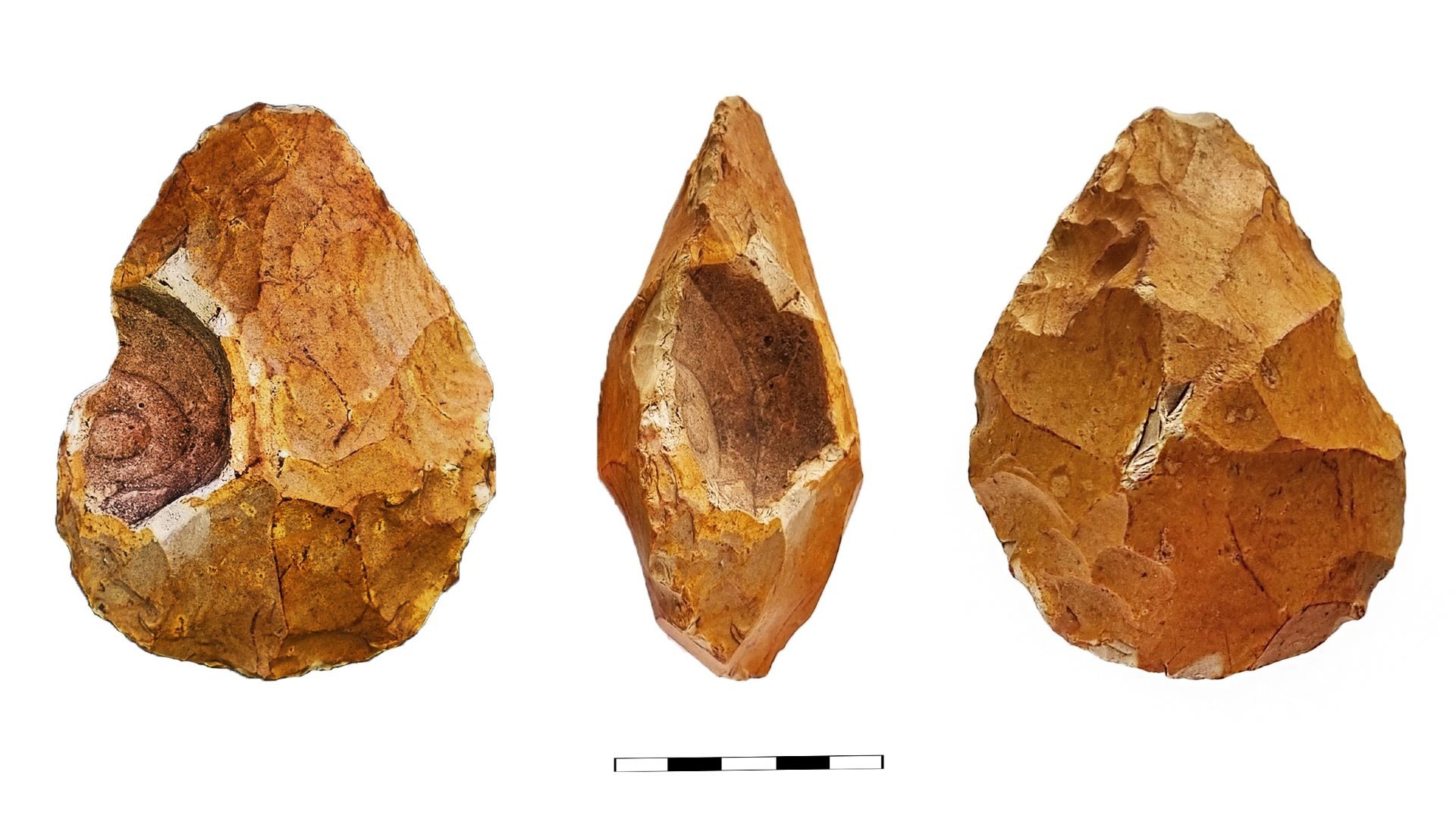
A groundbreaking discovery in Israel’s Sakhnin Valley is challenging our understanding of prehistoric intelligence. Archaeologists have unearthed a significant collection of stone hand axes that appear to have been crafted with a purpose far beyond mere utility: the deliberate incorporation of fossils, geodes, and unique geological formations.
The find, detailed in the journal Tel Aviv, represents the largest concentration of such specialized tools ever discovered. While similar items have been found sporadically across the globe, this is the first time a cluster of these “extraordinary” tools has been found together, suggesting a widespread and intentional behavior among Homo erectus.
The Evidence of Intentionality
The discovery began when local resident Muataz Shalata identified several unusual hand axes, prompting a specialized survey in 2025. Researchers identified over 200 hand axes, 10 of which featured distinct geological anomalies, such as:
– Fossils embedded within the stone.
– Geodes containing internal crystalline structures.
– Natural hollows resembling miniature caves.
– Concretions creating ripple-like patterns.
The key to this discovery lies in the difficulty of the craft. Professor Ran Barkai of Tel Aviv University notes that incorporating these features actually made the tools more brittle and harder to shape. From a purely functional standpoint, these inclusions were “obstacles.” The fact that Homo erectus went through the extra labor to include them suggests that the aesthetic or symbolic value of the tool outweighed its practical flaws.
The “Holy Triad”: Humans, Elephants, and Stone
The study also highlights a profound connection between these early humans and the megafauna of their era. These hand axes were primarily used for butchering large animals, most notably elephants.
Researchers have identified what they call a “holy triad” of survival: elephants, stone, and water. Evidence suggests that Homo erectus strategically placed their tool-making sites along elephant migration routes near water sources. This relationship was so deeply ingrained that replicas of hand axes have even been found fashioned from broken elephant bones, indicating that these animals were central to both the physical survival and the cultural landscape of early humans.
A Bridge to the Cosmos?
Perhaps the most provocative theory presented by the researchers is that these tools served a metaphysical purpose. The study suggests that Homo erectus may have viewed fossils and geodes not just as rocks, but as traces of a primordial time and place.
“I believe that humans were not just manipulating ‘natural resources’ by using stone tools, but were doing this while paying respect to these entities… the stone tools were conceived as mediators between humans and the cosmos.” — Ran Barkai
This theory is supported by the discovery of a stone ball painstakingly shaped from a geode—a process that offered no practical survival advantage but demonstrated a high level of artistic or symbolic intent. This points to an ancient human trait: the desire to find meaning in the extraordinary and to seek connection with the larger universe.
Scientific Debate and Next Steps
While the findings are a major milestone, the archaeological community remains cautious. Professor Sarah Wurz of the University of the Witwatersrand notes that while the find proves the high “perceptive abilities” of past humans, more “inferential scaffolding”—or direct evidence—is needed to definitively prove that these tools were used for symbolic or religious rituals rather than being accidental.
The next phase of research will involve deep-site excavations. So far, the artifacts have only been recovered from the surface; digging into the original archaeological layers will provide the context needed to confirm whether these tools were part of a structured, symbolic tradition.
Conclusion: This discovery suggests that Homo erectus possessed a level of cognitive complexity previously underestimated, potentially using stone tools as symbolic bridges between their daily survival and a deeper, more cosmic understanding of the world.