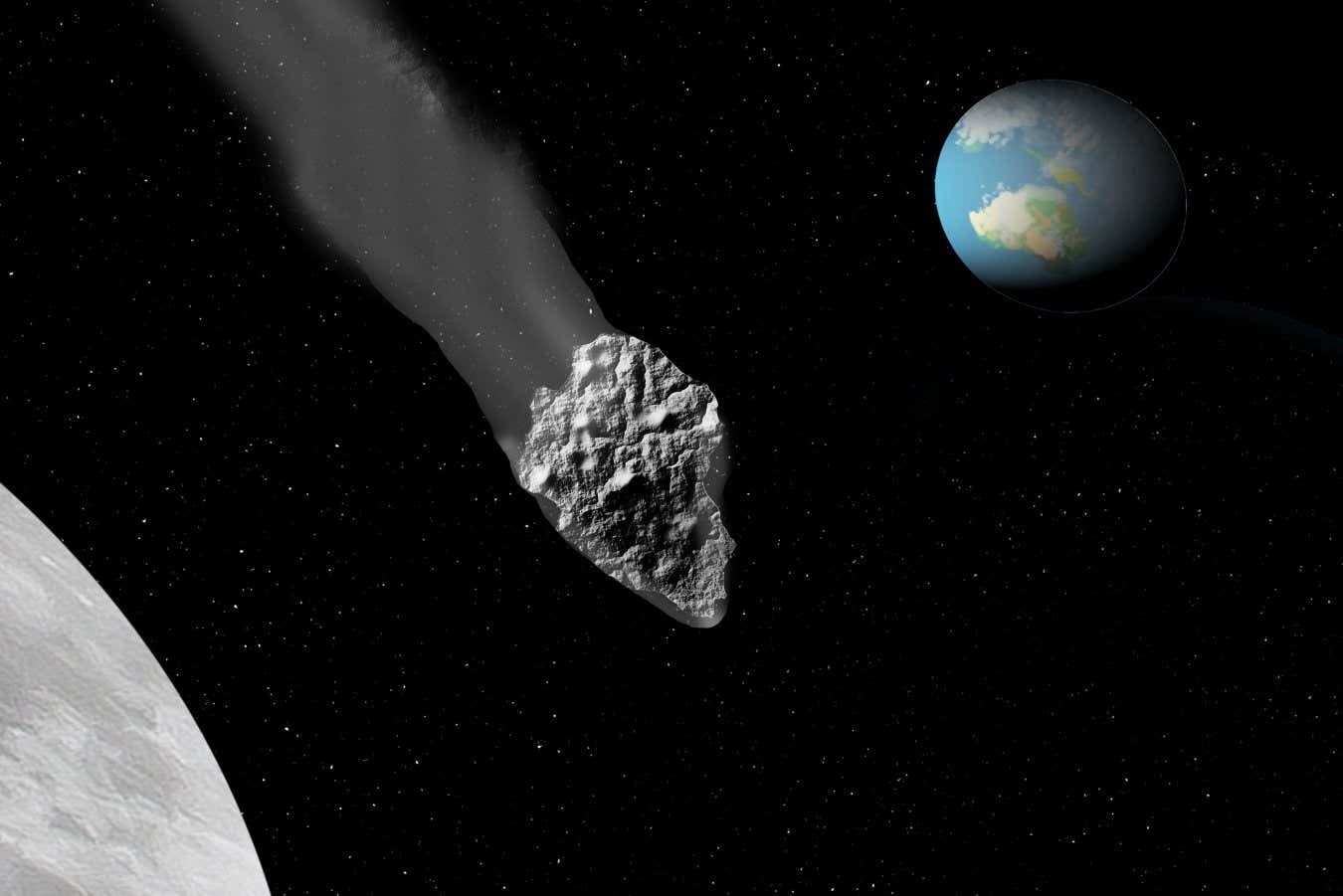
A new proposal suggests using a massive orbiting magnet to gently pull asteroids off course, offering an alternative to potentially destructive kinetic impactors. The concept, dubbed “Non-Contact Orbital Velocity Adjustment” (NOVA), presented by Gunther Kletetschka at the Lunar and Planetary Science Conference, avoids the fragmentation risks associated with traditional deflection methods.
The NOVA Concept Explained
Unlike slamming a spacecraft into an asteroid—which could shatter it into multiple hazardous fragments—NOVA proposes a more subtle approach. A spacecraft equipped with a 20-meter diameter superconducting magnet, powered by a nuclear fission reactor, would orbit a target asteroid at a close range (10-15 meters). The magnet would then slowly extract iron-rich material from the asteroid, effectively shrinking it while simultaneously increasing the spacecraft’s mass and magnetic field.
This method is particularly relevant given that most asteroids aren’t solid rocks, but loosely bound “rubble piles” held together by weak gravity. Pushing such an asteroid risks breaking it apart, creating a far greater threat than the original object. NOVA, in contrast, offers a controlled, incremental deflection.
Feasibility and Challenges
Kletetschka’s calculations suggest that deflecting a small asteroid, like 2024 YR4 (which briefly posed a potential collision risk in 2032), would require at least 170 days of continuous operation. While the concept is theoretically sound, several challenges remain:
- Iron Content: The amount of iron within asteroids varies, and accurate knowledge is crucial for effectiveness.
- Proximity Operations: Maintaining a spacecraft in such close orbit for extended periods is technically demanding.
- Untested Technology: The NOVA method has not been tested in a real-world scenario, meaning its efficacy remains unproven.
Despite these hurdles, Kletetschka argues that adding another tool to our planetary defense arsenal is worthwhile, especially given NOVA’s minimal risk of exacerbating the problem.
“This electromagnetic deflection is plausible, but we have critical uncertainties,” Kletetschka admits. “However, adding a tool to our planetary defense toolbelt couldn’t be a bad thing, especially as it would have essentially zero risk of worsening the problem.”
The development of NOVA represents an intriguing step towards more nuanced asteroid deflection strategies. As our ability to detect and track near-Earth objects improves, so too must our capacity to respond effectively — and this method could become a valuable part of that response.