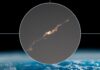
Thousands of stars remarkably similar to our sun have been identified, bolstering a theory that the sun, and potentially life-bearing planets, migrated outward from the densely populated center of the Milky Way galaxy. This movement may be key to understanding why Earth exists in a relatively stable environment conducive to life, rather than forming in the chaotic inner regions.
The Discovery of Solar Twins
Researchers analyzing data from the European Space Agency’s Gaia telescope found 6,594 stellar “twins”—stars with nearly identical ages, temperatures, compositions, and surface gravities to our sun. This is over 30 times more than previous surveys had revealed, and crucially, most of these stars reside in the sun’s immediate galactic neighborhood. The sheer number of matches suggests a common origin and a coordinated movement.
Galactic Bar Formation and Stellar Migration
The findings support a model where the sun and its “siblings” were ejected from the galactic center as the Milky Way’s central bar formed billions of years ago. This bar, a dense concentration of stars and gas, acted as both a catalyst for star formation and a trigger for widespread stellar migration. The sun’s own chemical composition confirms it originated several thousand light-years inward, yet models previously struggled to explain how it crossed the galactic bar.
“We propose that the formation of the Milky Way’s central bar enhanced star formation and also triggered large-scale migration, leading to the formation and outward migration of the sun—and many solar twins.” – Daisuke Taniguchi, Tokyo Metropolitan University
The new hypothesis resolves this conflict by suggesting the bar solidified after many stars had already moved outward. This timeline places the bar’s formation between 4 and 6 billion years ago—consistent with the sun’s age of 4.5 billion years.
Why This Matters for Life
The galactic center is a turbulent place, prone to frequent supernovas and other energetic events. Such an environment would be hostile to life as we know it. The outward migration of the sun implies Earth may have spent most of its history in the quieter outer disk.
This isn’t a matter of pure luck; rather, the conditions that allowed for life on Earth may be a direct result of galactic structure and the sun’s journey from the crowded core. If the sun’s migration occurred relatively soon after its birth, it suggests that our solar system actively sought out stability, rather than being randomly placed in it.
The sun and Earth’s movement into a more stable region may have been inevitable given the galaxy’s evolution. This discovery isn’t just about stellar origins, but about the conditions that enable life to flourish in a vast, chaotic universe.