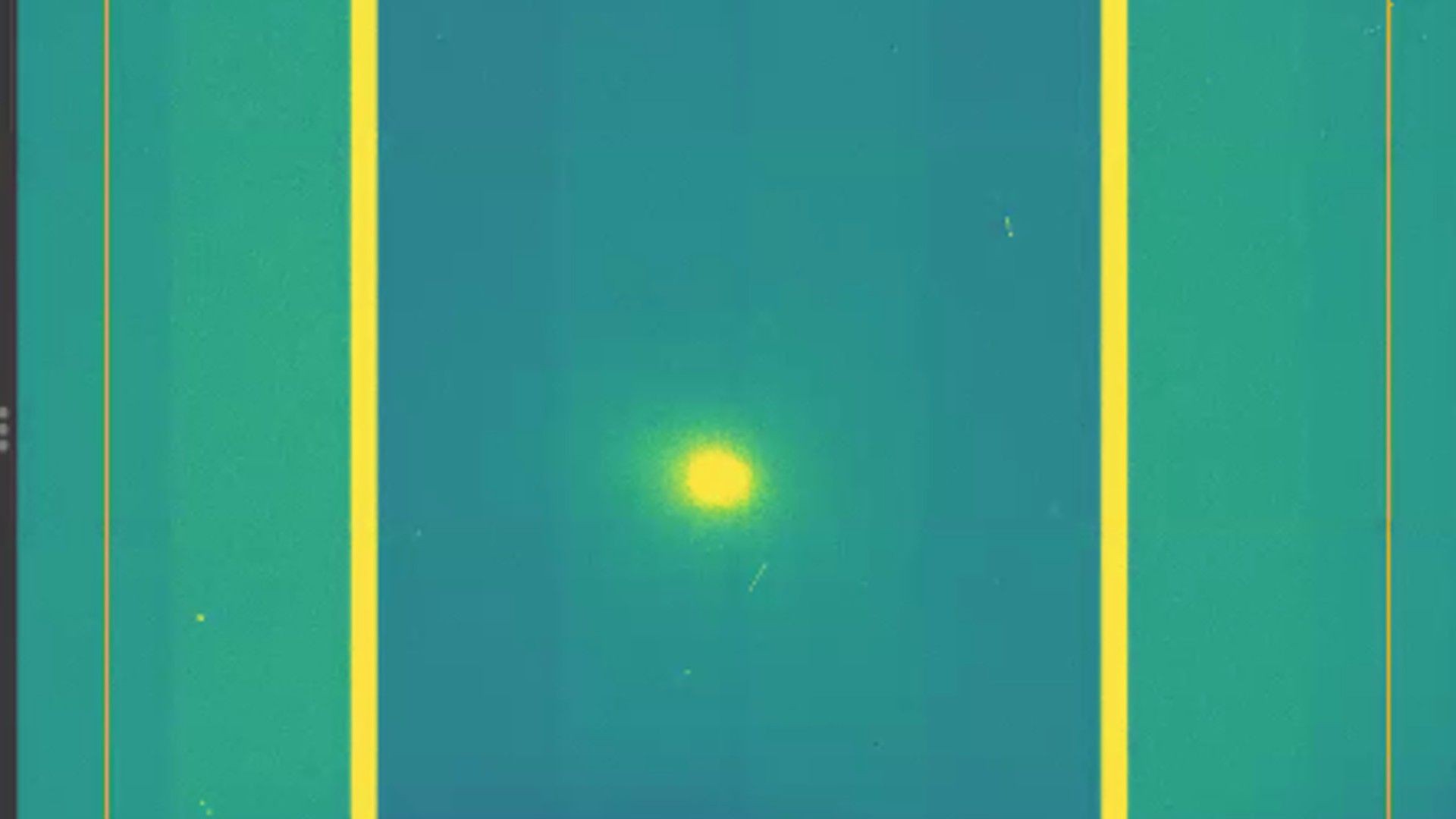
Scientists recently observed interstellar comet 3I/ATLAS as it departed our solar system, capturing data that provides a rare look at an object potentially older than the sun itself. The observations, conducted in real-time from Hawaii’s Maunakea volcano and previously by Chile’s Gemini South telescope, revealed unique chemical compositions and shed light on the comet’s extraordinary age.
A Time Capsule from Beyond Our System
Comet 3I/ATLAS isn’t just another celestial body; it’s a relic of the early galaxy, possibly formed billions of years before our sun existed. The comet’s close pass by our solar system allowed astronomers to analyze its composition, revealing a distinct lack of water-rich features common in our own comets, and instead exhibiting high concentrations of carbon dioxide and cyanogen.
This unusual composition, combined with its immense velocity (approximately 209,000 kilometers per hour at its closest approach to the sun), suggests an origin far beyond our solar system. The comet has been wandering the Milky Way for so long that tracing its origins back to a specific star system is now nearly impossible.
Unveiling the Comet’s Age: Billions of Years Old
Determining the age of 3I/ATLAS is not straightforward, but two independent studies have converged on a similar conclusion. By analyzing the comet’s velocity relative to the sun, researchers estimate its age to be between 3 billion and 14 billion years old – placing it firmly among the oldest comets ever observed. This means 3I/ATLAS predates our own solar system, having witnessed countless galactic orbits before its brief visit to our neighborhood.
The comet’s journey has been chaotic, distorted by gravitational interactions with gas clouds, spiral arms, and dark matter. This constant tug-of-war has erased any clear path back to its point of origin, leaving it as a truly interstellar wanderer.
Real-Time Observation and Open Data Access
The observations were conducted through a collaborative effort between the Gemini North Telescope and Shadow the Scientists, an organization dedicated to connecting experts and the public through live scientific sessions. The team meticulously calibrated their instruments, accounting for atmospheric distortions and telescope imperfections to ensure data accuracy.
What distinguishes this study is the immediate public release of all data, allowing any researcher to analyze the findings independently. This open-access approach accelerates scientific progress and ensures transparency in the exploration of our universe.
A Glimpse into Galactic History
The fleeting encounter with 3I/ATLAS has provided a unique opportunity to study the debris of other planetary systems, eroded by billions of years of interstellar travel. The comet’s existence confirms that our solar system is not alone in the galaxy, and that ancient wanderers continue to roam the cosmic landscape.
The comet’s journey reminds us that the universe is filled with objects that predate our own existence, carrying within them stories from an earlier era. Continued observation of 3I/ATLAS—and similar interstellar visitors—will offer invaluable insights into the formation and evolution of galaxies.