


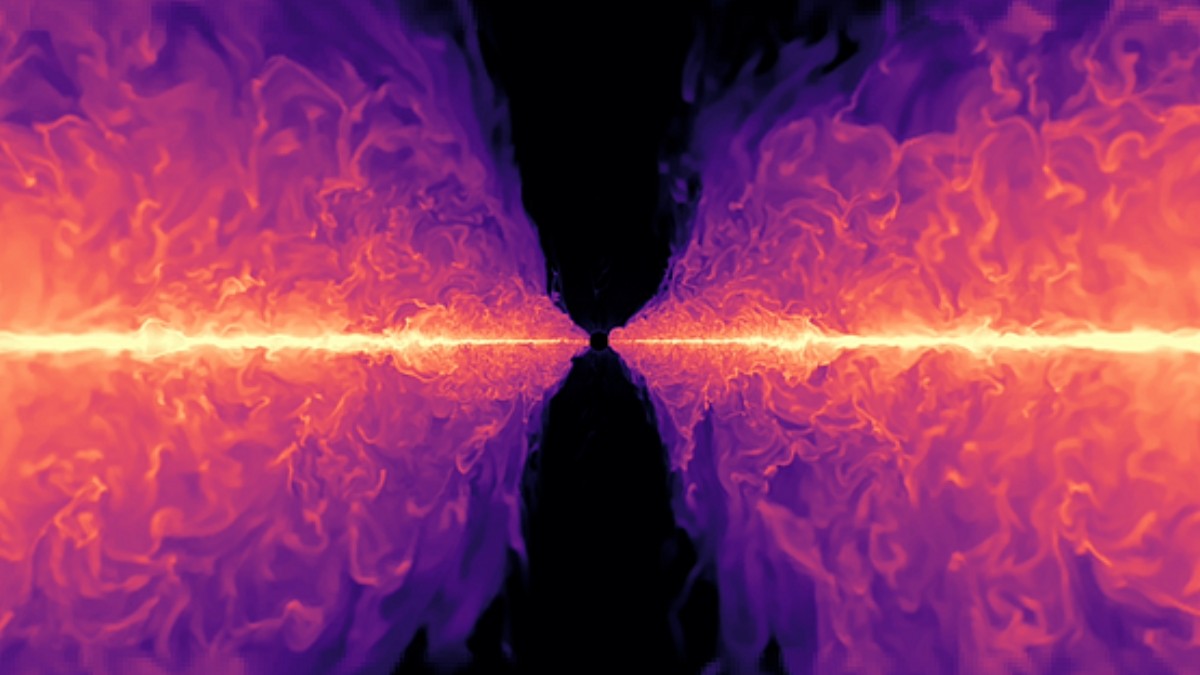
New simulations, powered by some of the world’s most powerful supercomputers, are providing the clearest picture yet of how black holes consume matter and unleash energy. For decades, astrophysicists have struggled to accurately model the chaotic environments surrounding these cosmic behemoths, but recent breakthroughs have allowed for more realistic calculations than ever before.
The Challenge of Modeling Black Hole Dynamics
The regions immediately around black holes are among the most violent and unstable in the universe. Matter spiraling toward the event horizon doesn’t simply fall in; it collides, heats up to extreme temperatures, and emits intense radiation in the form of jets and flares. Previous models often relied on simplifications to make calculations manageable, which inevitably sacrificed accuracy. These shortcuts meant that key physical processes were either ignored or approximated, leading to a limited understanding of how black holes really work.
Breakthrough Simulations Combine Data and Theory
Researchers at the Flatiron Institute used two high-performance supercomputers to run simulations incorporating detailed observations of black hole accretion flows, along with precise measurements of spin and magnetic field strength. This approach avoided many of the oversimplifications plaguing earlier studies. The result is a model that accurately describes the behavior of stellar-mass black holes – those roughly the size of our Sun – as they pull in gas, light, and magnetism.
“This is the first time we’ve been able to see what happens when the most important physical processes in black hole accretion are included accurately,” says astrophysicist Lizhong Zhang. “These systems are extremely nonlinear – any over-simplifying assumption can completely change the outcome.”
Key Findings: Accretion Disks, Magnetic Fields, and Energy Release
The simulations confirm that black holes accumulate thick disks of matter before swallowing it. These disks absorb significant radiation, but instead of being destroyed, much of the energy is released in the form of powerful winds and jets. The team also observed how a narrow funnel forms near the black hole’s horizon, allowing material to be drawn in at incredible rates. The configuration of surrounding magnetic fields was found to play a critical role, guiding gas towards the black hole and channeling energy into focused beams that can only be observed from certain angles.
Why This Matters: Bridging Theory and Observation
These simulations don’t just confirm existing theories; they help explain observations that have puzzled astronomers for years. The models align with data from various black hole systems, including those emitting unexpectedly low levels of X-ray radiation. The team believes that these discrepancies, known as “little red dots”, may be resolved by refining their simulations further.
Future Research: Scaling Up and Solving Cosmic Mysteries
The researchers plan to apply their models to supermassive black holes, such as Sagittarius A at the center of the Milky Way. This work could potentially unlock deeper insights into the behavior of these enigmatic objects and provide a more complete understanding of how black holes shape the universe. * By treating radiation accurately within the framework of Einstein’s theory of general relativity, the team has created a powerful tool for exploring the extremes of physics.
The implications of this research extend beyond astrophysics. By pushing the limits of supercomputing and theoretical modeling, scientists are gaining a deeper understanding of gravity, magnetism, and the fundamental laws governing the cosmos.


