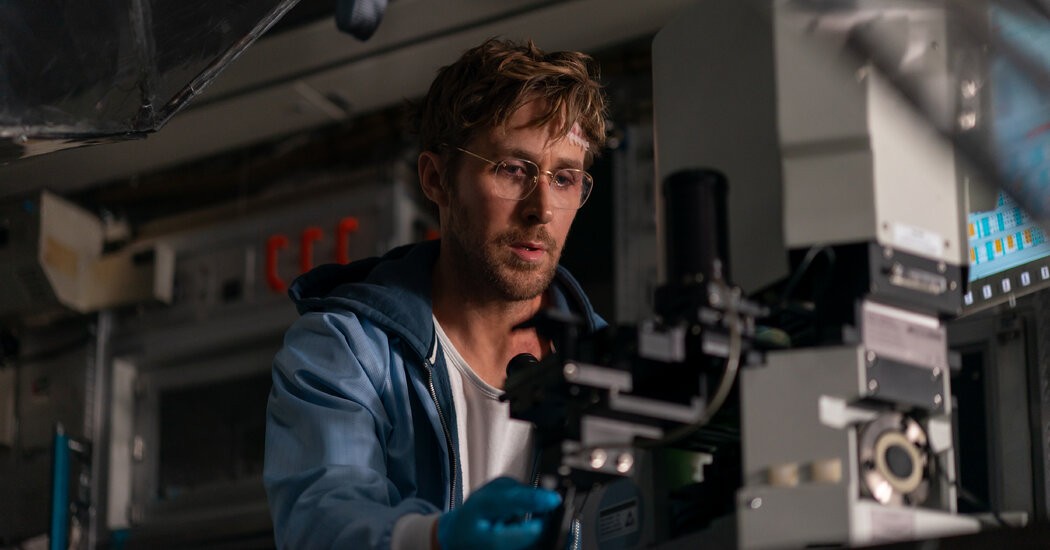
The debate surrounding the new sci-fi blockbuster Project Hail Mary has moved beyond Ryan Gosling’s performance or the film’s optimistic view of global cooperation. Instead, the conversation has turned to a more fundamental question: How much of the science on screen actually holds up to scrutiny?
While some argue that nitpicking a work of fiction is a fruitless endeavor, the debate is uniquely charged here because of the source material. The film is based on the novel by Andy Weir, author of The Martian, whose reputation is built on “hard science fiction”—a subgenre where the plot is driven by plausible scientific principles rather than pure fantasy. For Weir, and by extension his audience, scientific accuracy isn’t just a detail; it is the core of the storytelling.
The Tension Between Realism and Imagination
In hard science fiction, the “science” acts as the engine of the plot. When a story relies on physics, biology, or chemistry to solve problems, any significant error can break the reader’s or viewer’s immersion. This has led to a wave of scrutiny from both armchair enthusiasts and professional scientists regarding several key elements:
- Interstellar Travel: The mechanics of how a spacecraft moves between stars.
- Microbiology: The technical accuracy of the protagonist’s laboratory work.
- Extraterrestrial Life: The biological plausibility of alien organisms.
This scrutiny highlights a growing trend in modern science fiction: as audiences become more scientifically literate, they demand a higher level of “plausibility” from creators, even when the technology depicted is clearly impossible.
The “Astrophage” Problem
The central conflict of Project Hail Mary hinges on a fictional biological threat: astrophage. In the story, this “space mold” enters our solar system and begins absorbing solar energy at such a massive scale that it threatens to plunge Earth into a new ice age.
While this serves as a high-stakes catalyst for the plot, it has drawn skepticism from the scientific community. Jillian Bellovary, director of the astrophysics masters program at the CUNY Graduate Center, has questioned the physical reality of such a crisis.
The core issue is one of scale and energy. For a microbe to absorb enough sunlight to fundamentally alter a star’s temperature and impact a planet’s climate, the sheer volume of biomass required would be astronomical. This creates a scientific paradox: the very organism capable of such a feat would likely require more energy than a single star could provide without fundamentally changing the nature of the star itself.
Why the Accuracy Matters
The debate over Project Hail Mary is not merely about “correcting” a movie; it is about the purpose of the genre.
- If the science is too loose, the story risks becoming a space fantasy, losing the tension that comes from seeing a character solve real-world problems with logic.
- If the science is too rigid, the story may become limited by what we currently know, preventing the “what if” leaps that make science fiction exciting.
Ultimately, the friction between Weir’s “hard science” approach and the laws of physics is exactly what keeps the audience engaged. The “errors” identified by experts don’t necessarily ruin the film; rather, they highlight the thin line filmmakers must walk between the known universe and the infinite possibilities of the imagination.
The value of hard science fiction lies in its ability to use the laws of reality as a playground,, even if the playground occasionally bends the rules.
Conclusion
The scrutiny of Project Hail Mary reflects a sophisticated audience that views scientific plausibility as a key component of narrative tension. Whether the film’s physics are perfect or flawed, the debate itself proves that the intersection of science and storytelling remains one of the most compelling frontiers in modern media.