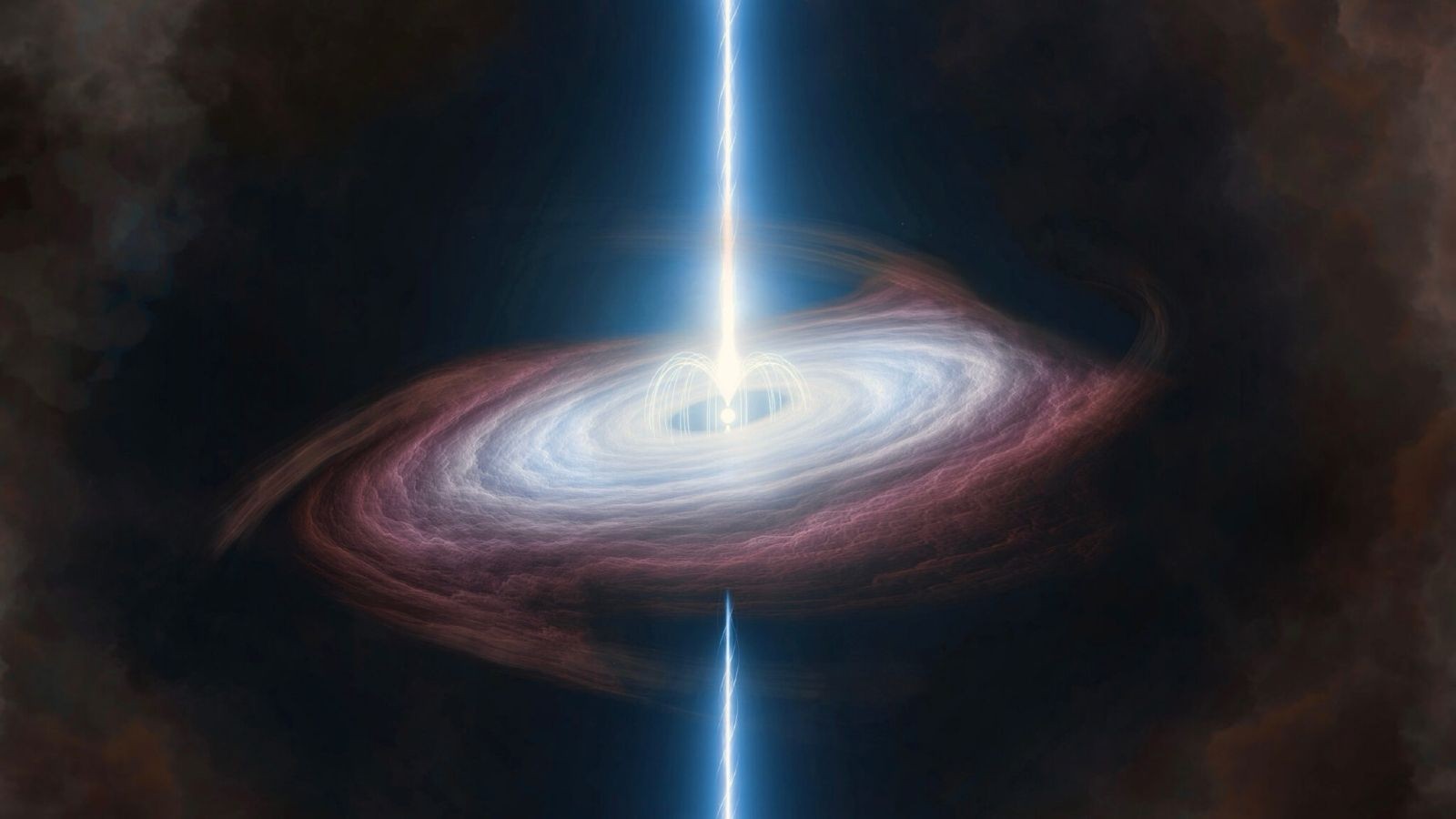
For the first time, scientists have directly observed the birth of a magnetar – one of the universe’s most intensely magnetic objects – within the heart of an exceptionally bright supernova. This discovery isn’t just an observation; it confirms a decades-old prediction rooted in Albert Einstein’s theory of general relativity, making it the first time this theory has been essential to understanding a supernova’s mechanics.
The Extreme Nature of Magnetars
Magnetars are essentially hypercharged neutron stars, the collapsed cores of massive stars that have gone supernova. They pack the mass of our sun into a sphere just a few miles across, resulting in unimaginable density. Their rapid rotation generates incredibly powerful magnetic fields, but magnetars take this to the extreme; their fields are strong enough to distort matter at the atomic level.
These aren’t just theoretical oddities. For over a decade, astrophysicists have theorized that magnetar formation could explain superluminous supernovas, explosions that shine at least ten times brighter than typical stellar deaths. The idea is that the magnetar’s intense magnetism accelerates charged particles, boosting the supernova’s luminosity. Until now, however, proof remained elusive.
SN 2024afav: The Smoking Gun
The breakthrough came with the observation of SN 2024afav, a superluminous supernova spotted in December 2024 and monitored by over two dozen telescopes worldwide. The light curve – the graph of its brightness over time – showed an unusual pattern: instead of a smooth fade after peaking, the supernova repeatedly brightened and dimmed at least four times. This behavior is precisely what would be expected if a newly formed magnetar were driving the explosion.
“This is definitive evidence for a magnetar forming as the result of a superluminous supernova core collapse,” stated study co-author Alexei Filippenko of UC Berkeley. The significance isn’t just the confirmation, but that this is the first time such a birth has ever been observed.
Researchers estimate the newborn magnetar spins at 238 times per second and boasts a magnetic field 300 trillion times stronger than Earth’s, protecting us from damaging solar flares.
General Relativity in Action: A Wobbling Disk
The key to confirming the magnetar’s role lies in the observed wobbles within the light curve. These fluctuations suggest the presence of an accretion disk – gas and dust pulled back toward the magnetar by its extreme gravity. Crucially, Einstein’s general relativity predicts that this disk would wobble due to a phenomenon called Lense-Thirring precession. The wobbling causes the disk to periodically block and reflect light, making the system appear as a “strobing cosmic lighthouse”.
The team detected four wobbles, each shorter and less intense than the last, matching the expected pattern from the Lense-Thirring effect. “We tested several ideas… but only Lense-Thirring precession matched the timing perfectly,” said study lead author Joseph Farah. This is also the first time general relativity has been needed to describe the mechanics of a supernova.
What This Means
The findings don’t mean all superluminous supernovas involve magnetars; other mechanisms, like dense gas “cocoons” around the exploding star, can also drive extreme brightness. But this discovery provides a critical piece of the puzzle, confirming that magnetar births are a real phenomenon in the universe.
Further research will focus on determining how common magnetar-driven supernovas are and refining our understanding of these powerful events. The observation marks not only a triumph for observational astronomy but also a striking validation of Einstein’s theories in one of the most extreme environments in the cosmos.