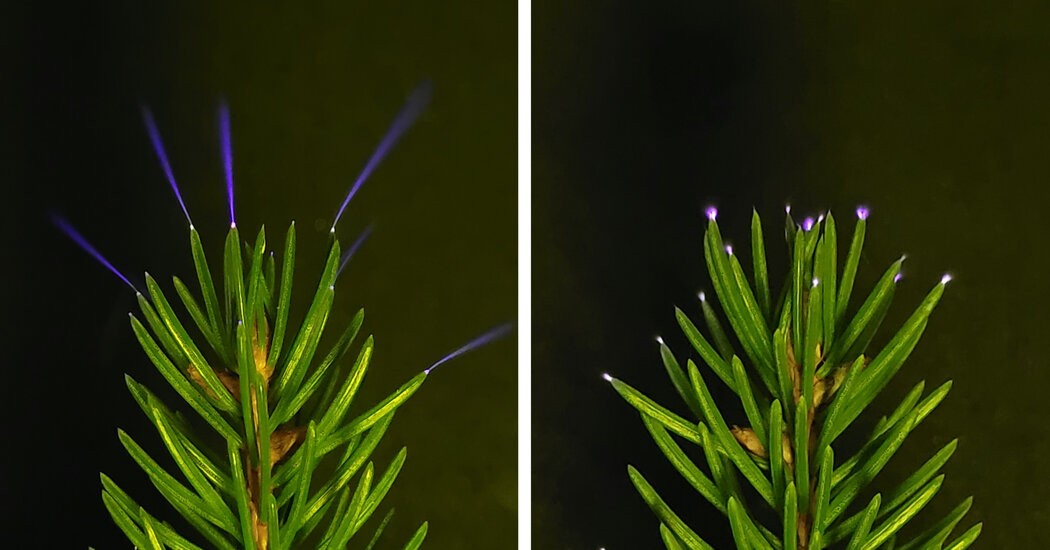
St. Elmo’s Fire, a rarely observed electrical phenomenon, may be far more common in forests during thunderstorms than previously thought. New research suggests that treetops can light up with a faint purple glow as electrical charges concentrate during storms. This eerie light, historically considered an omen, occurs when a strong electric field ionizes air molecules around sharp points – in this case, the tips of trees.
The Science Behind the Glow
The phenomenon, known as St. Elmo’s Fire, has long been documented on objects like ship masts and lightning rods. Scientists have now confirmed that tree branches, particularly those with waxy needles like spruces, can also emit this violet glow when exposed to strong electrical fields. The glow is created by the formation of plasma, a superheated state of matter, in the air surrounding the sharp points of the trees.
Researchers at Pennsylvania State University led by meteorologist Patrick McFarland, conducted both lab experiments and field observations to prove this. They found that under the right storm conditions, the treetops could appear to flicker with purple light, resembling a swarm of fireflies. The glow is often too faint to be seen with the naked eye, but it’s there.
How Researchers Verified the Glow
McFarland and his team tested their hypothesis by exposing a spruce branch to high-voltage fields in the lab. The results were conclusive: the needles glowed with balls of purple light. They also chased storms in a modified minivan to capture images and videos of weak electrical discharges, called coronae, occurring naturally on tree tips during thunderstorms.
“It would look like a whole bunch of fireflies or a really cool light show,” said McFarland, describing the potential appearance of this phenomenon in the wild.
Why This Matters
The discovery highlights that electrical activity in storms extends beyond visible lightning strikes. It reveals a subtle, but widespread, electrical interaction between storms and forests. This knowledge could inform future studies on atmospheric electricity, wildfire ignition risks, and even the effects of strong electrical fields on plant life.
The fact that this phenomenon was previously unobserved in forests underscores how much remains unknown about the complex interplay between weather and natural environments. The study also shows that even well-understood phenomena like St. Elmo’s Fire can still hold surprising secrets.
The next time you’re near a forest during a thunderstorm, remember that there may be a hidden purple glow flickering above you.