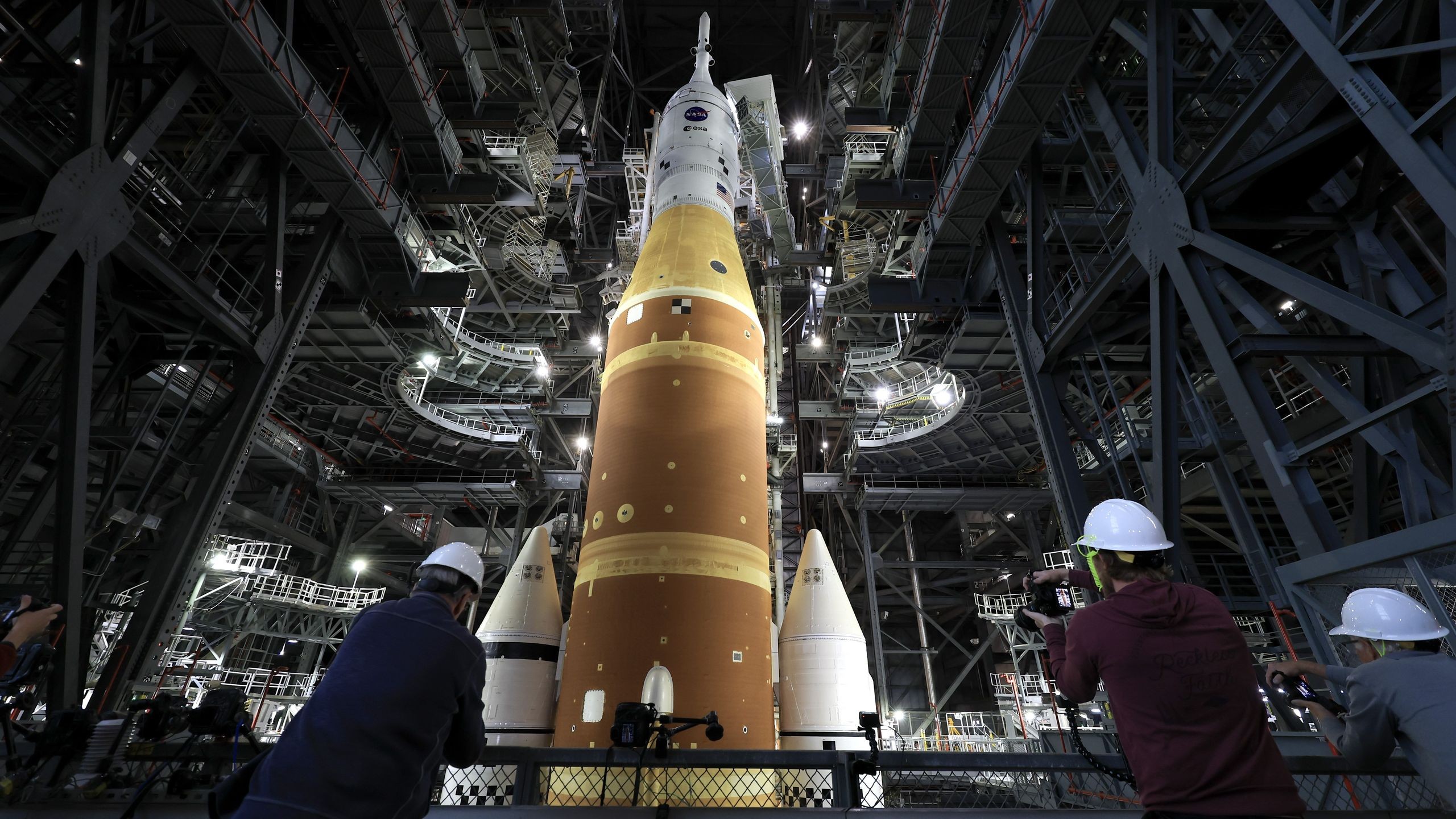
NASA’s Artemis II rocket, the centerpiece of the agency’s renewed lunar program, has once again begun its slow, deliberate journey to the launchpad at Kennedy Space Center in Florida. The move represents a final push to meet a potential April launch window for the first crewed mission around the moon in over 50 years.
Recurring Delays and Repairs
This is not the first time the 322-foot-tall Space Launch System (SLS) and Orion capsule stack has made this trek. An initial rollout in January was halted after multiple hydrogen leaks were detected during wet dress rehearsals – full simulations of the launch process. The rocket was then returned to the Vehicle Assembly Building (VAB) for repairs. These repeated setbacks highlight the inherent challenges of working with complex, next-generation hardware.
The current journey, covering a 4-mile route at a leisurely 1 mph, is expected to take up to 12 hours. High winds caused initial delays, underscoring the sensitivity of the operation. Upon arrival at Launch Pad 39B, the rocket will undergo final testing, including another crucial wet dress rehearsal. NASA will then announce a specific launch date within the April 1-6 or April 30 windows if all systems check out.
The Stakes Are High
The Artemis II mission carries a four-person crew who have already entered quarantine protocols. The ten-day flight will orbit the moon and return, serving as a critical test of the SLS and Orion systems with humans onboard.
NASA has set a firm deadline of April 2026 for this launch, beyond which the mission will be officially considered delayed. This pressure reflects the agency’s desire to maintain momentum in its lunar ambitions after decades of stagnation.
A Broader Shift in NASA’s Strategy
The Artemis program has faced significant challenges since its inception. The SLS rocket for the Artemis I mission required multiple trips back to the VAB for repairs before finally launching successfully in 2022. These cumulative delays have prompted NASA to rethink its approach, aiming for annual launches and potentially reducing reliance on traditional contractors like SpaceX and Boeing. The agency now targets two lunar landings by 2028.
The successful launch of Artemis II is crucial not only for the mission itself but also for demonstrating the viability of NASA’s revised strategy. It will be a pivotal moment in determining whether the United States can reassert its dominance in space exploration.