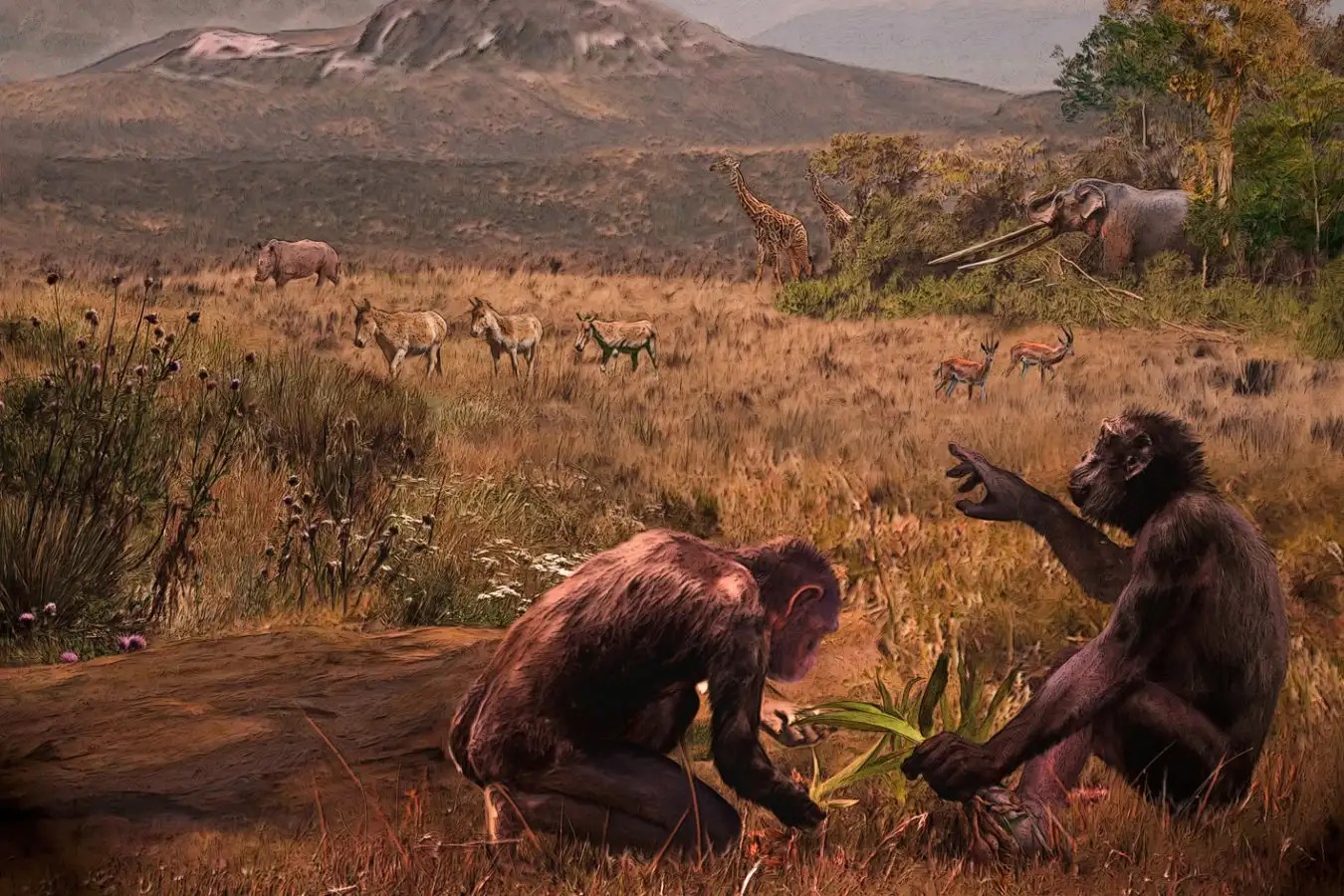
New fossil evidence suggests that the earliest forms of upright walking in hominins may have evolved in Europe, not Africa, challenging long-held assumptions about human origins. A 7.2-million-year-old leg bone discovered in Bulgaria shows anatomical features consistent with bipedalism, predating the oldest known hominin fossils from Africa. This discovery raises the possibility that the evolutionary path to walking upright began in Europe, with later migrations into Africa driving further development.
The Bulgarian Discovery: “Diva” and Graecopithecus
Researchers excavating at Azmaka, Bulgaria, have unearthed a remarkably well-preserved femur – nicknamed “Diva” – dating back 7.2 million years. The bone’s structure suggests an animal capable of standing and walking on two legs. The team associates the femur with Graecopithecus freybergi, a little-known ape species previously identified only from fragmented jaw and tooth fossils.
While the link between the femur and Graecopithecus is currently the most plausible explanation, researchers emphasize the need for more fossil evidence to confirm the association. The current evidence is “loose,” as one expert put it, and relies on interpreting features in a single bone.
Why This Matters: Rethinking Human Evolution
The standard narrative of human evolution places Africa as the primary cradle of humankind, with bipedalism emerging there before spreading elsewhere. If confirmed, this new evidence would rewrite that story. It implies that early hominins may have developed upright walking in Europe, possibly driven by environmental pressures, and then migrated into Africa, where later hominin species evolved.
This shift in understanding isn’t just about location; it’s about the broader forces shaping human origins. Climatic changes between 8.75 and 6.25 million years ago could have triggered these migrations. It also raises questions about why bipedality evolved in the first place, and whether it first emerged as an adaptation to arboreal (tree-dwelling) life, as some theories suggest.
The Challenge of Diagnosing Bipedality
Identifying bipedalism in ancient fossils isn’t easy. Many features once thought unique to upright walkers have since been found in four-legged apes, making it difficult to determine locomotor behavior from isolated bones. The Bulgarian femur shows both bipedal and quadrupedal traits, complicating the analysis.
Researchers are raising the bar for what constitutes definitive evidence of bipedality. More fossils and rigorous comparative studies are needed to confidently distinguish between features indicative of walking upright and those that might have evolved for other purposes. The debate over the Sahelanthropus tchadensis femur, another early hominin with disputed bipedal traits, highlights this challenge.
The European Hypothesis: Ongoing Research
The team behind the Bulgarian discovery has previously proposed that key steps in hominin evolution occurred in Europe, based on evidence from Graecopithecus jawbones and another European ape, Danuvius guggenmosi. The femur further strengthens this hypothesis, but it’s far from conclusive.
Until more fossils emerge and the relationships between these early apes and hominins are clarified, the question of where bipedality first arose remains open. The Bulgarian discovery has reignited the debate, pushing scientists to re-evaluate existing evidence and seek new clues in the fossil record.
The finding serves as a reminder that our understanding of human origins is constantly evolving. Further research, particularly the discovery of more complete fossils, will be critical in resolving this debate and painting a more accurate picture of our evolutionary past.