Scientists at CERN’s Large Hadron Collider (LHC) have confirmed that the universe’s earliest state – a trillion-degree plasma of quarks and gluons – behaved like a liquid, supporting the idea that the early cosmos was a literal “primordial soup.” This discovery provides crucial evidence for understanding the conditions immediately after the Big Bang, when fundamental particles first formed.
Recreating the Early Universe
The quark-gluon plasma (QGP), a state of matter that existed for mere millionths of a second after the universe’s birth, is now artificially recreated by colliding heavy lead ions at near-light speed within the LHC. Under these extreme conditions, quarks and gluons, normally confined within protons and neutrons, are freed, briefly mimicking the environment of the early universe.
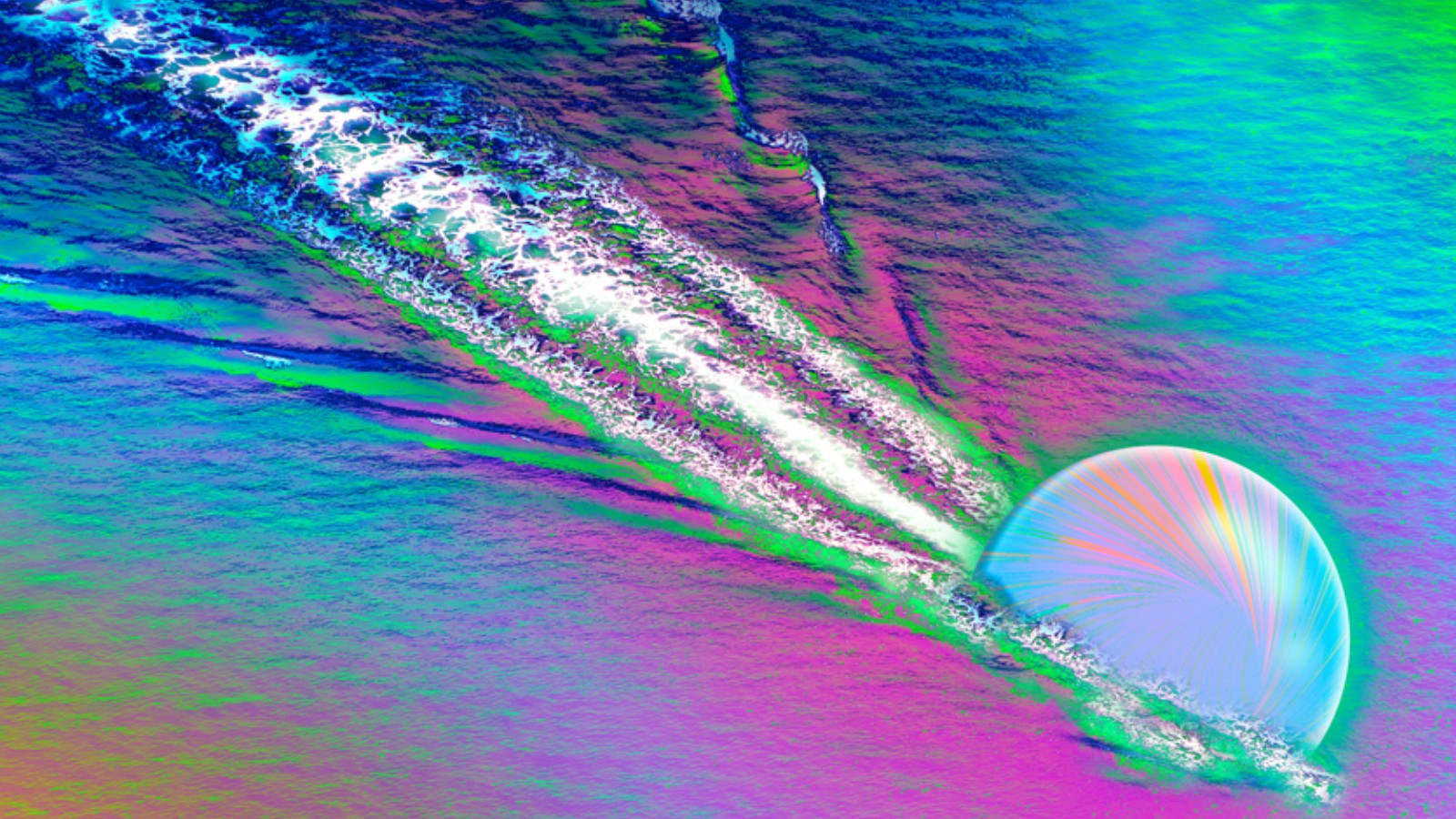
Researchers from MIT, using the LHC’s Compact Muon Solenoid (CMS) detector, observed that particles moving through this QGP created “wakes” akin to those left by a boat cutting through water. This behavior proves the plasma responds to moving particles like a fluid, not as individual, randomly scattering particles. This cohesion is what defines it as a liquid.
The ‘Hybrid Model’ Confirmed
The findings support the “hybrid model” of QGP, which predicted this fluid-like response. Prior experiments struggled to detect these wakes because opposing quarks obscured each other’s effects. The MIT team developed a novel technique, shifting focus from quark pairs to analyzing interactions between quarks and neutral Z-bosons. Z-bosons have minimal impact on the surrounding plasma, allowing researchers to isolate and observe the wakes produced solely by quarks.
After analyzing 13 billion LHC collisions, the team identified over 2,000 instances where a quark left a clear wake pattern consistent with fluid dynamics. This evidence confirms that the QGP isn’t merely a fluid but a true liquid, able to slow down moving particles and generate ripples.
Implications for Cosmology
This discovery is significant because it validates theoretical models of the early universe and provides insights into the formation of matter. The QGP wasn’t just the first liquid to exist; at trillions of degrees, it was also the hottest. Being a near-perfect liquid means its components flowed together smoothly, without friction.
“We’ve gained the first direct evidence that the quark indeed drags more plasma with it as it travels,” said Yen-Jie Lee, a team member at MIT. “This will enable us to study the properties and behavior of this exotic fluid in unprecedented detail.”
The ability to study this primordial soup will refine our understanding of the universe’s earliest moments and the conditions that birthed the matter we see today.