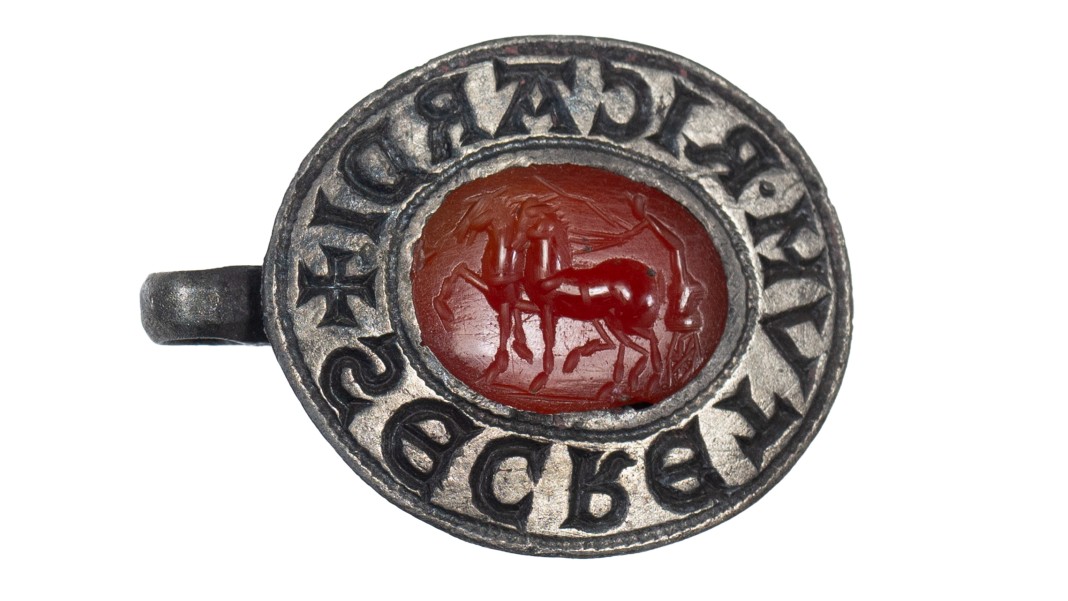
A recently discovered medieval seal from Essex, U.K., combines craftsmanship from two drastically different eras: the Middle Ages and the Roman Empire. The artifact, unearthed by a metal detectorist in late 2024, features an 800-year-old silver matrix holding a 2,000-year-old gemstone – a striking combination that speaks to the owner’s wealth and education.
The Discovery and Its Oddities
The seal is remarkably small, just one inch long and weighing under an ounce. Unlike typical signet rings, it had a loop suggesting it was worn as a pendant. What makes this find exceptional isn’t just its age, but how two periods are combined in one object.
Lori Rogerson, a finds liaison officer for Essex, described the discovery as “special” because such pairings are rare. The seal’s composition highlights a deliberate mixing of historical contexts, raising questions about the owner’s motivations.
“Richard’s Secret” Inscribed in Silver
The silver frame is engraved with the Latin phrase “SECRETUM.RICARDI,” translating to “Richard’s secret” or “the secret seal of Richard.” A cross pattée, a medieval Christian symbol linked to groups like the Knights Templar, is also present.
The inscription suggests the seal belonged to a man named Richard, and the “secret” held within was likely his personal mark of authority. The use of Latin itself indicates a level of literacy and social standing common among the nobility.
A 2,000-Year-Old Gemstone at the Center
The most intriguing part of the seal is the carnelian gemstone embedded in its center. This reddish-brown stone depicts a Roman chariot race, complete with a charioteer wielding a whip. The gemstone dates to the late first century B.C. or early first century A.D., meaning it was created over 1,200 years before the metal seal was made.
The engraving is designed to create the correct impression when pressed into wax. This means that Richard purposefully chose an ancient artifact to represent his authority.
Status and Symbolism
Rogerson believes Richard likely chose the Roman gemstone to display his knowledge of classical history and his ability to acquire rare items. Owning such a relic would have signaled significant wealth and social importance.
The combination of Roman and medieval imagery would have made a bold statement about Richard’s power. This wasn’t just a seal; it was a symbol of prestige.
Treasure Status and Future Display
The seal has been submitted for review under the U.K.’s Treasure Act of 1996 due to its silver content and age. The Braintree Museum in Essex hopes to acquire the artifact following a legal inquest.
This seal isn’t just an archaeological find; it’s a direct link to a nobleman’s ambition. It proves that even in the Middle Ages, status was often displayed through access to rare and ancient symbols of power.