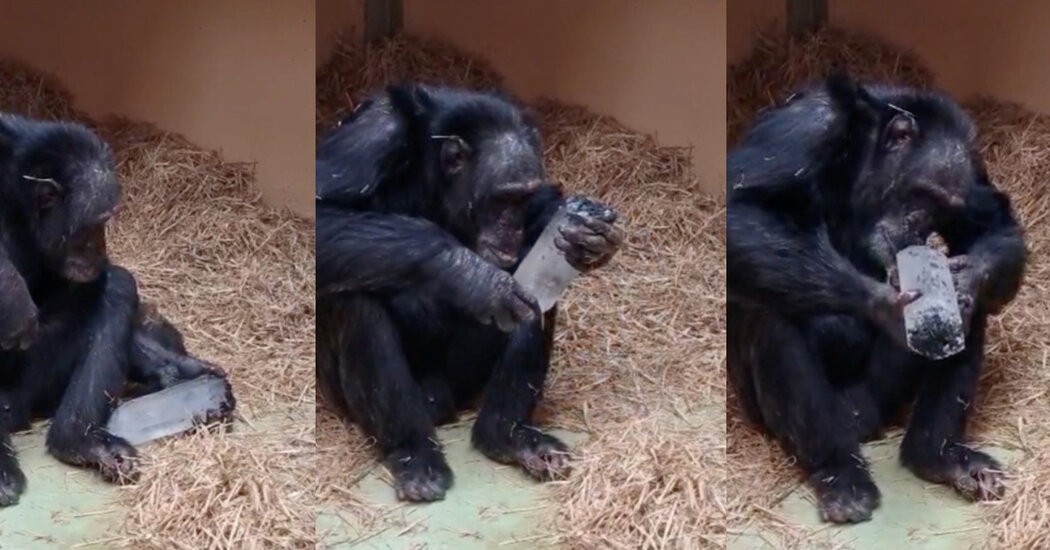
Chimpanzees, like humans, display a strong interest in crystals, sometimes refusing to return them even for high-value rewards like bananas and yogurt. A recent study published in Frontiers in Psychology reveals that these apes exhibit a clear preference for shimmering minerals, mirroring a behavior observed in prehistoric humans and modern societies alike.
The Crystal Experiment
Researchers led by crystallographer Juan Manuel García-Ruiz conducted an experiment at Rainfer Fundación Chimpatía near Madrid. Two groups of chimpanzees were presented with a choice: a multifaceted quartz crystal or a similar-sized sandstone rock. The chimps consistently gravitated toward the crystal, handling it with curiosity and, in some cases, outright hoarding it.
The study, playfully dubbed “The Monolith” in reference to the enigmatic object from 2001: A Space Odyssey, aimed to uncover the root of human fascination with crystals. Researchers found that recovering the largest crystal required significant bartering with the apes, highlighting their strong attachment. Some crystals were never retrieved.
Why Crystals? A Historical Perspective
The study builds on previous archaeological findings of quartz and other crystals dating back 700,000 years. These stones were gathered by early humans, despite lacking any apparent practical use as tools or ornaments. Dr. García-Ruiz suggests this early attraction may be linked to the material properties of crystals themselves.
The contemporary human obsession with crystals – often accompanied by beliefs in healing or supernatural properties – may stem from similar innate preferences. While some dismiss these beliefs as irrational, Dr. García-Ruiz argues that understanding why this fascination exists is more valuable than simply debunking it.
“For me, what’s important is to tell people why” this belief exists.
The Bigger Picture
The chimpanzee study offers a unique perspective on the enduring human connection with crystals. It suggests that the appeal may be hardwired into our brains, predating language and culture. This raises broader questions about the evolutionary basis of aesthetic preferences and the allure of natural materials.
The findings don’t explain why crystals captivate us, but they demonstrate that this attraction isn’t uniquely human. It’s a behavior shared with our closest primate relatives, and likely, our distant ancestors as well.