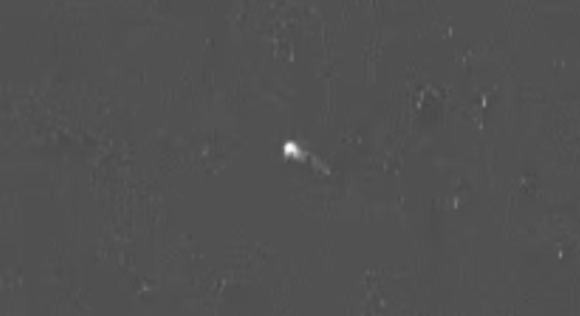
NASA’s Parker Solar Probe has captured unprecedented images of the interstellar comet 3I/ATLAS, an icy visitor from outside our solar system. These observations, conducted between October 18 and November 5, 2025, provide a unique perspective on the comet as it made its closest approach to the Sun and Earth. The probe’s Wide-Field Imager for Solar Probe (WISPR) instrument recorded approximately ten images per day, offering a crucial look at a celestial object otherwise obscured from Earth-based telescopes due to its proximity to the Sun.
Discovery and Trajectory
The comet, also designated C/2025 N1 (ATLAS) and A11pl3Z, was first detected on July 1, 2025, by the NASA-funded ATLAS survey telescope in Chile. It originated from the Sagittarius constellation, marking it as the third confirmed interstellar comet to visit our solar system. Its orbit brought it within 0.194 AU (Astronomical Units) of Mars on October 3, and to perihelion — its closest point to the Sun — on October 30 at a distance of about 209 million kilometers (130 million miles).
Unique Observational Opportunity
The Parker Solar Probe’s vantage point allowed scientists to view the comet when it was too close to the Sun to be easily observed from Earth. This is significant because comets near the Sun are difficult to study due to glare and atmospheric distortions. The probe was moving away from the Sun following its 25th solar flyby, providing a stable platform for capturing these images.
Data Processing and Future Analysis
The WISPR team is currently refining the raw images. Variations in exposure times caused some brightness fluctuations in the initial data, which researchers are correcting. This processing is essential for accurate measurements of the comet’s composition and behavior. The final calibrated images will provide valuable insights into interstellar objects and their interactions with our solar system.
“These images will ultimately help us better study this interstellar visitor,” researchers stated, emphasizing the importance of the data for understanding the dynamics of comets from beyond our Sun.
The Parker Solar Probe’s observations of 3I/ATLAS represent a rare opportunity to study an interstellar comet up close, enhancing our knowledge of objects originating from other star systems.