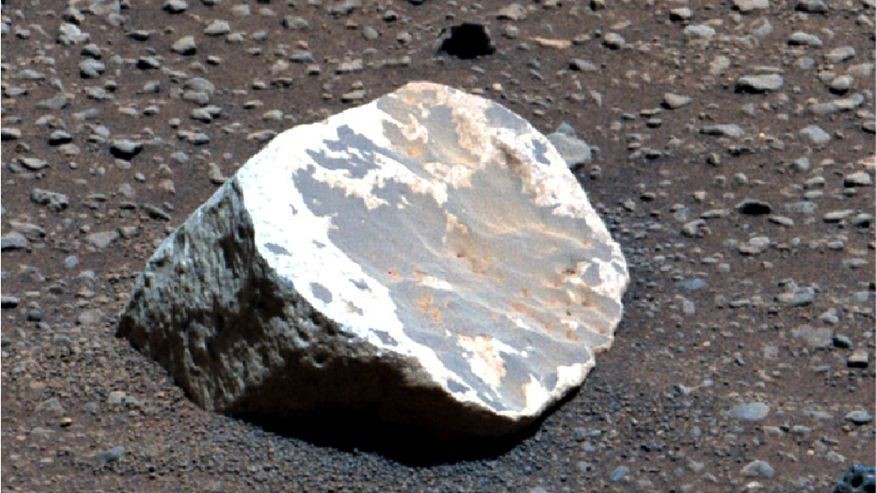
NASA’s Perseverance rover has made a significant discovery in Jezero Crater: thousands of rocks bleached white and rich in kaolinite, a clay mineral that forms from prolonged exposure to water. This finding adds substantial evidence to the growing understanding that Mars was once warmer, wetter, and potentially rain-soaked for millions of years.
The Significance of Kaolinite
Kaolinite is not created quickly. On Earth, it forms through the slow leaching of elements from rock over thousands to millions of years, typically in warm, humid environments with frequent rainfall. The presence of such mineral-rich rocks on Mars suggests an ancient climate dramatically different from the cold, barren conditions observed today.
“All life uses water,” explains Adrian Broz, a postdoctoral researcher at Purdue University and the lead author of the new study. “So when we think about these rocks representing a rainfall-driven environment, that is a really incredible, habitable place where life could have thrived if it were ever on Mars.”
Jezero Crater: A Window into Mars’ Past
Perseverance has identified thousands of kaolinite-rich rocks scattered across Jezero Crater, a dry depression near the Martian equator once believed to have held a lake billions of years ago. These rocks range in size from pebbles to boulders, all sharing similar chemical compositions to terrestrial kaolinite deposits.
The rover’s ability to analyze these materials directly on the surface is crucial. Previous observations from orbit hinted at kaolinite deposits, but Perseverance’s ground-level analysis provides definitive proof of their formation through rainfall-driven weathering. The team has compared the Martian rocks to kaolinite deposits in Southern California and South Africa, further solidifying this conclusion.
The Mystery of Their Origin
The discovery raises a key question: where did these rocks come from? There is no immediately obvious bedrock source nearby, leading scientists to consider two main theories. The rocks may have been transported into the crater by ancient rivers flowing into Jezero, or they could have been blasted there by meteorite impacts.
“They’re clearly recording an incredible water event, but where did they come from?” asks Briony Horgan, a professor of planetary science at Purdue University. Researchers are now studying orbital data from fractured rock formations approximately 2 miles away and along the Neretva Vallis, an ancient river channel that fed into Jezero Crater, in hopes of uncovering the rocks’ origin.
The search for answers continues as Perseverance explores the crater rim, seeking clues about the transition of Mars from a warmer, wetter world to its current state. Understanding how the planet lost its atmosphere and magnetic field remains a central focus of the mission.
This discovery reinforces the notion that Mars was once a potentially habitable environment. The presence of kaolinite-rich rocks provides a tangible record of an ancient period when rainfall may have sculpted the Martian landscape, offering critical insights into the planet’s past and the possibility of past life.