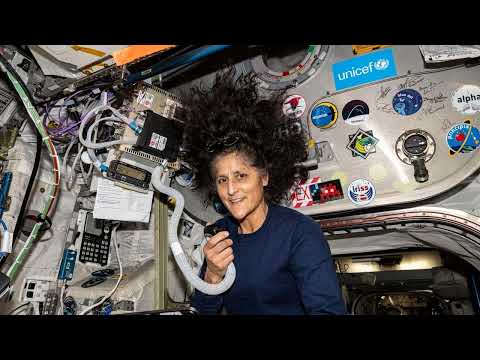
After nearly three decades of groundbreaking achievements in space exploration, astronaut Suni Williams has retired from NASA. Her departure marks the end of an extraordinary career defined by endurance, leadership, and pushing the boundaries of human potential beyond Earth.
A Legacy of Firsts and Records
Williams spent a total of 608 days in space over three missions, ranking second among American astronauts in cumulative time off-planet. She is celebrated for numerous milestones, including completing the first-ever marathon in space aboard the International Space Station (ISS) in 2007. This feat underscored her dedication to physical and mental resilience, even in the most extreme environments. 🚀
Her impact extends beyond personal records. Williams completed nine spacewalks totaling 62 hours and 6 minutes, setting a new standard for female astronauts and placing her fourth overall in spacewalking time. This accomplishment highlights her expertise in extravehicular activity, crucial for maintaining and upgrading space infrastructure.
Navigating Challenges and Commercial Partnerships
Williams’ final mission in 2024 aboard Boeing’s Starliner spacecraft presented unforeseen challenges. The flight experienced technical issues, forcing NASA to extend the crew’s stay aboard the ISS while engineers worked to resolve the problems. Despite these hurdles, Williams and fellow astronaut Butch Wilmore remained committed to the mission, ultimately returning to Earth after 286 days in orbit.
This mission underscored the complexities of integrating commercial partnerships into space exploration, while also demonstrating Williams’ ability to adapt and persevere in unpredictable circumstances. NASA’s reliance on private companies like Boeing and SpaceX is growing, and Williams’ experience provides valuable lessons for future collaborations.
From Naval Aviator to Space Pioneer
Before joining NASA in 1998 as part of the “Penguins” astronaut class, Williams had an impressive career as a U.S. Navy captain and pilot, logging over 4,000 flight hours in 40 different aircraft. Her background in aviation, combined with a master’s degree in engineering management, prepared her for the rigors of spaceflight.
Her transition from the cockpit to the cosmos illustrates how diverse skillsets contribute to successful space programs. NASA increasingly values astronauts with backgrounds in science, technology, engineering, and mathematics (STEM), ensuring a well-rounded team capable of handling complex challenges.
“Space is my absolute favorite place to be… The International Space Station, the people, the engineering, and the science are truly awe-inspiring,” Williams stated in her retirement announcement.
Williams’ departure leaves behind a legacy that will inspire future generations of astronauts. Her contributions to scientific research, technological advancements, and international collaboration have paved the way for Artemis missions to the Moon and ambitious plans for Mars exploration. The foundation she helped build ensures that humanity’s journey beyond Earth will continue.
Her retirement marks not an end, but a transition, with her influence resonating in the ongoing pursuit of space discovery.