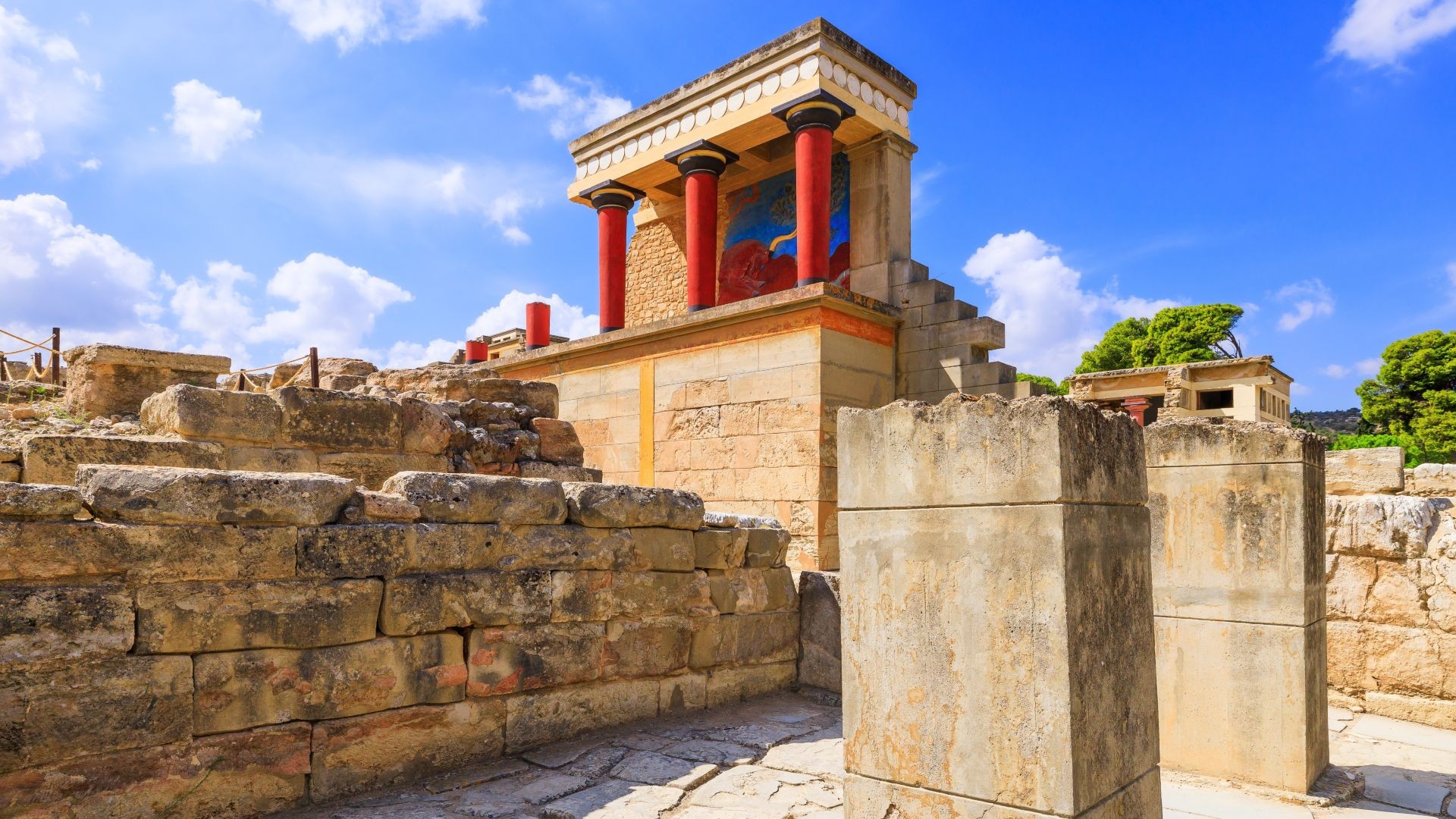
For centuries, the Minoan civilization has captivated historians with its grandeur. Flourishing on the island of Crete and its surrounding neighbors between roughly 2000 and 1500 B.C., the Minoans were masters of the Bronze Age. They constructed sprawling palace complexes—such as the massive site at Knossos, which covered an area equivalent to two football fields—and decorated them with vibrant frescoes of dolphins and marine life.
Yet, around 1500 B.C., the traces of this sophisticated culture began to fade. Their unique written scripts vanished, their palaces showed signs of destruction, and a new power, the Mycenaeans, rose to prominence. This sudden shift has led to a central historical question: Did the Minoan civilization collapse, or did it simply transform?
The Traditional Theories of Collapse
Historically, scholars have looked for a “smoking gun” to explain the decline of Crete. Several dramatic scenarios have been proposed:
- Natural Disasters: A massive volcanic eruption on the nearby island of Thera may have triggered tsunamis and ash clouds, devastating Minoan shipping and trade.
- External Invasion: The warrior-led Mycenaeans from mainland Greece may have conquered the island by force.
- Environmental Shifts: Climate change or disrupted trade routes could have undermined the economic foundations of the Minoan palaces.
However, modern archaeology suggests that these “catastrophic” explanations might oversimplify a much more nuanced reality.
Redefining “Minoan” and “Mycenaean”
One reason the “end” of the Minoans is so difficult to pin down is that our modern labels may not match ancient realities.
Guy Middleton, a specialist in Late Bronze Age Greece at Newcastle University, points out that “Minoan” and “Mycenaean” are archaeological labels used to describe material culture, rather than distinct ethnic groups. In the ancient world, people were fluid; a person living on the mainland might use Minoan-style pottery, while a Cretan might adopt mainland customs.
“These are modern distinctions. Who knows how [an ancient person] thought of himself?” says Middleton.
This suggests that the transition we see in the archaeological record might not be the replacement of one people by another, but rather a blending of styles and customs.
The Linguistic Shift: A Clue to Change
The most concrete evidence of change is found in writing. The Minoans used two undeciphered scripts—Linear A and Cretan hieroglyphs. Following the period of decline, these were replaced by Linear B, a script used by the Mycenaeans to write the early Greek language.
Experts offer two ways to interpret this linguistic turnover:
1. The Invasion Model: Philip Betancourt, a professor at Temple University, suggests that the disappearance of Minoan language could signal a gradual takeover by Greek-speaking invaders.
2. The Internal Evolution Model: Middleton proposes that this wasn’t an invasion, but an internal development. Just as Mycenaeans adopted Minoan art, Minoans may have voluntarily adopted mainland linguistic and cultural elements.
Evolution Over Extinction
Perhaps the most compelling argument is that the Minoan civilization never actually ended.
While the political structures and specific art styles changed, the people did not vanish. Genetic studies confirm that Minoan DNA persists in the populations of Crete today. Furthermore, many Minoan religious practices and deities continued to be worshipped long after the “Minoan” era supposedly concluded.
Nanno Marinatos, a professor at the University of Illinois Chicago, notes that the Minoans possessed a powerful navy that likely would have defended them against any conventional invasion. This supports the idea that the shift was less about conquest and more about adaptation.
Conclusion
The decline of the Minoans may not have been a sudden death, but a slow, complex evolution. Rather than a civilization being wiped off the map, it likely merged with neighboring cultures, proving that history is often defined more by continuous change than by abrupt endings.