Scientists have made a breakthrough in understanding the origin of one of the most powerful particles ever detected: the “Amaterasu” particle. Named after the Japanese sun goddess, this cosmic ray carries an astonishing 40 million times more energy than particles produced in the world’s largest accelerator, the Large Hadron Collider (LHC). The discovery sheds light on the extreme events that accelerate matter to unimaginable speeds and could help pinpoint the most violent regions of the universe.
The Puzzle of Ultra-High-Energy Cosmic Rays
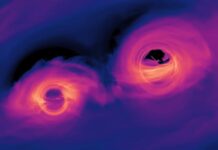
Cosmic rays are high-energy charged particles constantly bombarding Earth from space. The Amaterasu particle, detected in 2021, ranks as the second-most energetic ever observed — surpassed only by the legendary “Oh-My-God” particle detected in 1991. Such extreme energy levels are exceptionally rare, prompting scientists to investigate their sources: primarily, remnants of supernova explosions and the chaotic environments around supermassive black holes at the centers of galaxies.
The puzzle deepened because Amaterasu appeared to have originated from the “Local Void,” a vast, nearly empty region of space. The void lacks the dense, violent conditions typically associated with high-energy particle acceleration, making its origin even more perplexing.
New Analysis Points Beyond the Void
Researchers Francesca Capel and Nadine Bourriche from the Max Planck Institute for Physics challenged this assumption. Using a novel data-driven approach, they found evidence that Amaterasu likely originated not from the Local Void, but from a nearby star-forming galaxy. Specifically, their analysis suggests a strong probability that the particle was launched from M82, a relatively close and actively forming galaxy.
The team’s method combined realistic physics-based simulations with observational data using a statistical technique called Approximate Bayesian Computation in three dimensions. This technique compared the predicted paths of high-energy cosmic rays, taking into account the influence of magnetic fields, with actual observations to determine the most probable source locations.
Implications for Understanding Extreme Cosmic Events
The implications extend beyond solving the mystery of Amaterasu. By identifying potential cosmic ray factories, scientists can better understand how the universe accelerates matter to such extreme energies. This knowledge could also reveal insights into the behavior of matter under conditions far beyond anything achievable in laboratories.
“Exploring ultra-high-energy cosmic rays helps us to better understand how the Universe can accelerate matter to such energies, and also to identify environments where we can study the behavior of matter in such extreme conditions,” said Capel.
The research team is now focused on refining their statistical analysis methods to maximize the potential of existing data, aiming for an even deeper understanding of the forces that shape the universe’s most energetic particles. This work will help to unlock the secrets of the cosmos’ most violent environments.