
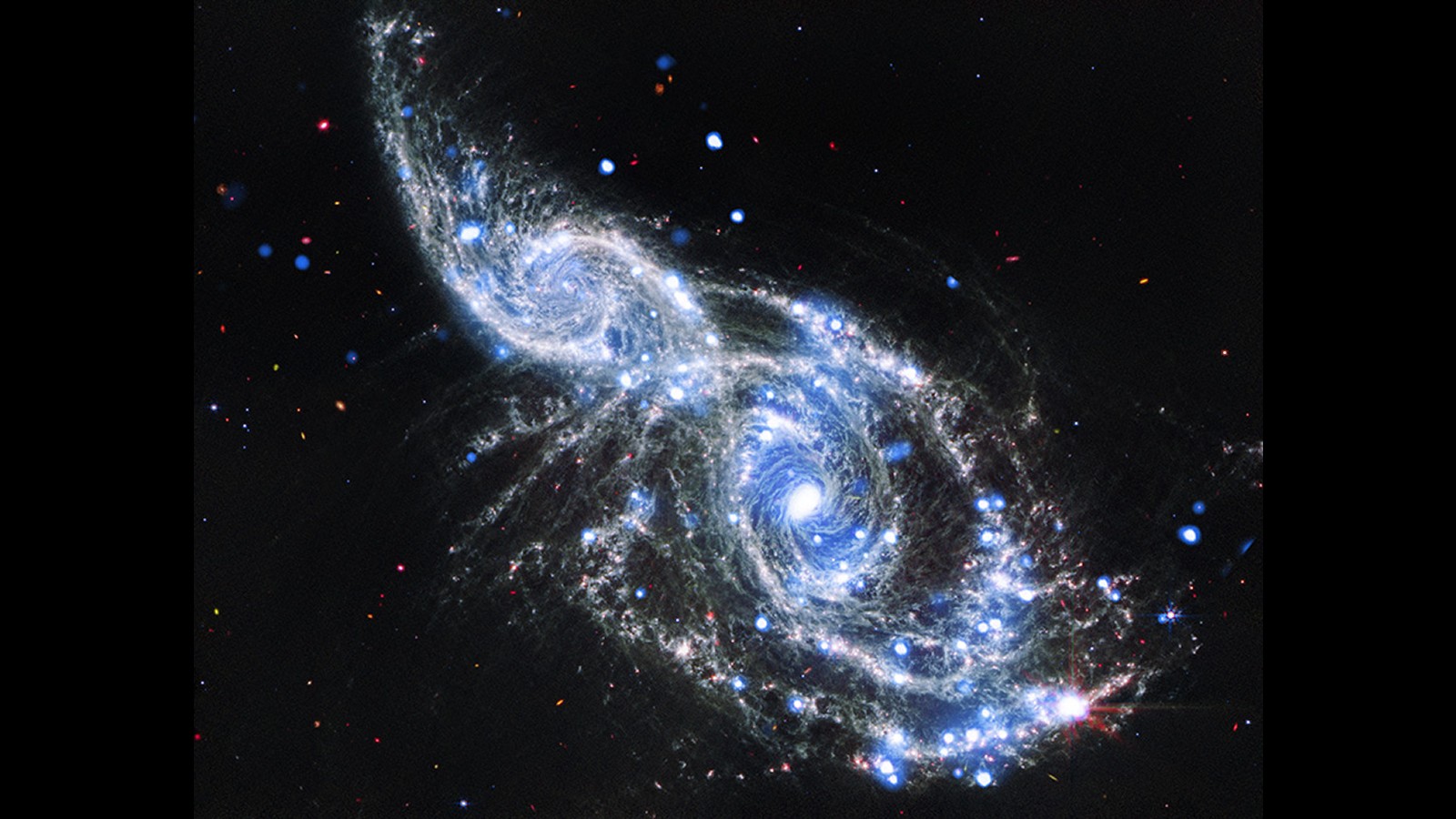
A newly released composite image from the James Webb Space Telescope (JWST) and the Chandra X-ray Observatory depicts the dramatic collision of two spiral galaxies, NGC 2207 and IC 2163. The striking portrait, revealed this week, blends infrared and X-ray light to showcase the intense gravitational forces at play as the galaxies merge.
Galactic Merger in Real Time
NGC 2207, the larger of the two, is visibly distorting IC 2163. The gravitational interaction stretches out stellar streams and compresses gas clouds, triggering new star formation within this chaotic system. The image presents a unique “face-on” view of this process, allowing scientists to observe the merger unfold with unprecedented clarity.
This isn’t just a pretty picture: galactic mergers are fundamental to how galaxies evolve. By studying these collisions, astronomers aim to refine models of galactic interaction, which are crucial to understanding the larger structure of the universe. The current observation is particularly useful because the galaxies are positioned in such a way that the collision is visible from Earth without obstruction.
Complementary Data Reveals Hidden Dynamics
The image combines data from multiple sources. JWST’s mid-infrared vision (displayed in white, gray, and red) highlights dust and cooler materials, revealing the core structures of the galaxies and their spiral arms. Chandra’s X-ray data (shown in blue) exposes high-energy phenomena: binary star systems, remnants of supernova explosions, and regions of intense radiation.
“The combination of infrared and X-ray data gives us a complete picture of what’s happening in these colliding galaxies,” explains NASA. “We can see the dust, the stars, and the energetic events all at once.”
Part of a Larger Study
The NGC 2207/IC 2163 image is one of four new composites released simultaneously by Chandra, alongside views of star-forming regions (NGC 6334), a supernova remnant (G272.2-0.3), and a binary star system (R Aquarii). All images integrate data from JWST, the Hubble Space Telescope, the now-retired Spitzer Space Telescope, and ground-based observatories. This multi-wavelength approach allows for the most detailed analysis of high-energy and cooler phenomena across different cosmic environments.
The ongoing study of these galactic interactions will refine our understanding of how galaxies grow and change over time, providing a clearer picture of the universe’s evolution.