The Artemis II mission has reached its most critical transition point: the splashdown in the Pacific Ocean. While the Orion capsule has successfully returned to Earth, the astronauts—Reid Wiseman, Victor Glover, Christina Koch, and Jeremy Hansen—are currently floating dozens of miles from the San Diego coast. The mission is not over until the crew is safely extracted from a spacecraft that has just endured the extreme thermal stress of re-entry, reaching temperatures near 5,000 degrees Fahrenheit.
Stabilizing the Capsule at Sea
The moment the capsule hits the water, several automated systems activate to ensure the crew’s safety in a volatile marine environment.
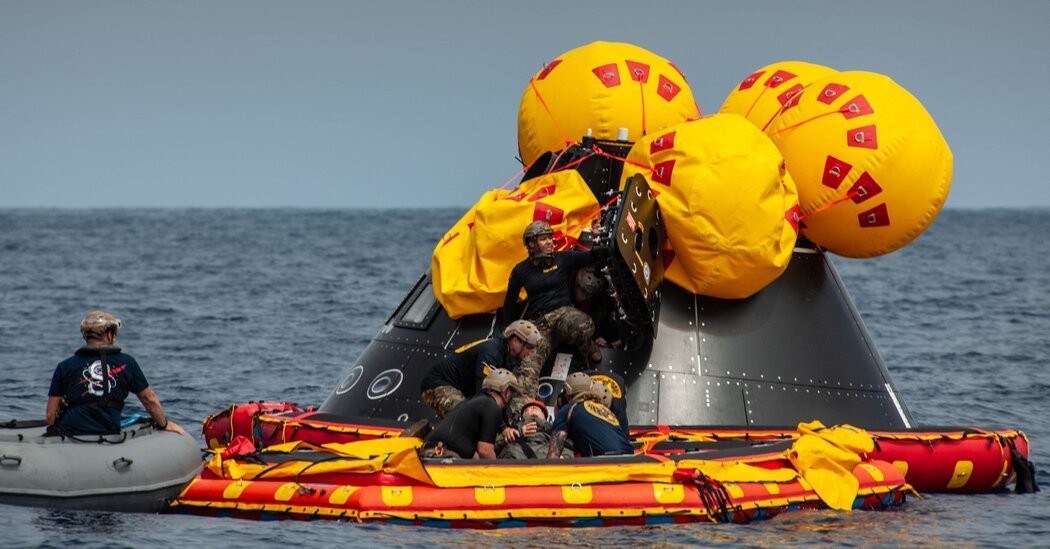
- Orientation Control: Five specialized airbags inflate on top of the Orion capsule. These serve a dual purpose: they reorient the craft if it lands upside down and provide stability against wind and choppy waves.
- Asset Tracking: Simultaneously, NASA and U.S. Navy recovery teams track the capsule’s position, along with jettisoned hardware such as the three main parachutes.
This stabilization is vital because a drifting or unstable capsule poses a significant risk to both the astronauts inside and the recovery vessels approaching them.
The Extraction Process: A Precision Operation
The transition from the spacecraft to the recovery ship is a highly choreographed sequence involving Navy divers, inflatable boats, and helicopters.
- Safety Assessment: Navy divers approach the Orion capsule via inflatable boats to conduct an immediate safety check, ensuring the environment is stable enough for the crew to exit.
- The “Front Porch” Setup: To facilitate a safe exit, recovery teams attach an inflatable collar around the capsule and deploy an inflatable platform known as the “front porch.”
- Helicopter Transfer: One by one, the four astronauts will step onto this platform. From there, they will be individually hoisted by helicopter and flown to the U.S.S. John P. Murtha.
NASA estimates this entire extraction phase will be completed within two hours of splashdown.
Securing the Hardware and Returning Home
Once the crew is airborne, the focus shifts to the Orion spacecraft itself. The recovery team will secure the capsule with heavy-duty lines and tow it to the U.S.S. John P. Murtha. The ship will utilize its “well deck”—a specialized area at the waterline—to bring the capsule on board.
The final stages of the mission involve two parallel tracks:
– The Crew: After being secured on the ship, the astronauts will undergo comprehensive medical evaluations before flying to NASA’s Johnson Space Center in Houston.
– The Hardware: The Orion capsule and other recovered components will be transported to a pier at the U.S. Naval Base San Diego before eventually being moved to Houston for analysis.
This complex recovery operation highlights the immense logistical coordination required to bring humans home safely from deep space, transitioning from the vacuum of orbit to the unpredictable conditions of the open ocean.
The Artemis II mission concludes with a highly technical maritime operation designed to ensure that both the crew and the spacecraft are recovered safely and efficiently for post-mission analysis.