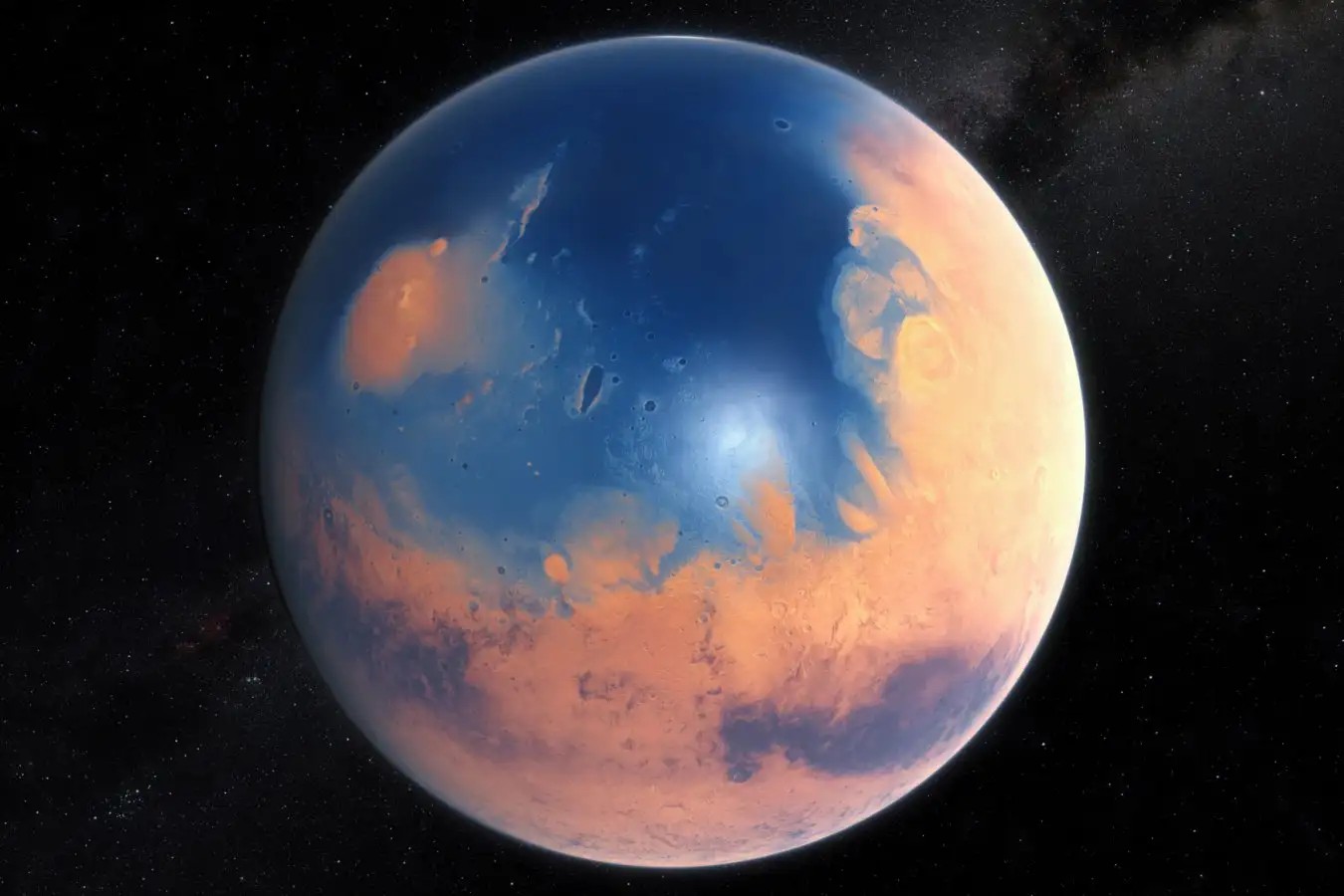
For decades, scientists have known that Mars was once a much wetter planet than it is today. Evidence suggests a past with liquid water on the surface and a denser, water-rich atmosphere. However, a critical accounting of water sources and losses reveals a significant discrepancy: we still don’t fully understand where all the Martian water went. This isn’t just an academic question. Understanding the fate of water on Mars is crucial for assessing its past habitability – whether it could have supported life – and for planning future human exploration.
The Noachian Period and the Water Discrepancy
Between 4.5 and 3.7 billion years ago, during the Noachian Period, Mars likely held enough water to cover the planet in an ocean 150 to 250 meters deep. Current estimates of water loss mechanisms – including atmospheric escape, absorption into rocks, and polar ice caps – only account for a few tens of meters of water removed. Today, the remaining water on Mars exists primarily as ice and hydrated minerals, equivalent to a global ocean just 30 meters deep.
As Bruce Jakosky of the University of Colorado Boulder notes, “How do you go from 150 meters, take away a couple of tens [of metres] and get to 30 metres? You can’t do that.” Even extreme scenarios – maximizing water input and loss – fail to fully explain the discrepancy. This implies there’s a fundamental gap in our understanding of Martian hydrology.
Possible Explanations and Emerging Theories
Several theories attempt to resolve this puzzle. Some suggest that more water evaporated into space than previously estimated. Others propose hidden underground ice deposits or misinterpretations of atmospheric interactions. It’s likely a combination of these factors, along with undiscovered processes, contributing to the missing water.
Recent research suggests that Mars’s hydrological cycle may have been radically different from Earth’s. Eric Hiatt of Washington University in St. Louis proposes that groundwater interactions with the surface and atmosphere might not follow terrestrial patterns. Bethany Ehlmann of the University of Colorado Boulder suggests we may underestimate the amount of water still on Mars today.
The Need for Ground Truth
Resolving this mystery requires more than just modeling. Jakosky argues that “this really requires boots on the ground.” While rovers and orbiters continue to gather data, a human presence on Mars would allow for direct geological analysis and more thorough subsurface investigation.
Unfortunately, with both NASA and SpaceX currently focused on lunar exploration, a manned mission to Mars is likely decades away. For now, progress will be incremental, relying on remote sensing and robotic analysis. The search for the missing water of Mars continues – a testament to how much we still don’t know about our planetary neighbor.
The fate of Martian water is not merely a historical question. It speaks to the potential for past life, the viability of future human settlements, and the fundamental processes that shape planetary evolution.