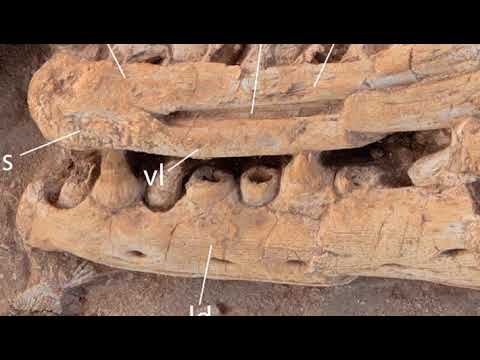
Paleontologists have unearthed a new species of giant mosasaur, Pluridens imelaki, from Late Cretaceous phosphate deposits in Morocco. This discovery sheds light on the diversity of marine reptiles shortly before the Cretaceous-Paleogene extinction event. The new species, belonging to the Halisaurinae subfamily, reached an estimated length of over 9 meters (29.5 feet). This makes P. imelaki comparable in size to some of the largest predatory mosasaurs known from the region, challenging previous assumptions about the size limits within this group.
Late Cretaceous Marine Ecosystems
The discovery occurred in the phosphate beds of Couche III at Sidi Chennane, in Morocco’s Khouribga province. These deposits represent a shallow marine embayment along the eastern margin of the Atlantic, formed by an upwelling zone during the Late Maastrichtian and Early Eocene epochs—roughly 66-67 million years ago. The region is notable for its exceptionally diverse marine reptile fauna, with over 16 mosasaur species already identified. All four major mosasaurid subfamilies—Mosasaurinae, Plioplatecarpini, Tylosaurinae, and Halisaurinae—are represented in these phosphates, along with the basal mosasauroid Pachyvaranus.
Halisaurinae Diversity and Adaptation
The Halisaurinae subfamily was previously thought to consist of smaller mosasaurs, with earlier species ranging from 4-5 meters (Halisaurus ) to 7.5 meters (Pluridens serpentis ). Pluridens imelaki challenges this understanding by demonstrating that Halisaurinae were capable of reaching considerable size. Differences in jaw structure, tooth shape, and eye size suggest this species occupied a distinct ecological niche within the end-Cretaceous marine ecosystem. Rather than being outcompeted by larger mosasaurs, the Halisaurinae experienced an adaptive radiation in the Late Cretaceous and remained important predators in low-latitude environments.
Implications of the Discovery
The discovery of Pluridens imelaki highlights the complexity of marine ecosystems during the Late Cretaceous. The Late Cretaceous witnessed a major radiation of the Mosasauridae, a specialized clade of large marine squamates, which became the dominant marine predators during the final 25 million years of the period. The diversity of mosasaurs in Morocco suggests a high level of ecological specialization before the mass extinction event. The 1.25-meter-long skull and associated lower jaws provide critical evidence for understanding the feeding strategies and evolutionary relationships of this giant mosasaur.
The finding reinforces the idea that marine reptiles were far more diverse and adaptable than previously assumed, even in the final stages of the Cretaceous period.
The study, published in the journal Diversity, provides new insights into the evolution of mosasaurs and underscores the importance of Moroccan phosphate deposits as a key site for paleontological research.