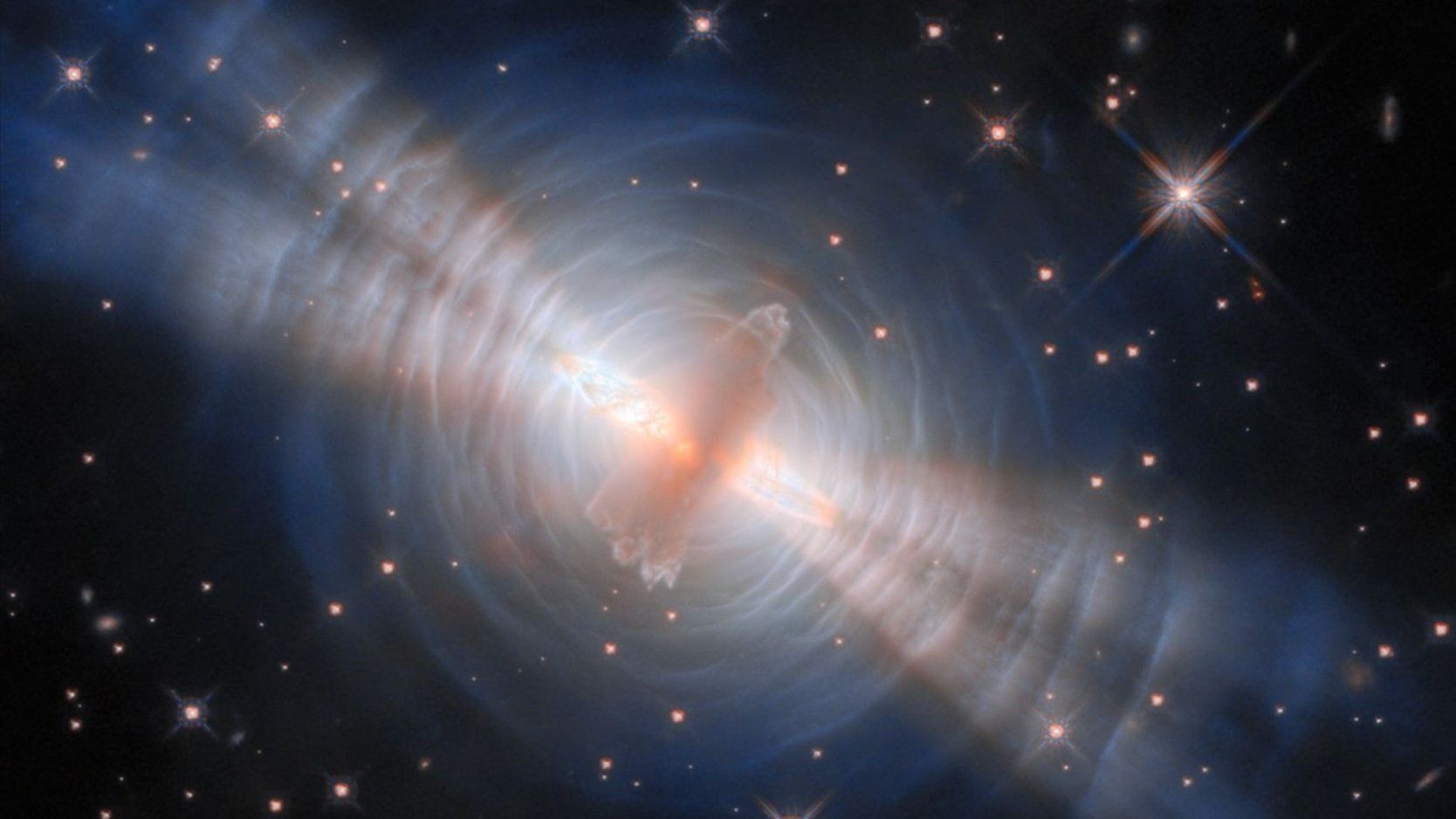
The Hubble Space Telescope has revealed a striking image of a star nearing the end of its life, located 1,000 light-years away in the Cygnus constellation. Known as the Egg Nebula, this celestial object displays a dramatic and rare phase in stellar evolution, offering scientists an unprecedented opportunity to study how stars die and seed the universe with materials for new planetary systems.
The Egg Nebula: A Stellar Swan Song
The nebula gets its name from its appearance: a bright central star (the “yolk”) encircled by a vast cloud of dust and gas (the “egg white”). Unlike many nebulae, which glow due to ionized gas, the Egg Nebula shines with light directly emitted from its dying star. This light pierces through openings in the dense surrounding shell, creating twin beams that cut across a series of rippling arcs.
This phenomenon is particularly significant because the Egg Nebula is a pre-planetary nebula – an extremely early stage in the formation of a planetary nebula. These glowing shells are created when sun-like stars shed their outer layers as they age, but the Egg Nebula is unique; NASA describes it as “the first, youngest, and closest pre-planetary nebula ever discovered.”
Why This Matters: Stellar Evolution in Real Time
The pre-planetary phase is fleeting, lasting only a few thousand years. This makes the Egg Nebula an exceptional observation point. Scientists can essentially watch the star’s final ejection of matter unfold in near real-time, gaining insights into a process that usually happens too quickly to study in detail.
Over time, the star’s core will heat up and cause the surrounding gas to glow, marking the transition to a full-fledged planetary nebula. These nebulae themselves are critical; they don’t form planets directly, but they distribute the raw materials (dust and gas) that future star systems—like our own—need to coalesce.
Orderly Death: A Puzzling Symmetry
What makes the Egg Nebula even more intriguing is the orderliness of its structure. The symmetrical patterns observed by Hubble suggest that the star isn’t dying in a violent supernova explosion, but through a series of coordinated, though poorly understood, “sputtering events” in its carbon-rich core. This warrants further study, as it challenges existing models of stellar death.
By combining recent and past Hubble observations, researchers have built the most detailed portrait yet of the Egg Nebula’s layers. This detailed view provides new clues about how dying stars sculpt the material that will eventually contribute to future star and planet formation.
The Egg Nebula stands as a vivid reminder that even in death, stars play a crucial role in the ongoing cycle of cosmic creation. Its final act, captured by Hubble, is not just a spectacular sight, but a valuable window into the universe’s relentless renewal.