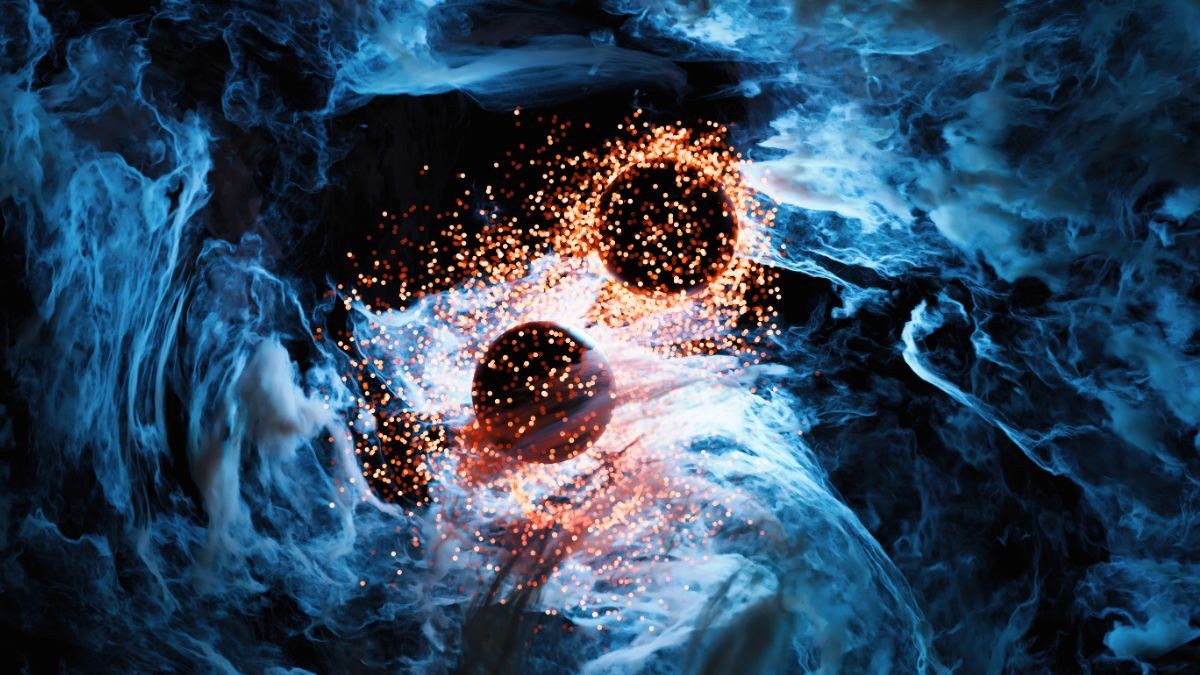
Scientists have definitively confirmed that the universe in its earliest moments behaved like an incredibly hot, dense liquid – a “soup” of fundamental particles known as quark-gluon plasma (QGP). This breakthrough, achieved through high-energy collisions at the Large Hadron Collider (LHC) at CERN, provides the strongest evidence yet for the fluid-like properties of matter just after the Big Bang.
The Universe’s First Liquid
Immediately following the Big Bang, the universe existed as a state of matter we’ve never directly observed outside of laboratory simulations: QGP. This exotic substance, hotter than a billion suns, was not just hot but also behaved like a liquid, resisting flow like honey rather than behaving like a gas.
This discovery matters because it validates theoretical models of the early universe and helps us understand how fundamental forces emerged from this chaotic state. The existence of QGP as a fluid has been debated for years; now, physicists have clear experimental proof.
Recreating the Big Bang in Collisions
Researchers at MIT and CERN recreated conditions similar to those immediately following the Big Bang by smashing heavy ions (lead particles) together at nearly the speed of light. These collisions generate temperatures high enough to briefly form QGP, which then decays into more familiar particles.
The key innovation was a novel method for analyzing the behavior of quarks within this plasma. Instead of looking for quark-antiquark pairs (which create confusing wakes), scientists focused on rare collisions that produce a quark alongside a neutral Z boson. The Z boson doesn’t interact with the plasma, allowing researchers to isolate the wake left by the quark.
The ‘Wake’ Reveals Fluid Behavior
The results were conclusive: quarks moving through QGP slow down and create disturbances akin to a boat moving through water. This confirms that the plasma isn’t just a collection of particles but a cohesive fluid capable of resisting motion and transferring energy. As physicist Yen-Jie Lee puts it, “Now we see the plasma is incredibly dense, such that it is able to slow down a quark, and produces splashes and swirls like a liquid. So quark-gluon plasma really is a primordial soup.”
Why This Matters
Understanding the behavior of QGP is crucial for several reasons:
- Early Universe Physics: The first milliseconds of the universe were dominated by QGP. Knowing its properties unlocks insights into the formation of matter as we know it.
- Fundamental Forces: The way QGP behaves provides clues about how the strong nuclear force, which binds quarks together, operates at extreme temperatures and densities.
- Future Research: The experimental techniques developed in this study can be applied to explore other high-energy collisions and exotic states of matter.
“In many other areas of science, the way you learn about the properties of a material is to disturb it in some way, and measure how the disturbance spreads and dissipates,” explains physicist Krishna Rajagopal.
This experiment doesn’t just confirm a theory; it provides a new way to probe the universe’s most extreme environments. The confirmation that the early universe was indeed a hot, swirling soup of particles opens exciting new avenues for understanding the origins of everything.