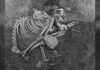
Paleontologists have rewritten the story of Europe’s dinosaur history, confirming that horned dinosaurs – ceratopsians – were far more common on the continent during the Late Cretaceous period (roughly 100-66 million years ago) than previously believed. The discovery resolves a long-standing mystery of missing fossils and reveals a more connected picture of dinosaur migration across the northern hemisphere.
The Puzzle of Missing Ceratopsians
For decades, ceratopsian fossils (the group including Triceratops and related species) were overwhelmingly found in Asia and North America, with only sparse and debated remains surfacing in Europe. This absence created a gap in understanding how these dinosaurs spread: the most logical route for them to reach North America would have been through Europe, but the fossil record didn’t support this.
The key to solving this puzzle lay in re-examining existing fossils, particularly Ajkaceratops from Hungary, first described in 2010. Initial interpretations were unclear, with some scientists classifying it as a distant cousin of Iguanodon rather than a true horned dinosaur.
New Evidence and Reclassifications
Using advanced CT scanning and detailed evolutionary analysis, researchers led by Professor Susannah Maidment of the Natural History Museum in London and the University of Birmingham have conclusively identified Ajkaceratops as a ceratopsian. Even more surprisingly, they found that other dinosaur species previously categorized as rhabdodontids (a type of ornithopod) were actually misidentified ceratopsians.
“When you only have small parts of the skeleton, it can be quite difficult to tell what’s what,” Professor Maidment explains. Shared characteristics between ceratopsians and other herbivorous dinosaurs made identification difficult, leading to decades of misclassification.
Implications for Dinosaur Migration
The confirmation of ceratopsians in Europe fills a critical gap in understanding how these dinosaurs moved across continents. The study suggests that during the Cretaceous period, Europe served as a land bridge between Asia and North America, allowing dinosaurs to “island hop” across the fragmented landmasses of the central European basin.
The researchers note that dinosaurs were capable of crossing bodies of water, evidenced by fossils of species like Allosaurus found on both sides of the nascent Atlantic Ocean. This suggests that even relatively short distances between islands would have been passable for some species.
Challenging Existing Assumptions
This discovery forces paleontologists to rethink previous assumptions about ancient ecosystems in Europe. The presence of ceratopsians suggests a more complex and interconnected dinosaur world than previously imagined, with horned dinosaurs hiding in plain sight for decades under incorrect classifications.
The study emphasizes the importance of re-analyzing existing fossil material with modern techniques, as even incomplete specimens can hold the key to rewriting evolutionary history. The findings have been published in the journal Nature, marking a significant shift in our understanding of dinosaur distribution and migration patterns.