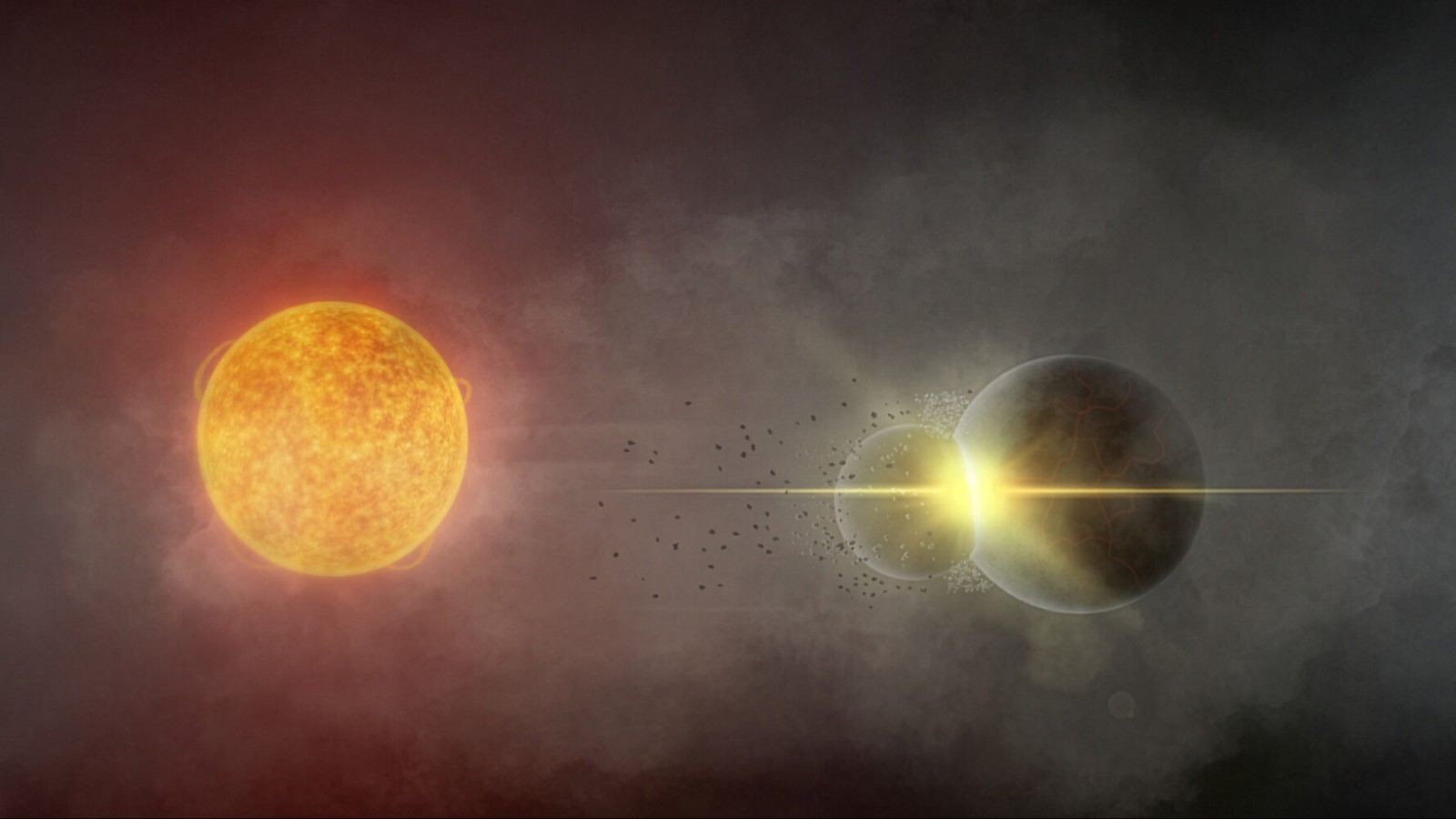
Astronomers have documented a dramatic collision between two planets orbiting a distant star, Gaia20ehk, located approximately 11,000 light-years away. This event provides a rare real-time observation of planetary destruction, and potentially, planetary birth. The star’s unusual behavior – erratic dips in brightness – alerted researchers to the ongoing cosmic catastrophe.
The Collision Unfolds
Before 2016, Gaia20ehk was a typical, stable star with predictable light output. However, it began exhibiting unusual flickering, culminating in a period of “completely bonkers” fluctuations around 2021. This wasn’t an internal stellar event, but rather the result of vast quantities of dust and debris passing between the star and Earth-based telescopes. The source: two planets colliding.
Researchers, led by Anastasios Tzanidakis at the University of Washington, found that the debris field was hot enough to glow in infrared light, indicating a high-energy impact. The collision likely unfolded in stages: initial glancing blows followed by a catastrophic final impact.
Parallels to Earth’s Moon Formation
What makes this event particularly significant is its striking similarity to the theorized impact that created Earth’s moon around 4.5 billion years ago. The debris cloud around Gaia20ehk orbits at a distance comparable to the Earth-moon system, raising the possibility that, over millions of years, this material could coalesce into an exomoon.
Why this matters: The formation of Earth’s moon is believed to have been critical for the development of life on our planet. It stabilizes Earth’s axial tilt, generates tides, and may even influence plate tectonics. Studying such collisions elsewhere could reveal how common these events are, offering insights into the potential for habitable worlds.
The Search for More Collisions
Detecting planetary collisions is exceptionally difficult. They require a specific alignment – the colliding planets must orbit between the star and our line of sight – and unfold over years, making them slow-moving astronomical stories. The team leveraged decades of existing data to identify this phenomenon, highlighting the potential for further discoveries through long-term observation.
A key question: How frequently do such events occur? The answer could refine our understanding of planetary system formation and the conditions necessary for life to emerge.
Astronomers are now actively searching for similar collisions, hoping to determine whether the Earth-moon event was a unique occurrence or a common process in the galaxy. This research could ultimately shed light on the prevalence of habitable worlds and the origins of life beyond Earth.