


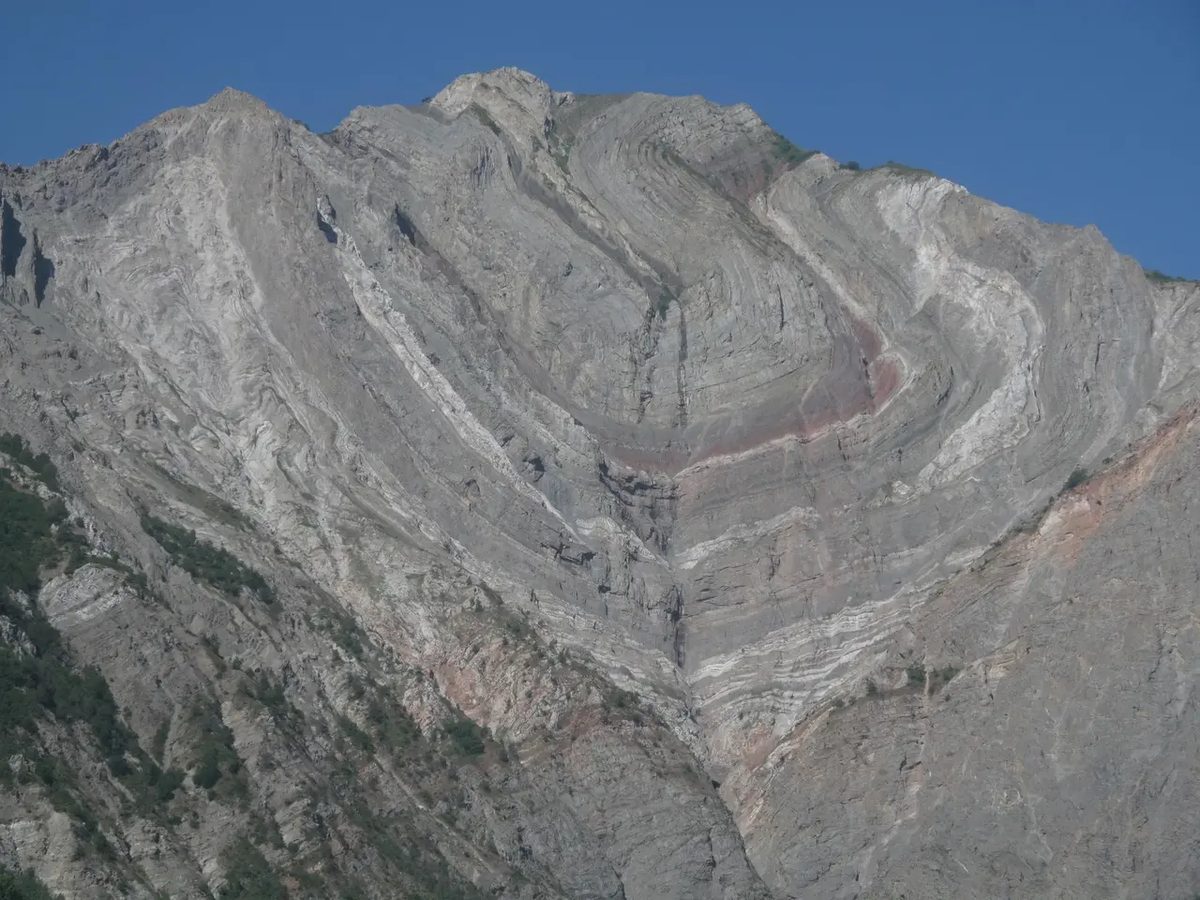
Rheology is the study of how materials flow and deform. It sounds like something out of a textbook, but it’s actually key to understanding why mountains form and earthquakes happen. The Earth’s outer shell, the lithosphere, does not act as a single solid body. Its mechanical behavior depends on where you look. It depends on the composition. Temperature is important. Depth is important.
These factors determine whether the rock behaves like glass or like dough. This difference is everything. It determines how the lithosphere is deformd under stress.
Elastic Shell of the planet
On a large scale, the lithosphere acts as an elastic entity. Elasticity means non-permanent deformation. It is completely reversible. Apply force and the material bends. Remove the force, the material returns to its original deform. Deformation stops when stress ceases.
Consider terrestrial tides. The moon’s gravity pulls on the earth. This attraction leads to repetitive elastic movements. The ground itself deforms. A certain point on the surface can move vertically several centimeters. Near the equator, this variation is 30-40 cm. Periodically. Predictable.
This elasticity is not just curiosity. It allows seismic waves to propagate through the planet. Without them, the internal structure of the Earth would remain hidden from us. We wouldn’t hear the planet’s deep hum.
When rocks break or flow
Look around at the landscape. You see faults. You can see the folds. These structures show that the rock’s behavior changes on a smaller scale. The lithosphere just doesn’t bend elastically. It breaks. It flows.
Geologists call this behavior “brittle” and “ductile”. They are fundamental to understanding crustal deformations.
Brittle deformation occurs near the surface. Temperatures are lower. The pressures are relatively low. Here the rock looks like brittle ceramics. It breaks. It creates faults. This is a shallow crust.
Ductile deformation takes place deeper. Higher temperatures and pressures allow the rock to flow plastically. It doesn’t snap. It stretches.
“The mechanical behavior of rocks changes from brittle to ductile with increasing depth, temperature and pressure.”
This transition zone is crucial. Here the rigid lid of the earth gives way to the mantle below. Understanding this rheological boundary helps explain everything from plate tectonics to volcanic activity.
Why do depth and temperature determine behavior?
The transition from brittle to ductile is not arbitrary. It’s physical. Heat makes atoms vibrate more strongly. They slip past each other more easily. The pressure closes the microcracks and forces the material to absorb stress through flow rather than fracture.
In the Earth’s shallow crust, rocks are cool and rigid. The stress builds up until the limit is reached. Then the breakdown. Earthquake.
In deep layers, heat softens the lattice structure of minerals. Rock flows. This is how mountains are formed over millions of years. Not with a sudden snap, but with a slow plastic bend.
The lithosphere is not uniform. It’s an layered system. A rigid shell over a ductile base. The action takes place at the interface between them. Where the stress is concentrated. Where the earth reveals its true mechanical nature.
This duality explains why some earthquakes are shallow and violent, while others are deep and silent. It
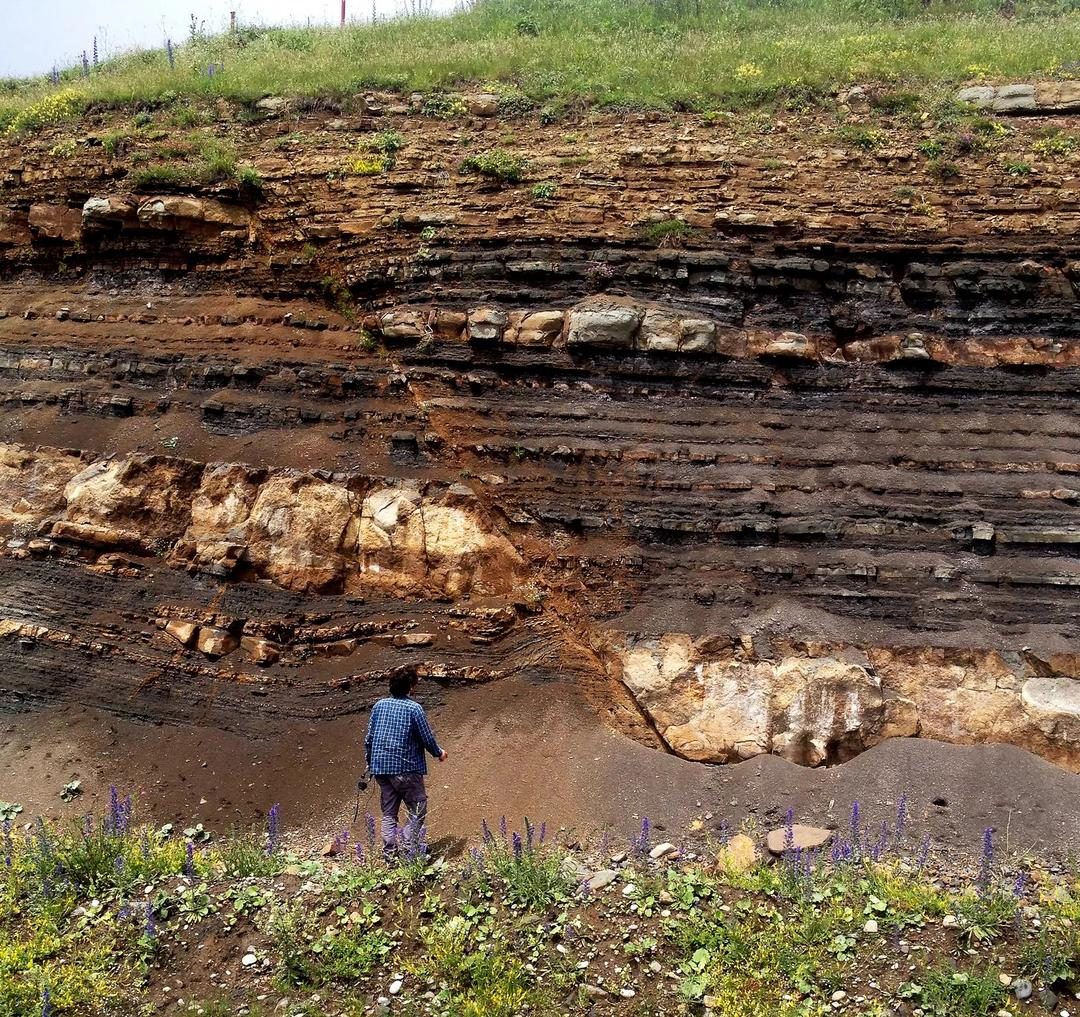

No persistent deformation occurs on the surface. It requires higher temperatures and pressures, such as deep underground where rocks exceed the plastic limit. In this environment, a rock that seems solid to us behaves like a viscous liquid. This is plastic. This allows the lithosphere to bend without breaking. This process is non-negotiable in Earth dynamics. It drives plate movement. It enables convection in the Earth’s mantle.
Take the granite. It breaks down on the surface. Smash it with a hammer and you’re done. But if you dive 10-20 kilometers deeper, that same granite becomes ductile. It flows. The depth at which brittle fracture transitions to ductile flow is called the brittle-ductile transition. This change is no accident. It depends on the rock composition. It depends on the temperature.
Lithospheric resistivity mapping with rheological profiles
Seismic data shows how deep these mechanical layers go. The hypocenters of earthquakes are cluster in the shallow lithosphere. On continents, they rarely exceed 20–30 kilometers. In the ocean, the limit is even lower – about 10 kilometers. But the mountains tell a different story. Under the thick crust, another seismic layer forms in the upper mantle at a depth of 80-120 kilometers.
Since earthquakes are caused by sudden ruptures, this distribution indicates that there are two distinct brittle zones in the lithosphere. One sits in the crust (continental or oceanic). The other is deeper in the mantle. Sandwiched between them is the lower crust. It won’t break. It flows steadily.
Researchers map this zone using rheological profiles. These profiles calculate the lithospheric resistance with respect to depth using certain laws. Byerlee’s Law governs frictional sliding. Creep laws govern ductile flow. Together they predict whether the rock will break or bend.
Imagine a continental crust rich in quartz and feldspar. The compressive strength increases as the temperature rises – up to 350 °C. Below this threshold, the rock is brittle. It creates seismicity. Above this, a phase change occurs in the quartz. It becomes ductile. Resistance decreases with depth and heat. This weak, fluid lower crust is the primary driver of large-scale tectonic adjustment.
The implication is stark. The crust is not a rigid shell. It is a multi-layered machine. The upper part snaps. The lower part slides. This dichotomy governs everything from mountain building to earthquake risk. Understanding the brittle-ductile transition helps you understand where faults break and where they simply slip.
This mechanical layering explains why some areas vibrate while others deform invisibly. It illustrates why deep earthquakes occur in subduction zones but not in stable shields. The rheological profile is the blueprint. It shows us where the earth holds its tension and where it lets go.
We often imagine the earth below as static. That’s not it. It constantly negotiates its own structure, shifting from brittle to ductile, staying put or moving depending on depth, heat and time. The question is not whether the earth moves. The question is how much of it is currently stuck waiting for the fault line to finally slip.
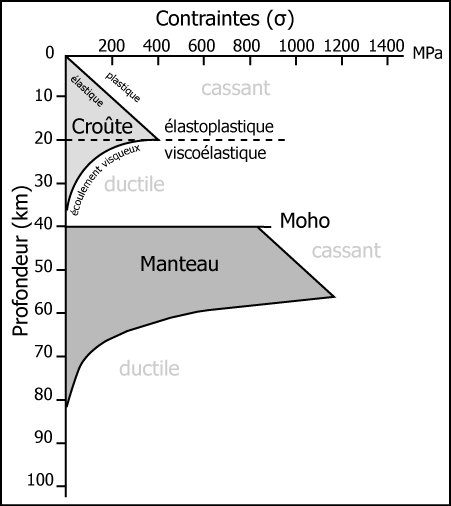

低于莫霍面,规则一夜之间就发生了变化。
主要矿物发生变化。 统治地壳的石英被橄榄石取代。 这不仅仅是成分的交换。 这是地球行为方式的根本性转变。 在 700 至 800 摄氏度左右的温度下,橄榄石会变脆。 它折断了。 它坏了。
因此,位于莫霍面下方的上地幔实际上比其上方的大陆地壳更坚硬。 有一瞬间,你会认为地球会牢固地结合在一起。 但这不会持续下去。
当你深入时,压力和热量就会增加。 橄榄石很快就会脱落其易碎的外壳。 它变得有延展性。 塑料。 上地幔的阻力急剧下降。 这种强度的崩溃一直持续到岩石圈底部,那里的温度大约为 1,200 到 1,300 摄氏度。
Why does the asthenosphere slide?
This particular layer lies at the boundary between the rigid lithosphere and the flowing asthenosphere and is the geological weak link. The peridotite here is very soft. It flows almost without resistance.
Seismologists call this the Low Velocity Zone (LVZ).
Why? This is because seismic waves are difficult to propagate. The material is too soft. It absorbs energy. This is a high attenuation area. This is more than just a curiosity for seismologists who study the mechanics of the deep Earth. It matters a lot in the real world.
The low speed range acts as a lubricant.
It separates the tectonic plate from the underlying mantle. The lithosphere rests on top of this smooth asthenosphere. Without this weak layer, discs can jam. It might not move. This detachment allows the hard plates of the Earth’s surface to drift, collide, and slide.
This is the reason for continental drift. Weak areas make this possible.


