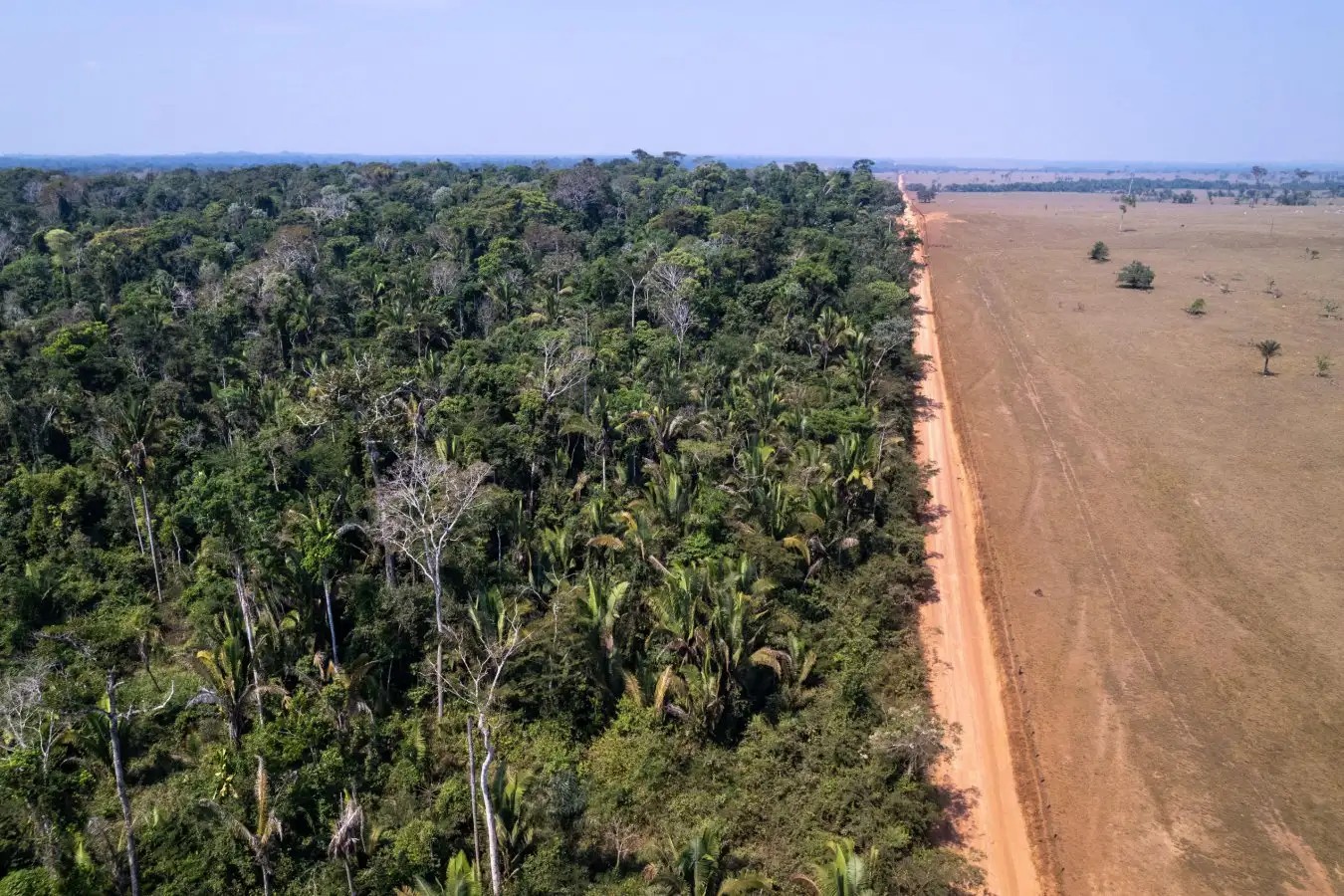
The Amazon rainforest is approaching a critical threshold that could trigger irreversible ecological collapse as early as the 2030s. While previous scientific consensus focused heavily on global temperature rise as the primary driver of this disaster, new research reveals a more immediate and interconnected danger: deforestation significantly lowers the temperature at which the forest can no longer sustain itself.
If current rates of forest destruction continue alongside global warming, the Amazon could transition from a lush rainforest to a dry savanna or scrubland within decades. This shift would not only devastate global biodiversity but also release massive amounts of stored carbon, accelerating climate change further.
The Synergy of Heat and Deforestation
For years, scientists modeled the Amazon’s resilience based largely on atmospheric temperature. A landmark 2022 study suggested that widespread forest dieback would likely occur if global warming reached 3.5°C, and potentially as low as 2°C. Given that current trajectories point to a warming of 2.6°C to 2.7°C by 2100, the risk was already considered high.
However, those earlier models did not fully account for the compounding effect of deforestation, which has already eliminated at least 15% of the original Amazon forest.
New modeling by Nico Wunderling and colleagues at the Potsdam Institute for Climate Impact Research changes the equation. By integrating both rising global temperatures and severe deforestation scenarios up to 2050, they found that the “tipping point” drops dramatically. If total forest loss reaches 22%, the Amazon could suffer widespread dieback with as little as 1.5°C of global warming.
This is a critical distinction because the world has already warmed by 1.3°C to 1.4°C and could hit the 1.5°C mark by the end of this decade.
“We found that there’s this about-2-degree reduction of the critical global warming threshold when deforestation is considered,” says Wunderling.
The Moisture Recycling Mechanism
The reason deforestation is so destabilizing lies in the Amazon’s unique hydrological cycle. The forest acts as a giant atmospheric pump. Moisture-laden winds from the Atlantic Ocean bring rain to the eastern Amazon. Trees absorb this water and release it back into the air through transpiration, creating “atmospheric rivers” that carry moisture westward.
Up to 50% of the rainfall in the western Amazon is recycled from the forest itself. When large areas are cleared for cattle ranching or agriculture, this recycling loop is broken.
- The Domino Effect: Cutting down trees reduces local humidity, causing forests downwind to dry out and die.
- The Vulnerability: This dried-out forest becomes highly susceptible to even small increases in temperature. As Wunderling notes, deforestation undermines the moisture recycling feedback, meaning “it only needs a little bit of a push from global warming to make these cascading transitions possible.”
A Narrow Window in the 2030s
The timeline for this potential collapse is tighter than previously thought. If deforestation resurges after a slight slowdown in recent years, the Amazon could cross its tipping point as soon as 2031.
The extent of the damage depends heavily on carbon emissions and deforestation rates:
* At 22–28% forest loss, models predict that 62–77% of the Amazon biome could transform into grassland, savanna, or scrubby forest.
Political Promises vs. On-the-Ground Reality
The political landscape in Brazil offers a glimmer of hope, but also significant challenges. In 2024, Brazil lost more than 28,000 square kilometers of primary forest, matching its previous record. However, deforestation rates nearly halved in 2025, bolstered by President Luiz Inácio Lula da Silva’s promise to halt Amazon deforestation by 2030.
David Armstrong McKay of the University of Sussex, who contributed to the 2022 tipping point study, suggests that achieving this goal would likely prevent the worst-case scenario.
“Stopping all deforestation is probably optimistic,” Armstrong McKay says. “But even if there is some deforestation continuing, it probably won’t meet this worst-case scenario modelled here.”
The Wildcard: Wildfires
Despite political promises, the ground reality remains precarious. In 2025, Brazil still lost approximately 0.5% of its primary forest. More alarmingly, the cause of destruction is shifting. For the past two years, two-thirds of forest destruction has been due to wildfires.
These fires typically start when farmers burn cleared vegetation, but they increasingly escape into neighboring intact forests. This is a new and dangerous trend:
- Climate Feedback: The rainforest is becoming hotter and drier, creating ideal conditions for fire spread.
- El Niño Risk: The upcoming El Niño climate phase is expected to worsen these dry conditions.
- Underestimated Vulnerability: Dominick Spracklen of the University of Leeds argues that the study may underestimate the Amazon’s vulnerability because it doesn’t fully capture the accelerating frequency and intensity of these fires.
“We’re getting these much bigger fires,” Spracklen warns. “That is worrying if we have moved into a new kind of regime where that can happen more and more.”
Conclusion
The Amazon has already shifted from being a carbon sink to a carbon source. If widespread dieback occurs, it could release enough carbon to heat the globe by an additional 0.2°C, while simultaneously destroying the planet’s largest store of terrestrial biodiversity.
The window to prevent this collapse is closing rapidly. While halting deforestation entirely may be optimistic, aggressive action to stop forest loss and control wildfires is essential to keep the Amazon away from its tipping point. The choice is no longer just about limiting global temperatures, but about preserving the physical structure of the forest that regulates those temperatures.