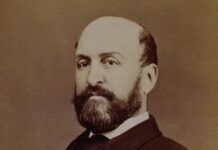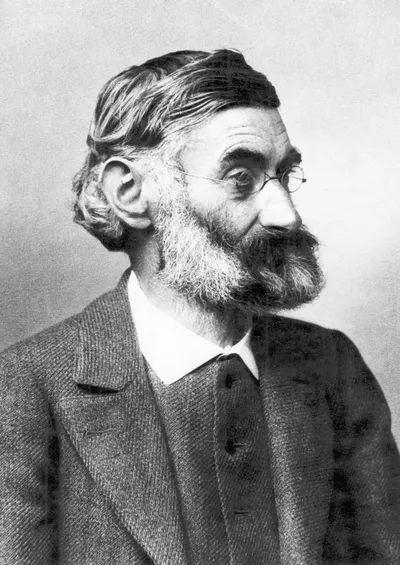
Ernst Abbe didn’t just optimize lenses. He rewrote the rules of how light behaves when it hits glass.
He was born in Eisenach in 1840 and grew up in Germany, which was still politically developing. But the world of physics was already crumbling under the weight of old assumptions. When Abbe died in Jena in 1905, the microscopes under scientists’ eyes were sharper, clearer, and fundamentally different from the hazy instruments that preceded them.
The problem with early optics wasn’t just bad glass. It was math.
Before Abbe, microscope builders speculated. They polished the lenses until they looked good and hoped for the best. Result? Blurred edges. Distorted shapes. What we now call coma and spherical aberration. You would see the cell, but it would appear to melt.
Abbe changed that in 1873.
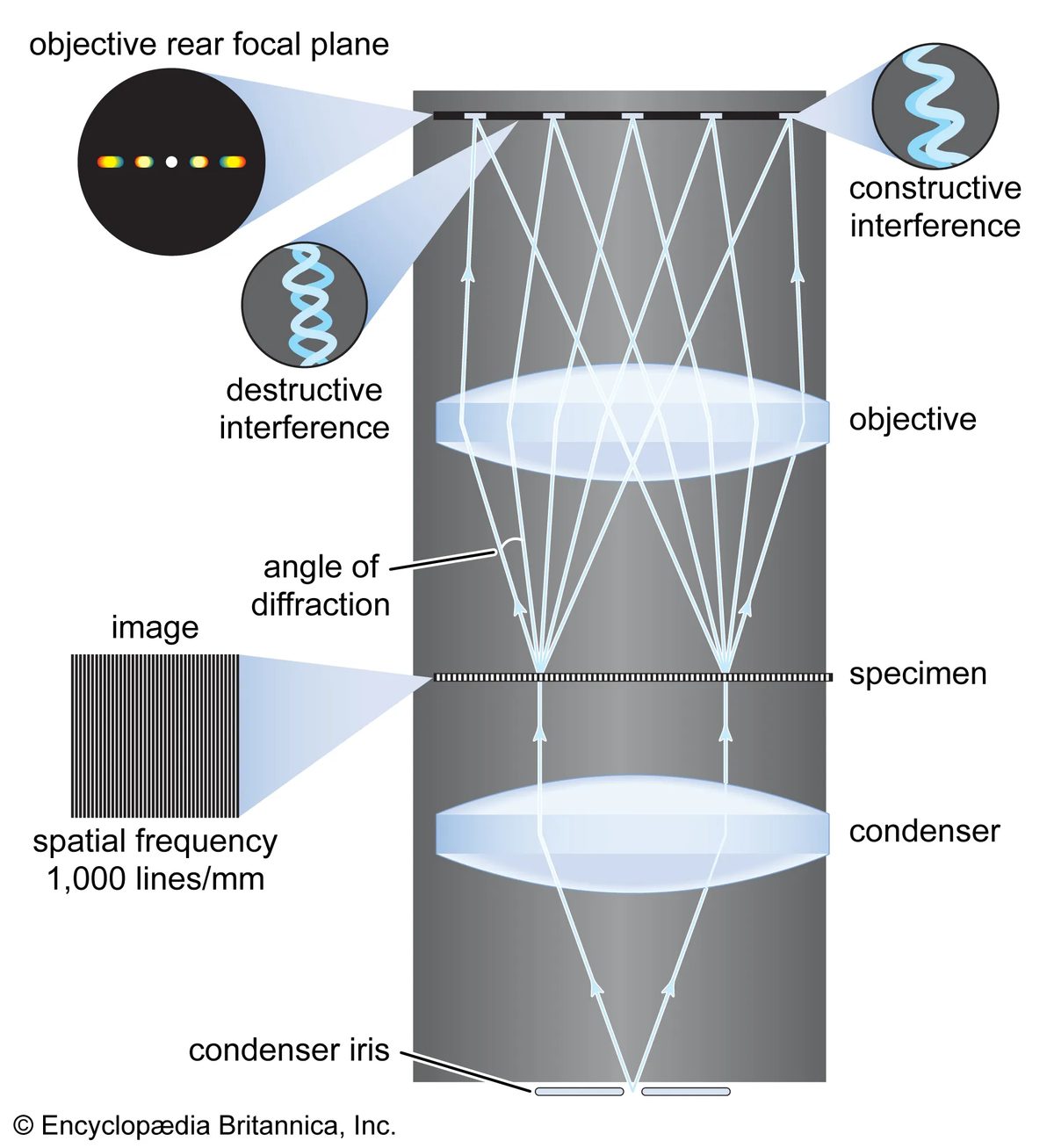
He discovered the optical formula now known as Abbe sine condition. This was no small adjustment. It was a requirement. If a lens wanted to produce a sharp image, it had to obey this mathematical law. Ignoring it you get blur. Respect it and you will get clarity.
This discovery defined the limits of magnification for decades. It showed the engineers exactly where the line is between seeing more and just seeing noise.
But he didn’t stop at the theory.
In 1870 Abbe introduced the condenser. This device focused the light directly on the sample. Previously, the lighting was uneven. Some parts of the slide were light; others drowned in the shadows. The condenser gave a strong and even light. It turned the microscope from a game of chance into an exact science.
He didn’t just invent parts. He reorganized the company behind it.
As the head of Carl Zeiss AG, Abbe saw employees not as cogs but as partners. He created benefits that were radical for the 19th century. Profit sharing. Paid vacation. Pension plan. He believed that a company with unhappy people could not produce high quality optics. The logic was simple. If you treat people well, they will care about the glass. If they take care of the glass, the image will be sharper.
This approach changed the optical industry. It showed that technical innovation and social responsibility are not opposing forces. They could drive each other.
Today, when you look through a high-end microscope and see sharp details, you see Abbe’s legacy. The sine condition is still the standard. The condenser is still a tool. And the idea that good work requires good conditions? This is more difficult to measure. But it’s true.
We now take clear images for granted. We zoom in on cells, bacteria, viruses. We assume that the lens simply works. That is not the case. It is forced to follow a formula discovered 150 years ago by a physicist who hated blur.
The question is whether we have learned to appreciate the hands that polish the glass as much as the glass itself. Abbe thought we should.
The rest is up to us.
From trial and error to scientific accuracy
The transition from artisanal guesswork to rigorous science in optics did not happen overnight. As early as 1863, Ernst Abbe settled at the University of Jena and climbed the academic ladder to become professor of physics and mathematics in 1870. He didn’t just teach; In 1878 he headed the astronomical and meteorological observatories. However, the real turning point came when Carl Zeiss, a German industrialist with a certain vision, intervened.
Zeiss was tired of the old ways. Making optical instruments has long been a game of trial and error, skill and luck rather than calculation. He wanted a mathematical backbone. Therefore, in 1866, he hired Abbe as director of research for optical works. The goal was clear: to provide a solid mathematical and scientific basis for the production of optical instruments.
The results were immediate and revolutionary. Just two years later, in 1868, Abbe invented the apochromatic lens system for microscopes. This was no small change. It eliminates both primary and secondary chromatic aberration of light, a problem that had affected optical clarity for decades. The lens corrected chromatic aberration in an unprecedented way. Zeiss recognized the value immediately, made Abbe his partner in 1876, and appointed him as his successor.
The glass problem and a new partnership
Despite these optical breakthroughs, there was a bottleneck. The quality of the glass itself was unsatisfactory. Lenses are only as good as the material they’re made from, and current glass options have been inconsistent. The breakthrough came from an unexpected source: Otto Schott, a German chemist. In 1879, Schott wrote to Abbe about a new lithium-based glass he had made. It was ideal for Zeiss instruments and provided the purity and consistency required for high quality optics.
This collaboration led to the founding of the Schott and Associates Glass Technology Laboratory in Jena in 1884. Schott, Abbe and Zeiss joined forces to solve a problem in materials science. After Zeiss’s death in 1888, Abbe assumed leadership of the Zeiss company and ran a growing industrial empire based on science rather than superstition.
Social experiment in business administration
Abbe wasn’t just worried about the lenses; he was obsessed with legacy. He feared that the future owners of Zeiss and Schott might be tempted to enrich themselves at the expense of the companies and their employees. He wanted neither a traditional family dynasty nor a predatory corporate takeover. Instead, he developed a structural solution.
In 1889 he founded and endowed the Carl Zeiss Foundation to manage two companies. In 1891, the foundation became the sole owner of Zeiss and Abbe’s share in Schott. (Schott later transferred his remaining shares to the foundation after his death in 1935 to ensure the structure remained stable.)
The rules published by Abbe in 1896 were radical at the time. They reorganized the two companies so that the management, the employees and the University of Jena shared the profit. It was a profit-sharing model that gave employees a share of the success they contributed to