


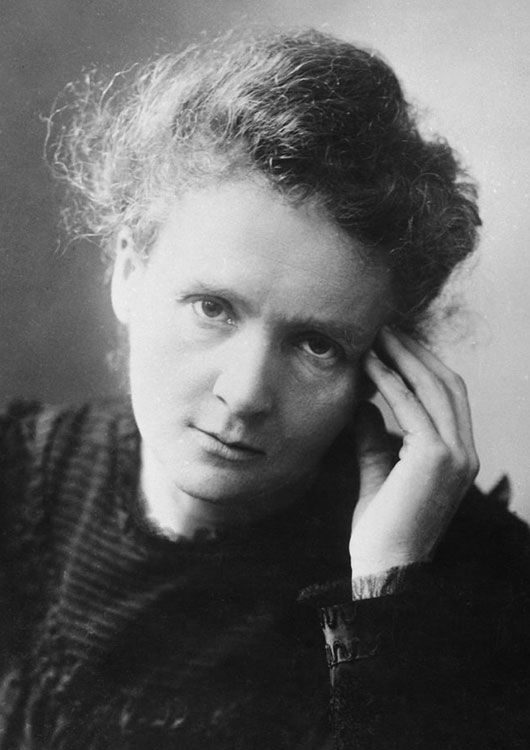
Marie Curie was not just a scientist. She was a force of nature in every sense of the word.
She was born Maria Skłodowska in Warsaw in 1867 and grew up in a Polish family under Russian rule. Life was hard. But her mind was sharper than ever. In 1891, she moved to Paris to study at the Sorbonne. This decision changed everything.
Paris was the center of science. And then something new happened. Henri Becquerel had just discovered radioactivity in uranium. It was strange. It was mystical. Curie wanted to know if other elements did it too.
She tested thorium. It glowed with radiation. She was on to something big.
The discovery that rewrote physics
In 1895, she married Pierre Curie. He was a physicist. They were partners in life and in the laboratory.
They worked with pitchblende, a mineral that was even more radioactive than uranium. It didn’t make any sense. If uranium was the source, the ore should be weaker. But it was stronger.
So they dug deeper.
They isolated two new elements from the rock. One was polonium. She named it after his native Poland, which was not yet on the map as an independent country. The other was radium. It glowed blue in the dark. It was powerful.
They also mapped the types of radiation. Alpha, beta, gamma. They named them. They defined them.
The word “radioactivity” came from her pen. She coined it.
In 1903, the Nobel Committee noticed. Pierre, Marie and Henri Becquerel shared the Nobel Prize in Physics. Marie was the first woman to win a Nobel Prize. It was a breakthrough. But that wasn’t the end.
Tragedy and triumph
Pierre died in 1906. He was hit by a horse-drawn carriage on a rainy Paris street. It was sudden. It was brutal.
Marie didn’t stop. She took his job. She was the first woman to teach at the Sorbonne. The lectures were full. People came to meet the genius’s widow. They stayed for the science.
She kept working on work on radium. She wanted to isolate it in its pure form. It was tedious. It was dangerous. She processed tons of ore.
In 1911, she won another Nobel Prize. This time it was in chemistry. She was the first person to win two Nobel Prizes. No one had done it before. Since then, no one has been able to achieve this special dual discipline.
Cost of discovery
She didn’t just study radiation. She lived in it.
At the time, no one knew it was dangerous. They treated the radium tubes like toys. She carried test tubes in his pockets. She slept with them. It seemed magical. It was actually fatal.
Her body broke down. She developed leukemia. It was slow. It was painful. She died in 1934 near Sallanches, France. The cause was clear: long-term exposure to radioactivity.
Her notebooks are still radioactive today. You can’t just read them. You must wear protective equipment. They are artifacts of a dangerous era.


