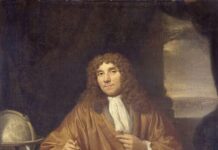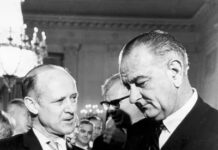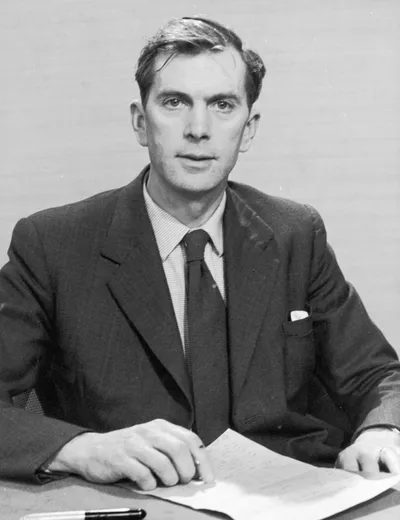
Sir Martin Ryle didn’t just look at the sky. He mapped it with a precision that didn’t exist before his hands touched the equipment. Born in Brighton in 1918, he died in Cambridge in 1984. But in between those dates, he changed astronomy forever.
He was a radio astronomer first and foremost. The world was used to looking for light. Ryle looked for signals. Invisible waves. Static from the cosmos. He built systems to catch them. Then he used those systems to pinpoint weak radio sources with startling accuracy.
Before Ryle, radio astronomy was a blurry science. He made it sharp. He observed the most distant galaxies known at the time. These weren’t just dots. They were confirmed, located, and studied. His work showed that the universe was far larger and more active than anyone had imagined.
The Radar Connection
Here is the thing people often miss. Ryle’s breakthroughs didn’t come from a telescope in the traditional sense. They came from World War II.
In 1939, he graduated from Oxford with a physics degree. Then the war started. He joined the Telecommunications Research Establishment. There, he designed radar equipment. Not for spotting bombers, but for understanding how radar waves behaved.
After the war, he took a fellowship at Cambridge’s Cavendish Laboratory. He had a new job: investigate extraterrestrial radio sources. He didn’t start from scratch. He used his radar knowledge. He applied the principles of radar synthesis to astronomy.
The result was the synthesis telescope. It wasn’t one giant dish. It was an array. Multiple smaller antennas working together. This allowed him to simulate a telescope the size of the baseline between the furthest antennas. The resolution improved dramatically. Weak signals became visible. Distant galaxies came into focus.
A Nobel for the Invisible
The recognition came late but heavy. In 1974, Ryle and Antony Hewish shared the Nobel Prize for Physics. It was the first Nobel awarded specifically for astronomical research. The committee didn’t just honor a discovery. They honored a method. A way of seeing that didn’t rely on glass lenses or simple mirrors.
Ryle didn’t just observe the universe. He taught it how to be heard clearly.
His career accelerated quickly. He served as a university lecturer in physics from 1948 to 1959. In 1957, he became director of the Mullard Radio Astronomy Observatory. By 1959, he was professor of radio astronomy. The field was his.
He was elected a fellow of the Royal Society in 1952. Knighted in 1966. These weren’t just honors. They were acknowledgments of a shift in scientific paradigm. He proved that radio waves were as valuable as visible light for understanding cosmic structures.
The Astronomer Royal
In 1972, he succeeded Sir Richard Woolley as Astronomer Royal. He held the position until 1982. This role is largely ceremonial in modern times, but in Ryle’s time, it carried weight. It meant he was the public face of British astronomy. He advocated for science funding. He pushed for better tools.
He was the nephew of Gilbert Ryle
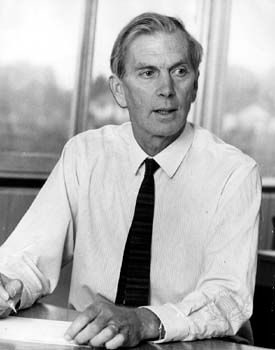
Ryle didn’t start by chasing the biggest objects in the universe. His early work was grounded in the local neighborhood. He studied radio waves from the Sun. He tracked sunspots. He pointed his instruments at a handful of nearby stars. This wasn’t flashy stuff. It was foundational.
He led the Cambridge radio astronomy group through the painstaking process of mapping these signals. The result was the Third Cambridge Catalogue in 1959. That list of radio sources did more than just organize data. It provided the clues that led directly to the discovery of the first quasi-stellar object, or quasar.
The Aperture Synthesis Breakthrough
Mapping distant radio sources like quasars required a new way of seeing. Traditional telescopes simply couldn’t resolve the details. Ryle solved this with a technique now known as aperture synthesis.
The concept was elegant in its simplicity. Instead of building one massive dish, he used two radio telescopes. By moving them along rails and changing the distance between them, he collected data from multiple perspectives. When that data hit the computer, the math did the heavy lifting. The resolving power skyrocketed.
In the mid-1960s, he put this theory into practice. The setup involved two telescopes on rails. At their maximum separation of 1.6 kilometers (about one mile), the system performed as if it were a single telescope with a 1.6-kilometer diameter. That is a massive increase in clarity for its time.
Finding the Pulsar
This high-resolution tool wasn’t just for cataloging distant quasars. It had immediate, local applications. The system was used to locate the first pulsar.
The pulsar itself had been discovered in 1967 by Jocelyn Bell and her advisor Antony Hewish of the Cambridge group. They detected the rhythmic signals. But to understand where these signals were coming from precisely, they needed high-resolution mapping. Ryle’s interferometer provided that precision. It pinned down the location, confirming the nature of these strange, ticking cosmic clocks.
The shift from static catalogs to dynamic, synthesized imaging changed everything. It allowed astronomers to see the universe with a sharpness that was previously impossible. Ryle’s method didn’t just improve the pictures. It created a new language for observing the sky.