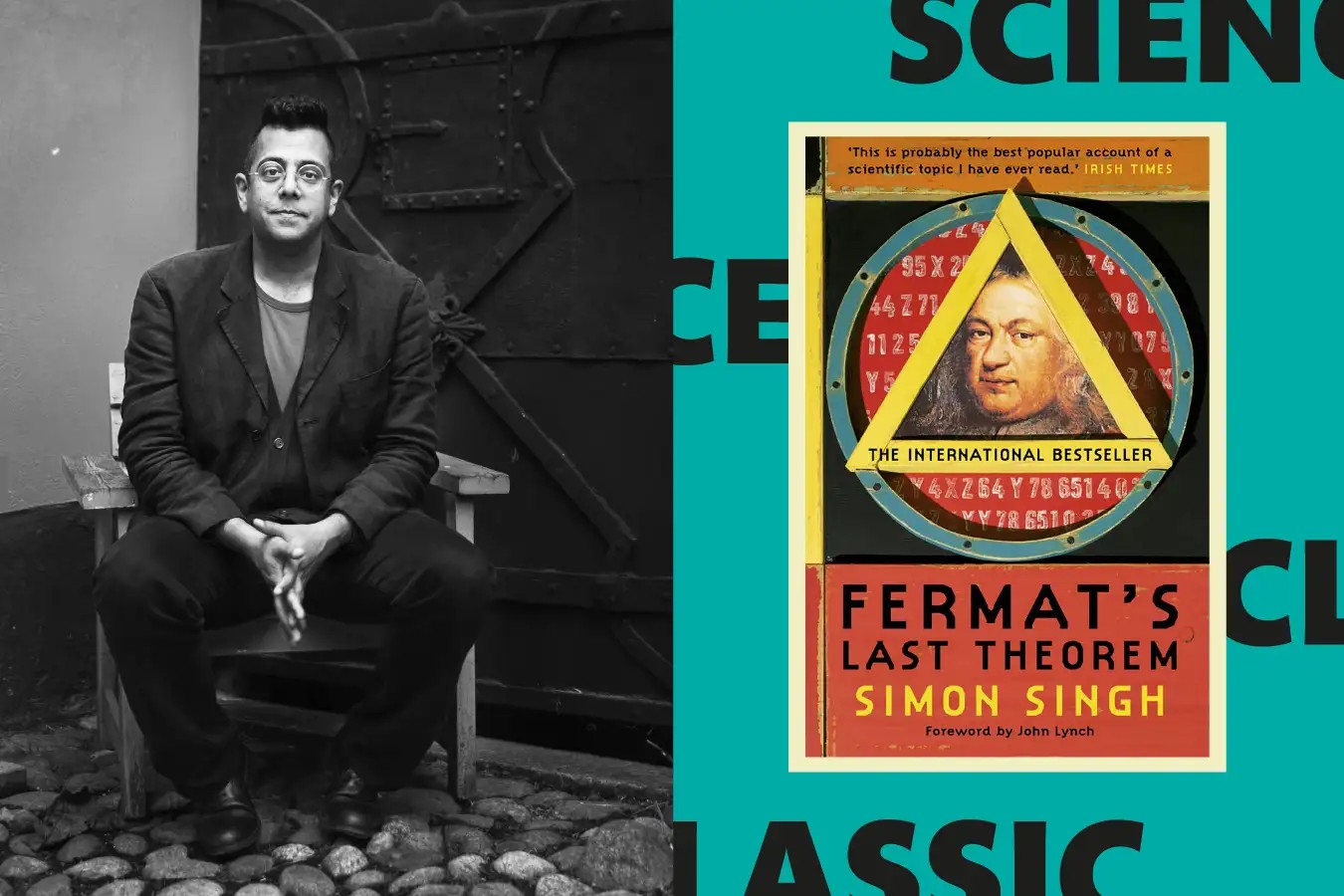
Mathematics is often perceived as a cold, abstract realm of numbers, far removed from the human experience. However, as Simon Singh demonstrates in his seminal 1997 book, Fermat’s Last Theorem, the pursuit of mathematical proof is a deeply human saga—filled with obsession, tragedy, secret societies, and ultimate triumph.
Nearly three decades after its publication, Singh’s work remains a definitive exploration of what it means to seek absolute truth through logic.
The Power of Absolute Proof
The story begins not with complex equations, but with the fundamental concept of mathematical proof. Singh uses Pythagoras to illustrate this distinction. While many civilizations had worked with triangles, Pythagoras was revolutionary because he didn’t rely on trial and error; he used incontrovertible logic to prove that his theorem ($x^2 + y^2 = z^2$) held true for every right-angled triangle.
This distinction is vital: in science, theories can be updated with new data, but in mathematics, a proven theorem is an eternal certainty. This quest for “absolute knowledge” is what drives the mathematicians featured in Singh’s narrative.
Fermat’s “Marginal” Mystery
The central drama revolves around Pierre de Fermat, a 17th-century French judge and brilliant mathematician. Fermat famously toyed with the Pythagorean equation. He conjectured that while $x^2 + y^2 = z^2$ has infinite whole-number solutions, the equation fails for any higher power. In other words:
If $n > 2$, then $x^n + y^n = z^n$ has no whole-number solutions.
In 1637, Fermat scribbled in the margin of a book that he had found a “truly marvelous” proof, but famously noted that the margin was too narrow to contain it. This cheeky, undocumented claim sparked a 350-year intellectual obsession, leaving generations of mathematicians searching for a ghost.
A Cast of Mathematical Tragedies and Triumphs
Singh breathes life into the history of mathematics by profiling the brilliant, often flawed individuals caught in Fermat’s shadow:
- Sophie Germain: A pioneer who had to work under a male pseudonym to contribute to the field.
- Évariste Galois: A revolutionary whose life was cut short by a duel, leaving behind groundbreaking work.
- Yutaka Taniyama: A mathematician whose insights laid the groundwork for the eventual solution, but who tragically took his own life.
The climax of the book focuses on Andrew Wiles, the mathematician who finally cracked the code in 1994. Wiles achieved this by building a logical bridge between two seemingly unrelated fields: elliptic curves and modular forms. This connection was not just a solution to a single problem; it was a validation of a much larger mathematical vision.
The Grand Design: The Langlands Program
The significance of Wiles’ proof extends far beyond Fermat’s specific conjecture. It provided early evidence for the Langlands program, a grand architectural vision in mathematics proposed by Robert Langlands in 1967.
The Langlands program suggests that all disparate branches of mathematics are deeply interconnected. The theory is that by finding these “bridges,” a problem that appears unsolvable in one field can be solved using the specialized tools of another. Wiles’ success proved that these connections are real, paving the way for modern breakthroughs, such as the 2024 advancements in harmonic analysis.
Conclusion
Fermat’s Last Theorem is more than a history of an equation; it is a testament to the human drive to understand the underlying structure of reality. By treating mathematical proofs as works of art, Singh reveals that the search for logic is, at its heart, a profound and beautiful human endeavor.