Well, actually, we do have an idea. And it involves a cosmic crash.
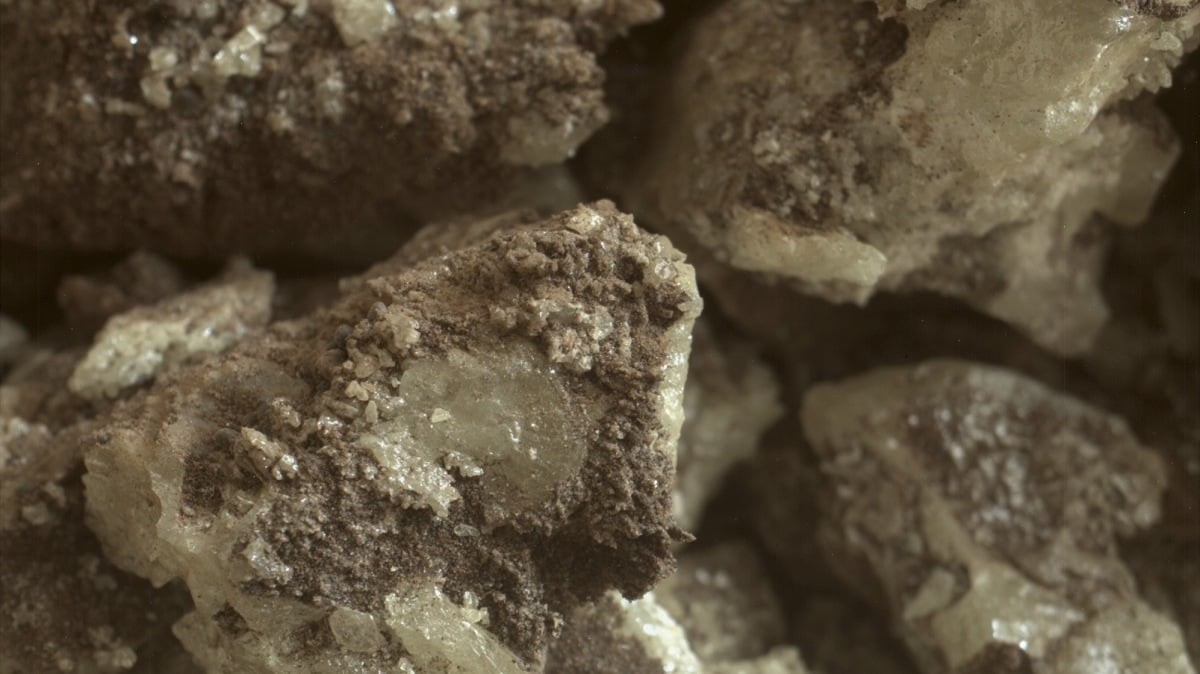
NASA’s Curiosity rover stumbled upon them by accident. It just drove right over the rocks at Gale Crater back in 2024, crushed the material, and revealed crystals the exact shade of Mello Yello sugar water.
At first glance it looked like a oddity. A small patch of weird stone. The team quickly realized this was not an anomaly. It was a field. A sprawling 50-yard carpet of pure elemental sulfur.
“We don’t think we’re anywhere near where a volcano is,” said Abigail Fraeman. The deputy project scientist was right. No vents nearby. No hot springs to blame for the yellow crust.
On Earth pure sulfur usually means volcanoes. Superheated gases hissing through fissures. Or maybe bacteria at work, turning chemical sludge into rock. Neither explanation really fit the Martian landscape where Curiosity was parked. So what left these deposits on the table?
A celestial shrapnel shower
Here is the new theory. An asteroid slammed into Mars. Not long after. It hit an area that was already hiding underground sulfur.
The impact generated insane heat. Enough to melt the hidden sulfur into a liquid. Imagine thick yellow lava, but cooler and more volatile. It cascaded downhill for a couple of miles before cooling into solid chunks.
It sounds dramatic. But check the geology.
Scientists presented this model at the European Geosciences Union Assembly in Vienna. They point to a damaged crater uphill. It’s about 1,28 feet wide. One side is broken. It looks less like a hole and more like a broken bowl spilling its contents. That broken lip? A natural gutter. The molten sulfur spilled out, traveled 2.5 miles down the slope, and pooled behind piles of fallen rocks.
The holes tell a story
The physical evidence supports this. The rocks found by the rover have holes. Round ones. Researchers believe these were gas bubbles. As the liquid sulfur cooled and solidified the trapped gas escaped, leaving voids.
Rover images show more of these holes at higher elevations in the deposit. Makes sense. If you pour cooling liquid into a valley the edges cool first. The bubbles get trapped near the surface while the deeper liquid remains hot longer.
So we have flow dynamics. We have cooling patterns. Now we need to check the physics.
Crunching the numbers
Can an asteroid actually create enough melted sulfur to cover 50 yards?
The team ran computer simulations. They modeled rocks hitting Mars at speeds between 11,00 mph and 22,00 mph. The faster the impact the more sulfur melts.
Here is the problem though. Most of that sulfur doesn’t stay put. Roughly 75 to 80 percent gets blasted out of the crater or vaporized into thin air. Only about a quarter remains inside to spill out.
For this math to work the ground before the crash had to be incredibly rich in sulfur. Like half the material. That is a lot of sulfur for a random patch of Martian dirt. Where did it come from? Probably ancient volcanoes.
The asteroid didn’t make the sulfur. It just cooked it. It acted like a cosmic pressure cooker.
But these models are rough. Really rough. Scientists admit they lack a specialized physics engine for how sulfur behaves under extreme impact pressures. It is guesswork informed by data but not precise simulation.
Curiosity is rolling toward the suspected source area. If the rocks there are saturated with sulfur the impact theory holds water. If they aren’t… well we still have yellow rocks lying around for no reason.
We’ll wait to see where the rover lands.