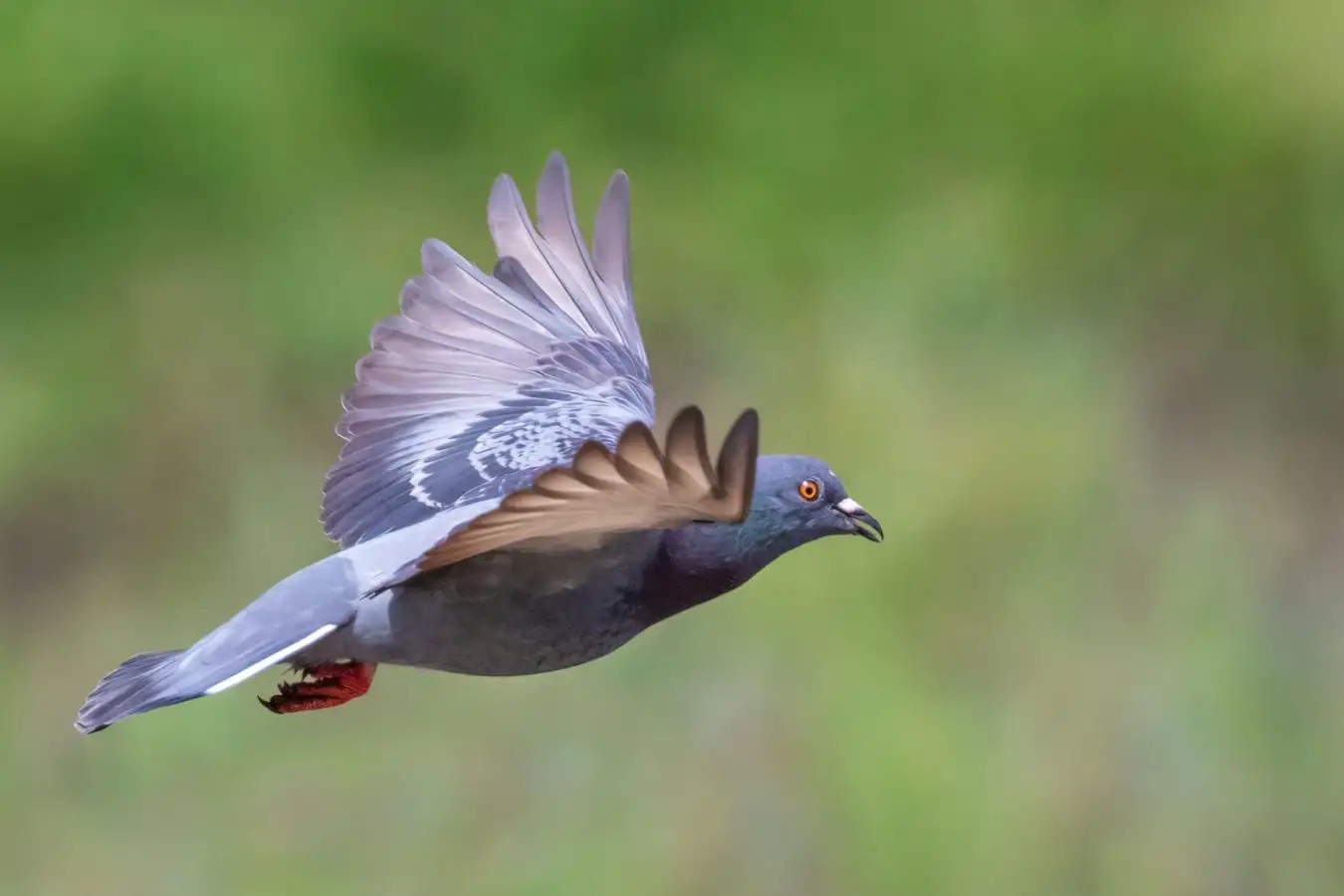
Scientists just figured something out. No one really knew before. They tracked eye movements of a bird actually flying for the first time.
Pigeons don’t look around in the air. They lock it. Their eyes go rigid. Fixed.
It helps them stay balanced. Sure. But it leaves their back wide open to danger.
“Whenever they start flying, the eyes.rotate forward on average”
— Ivo Ros, Caltech
How does this work on the ground? Easy. An animal sees something. It moves its head or eyes to focus. Then it uses saccades—those jerky pupil motions—to stabilize the view against the background. It’s how we keep the world from spinning out while we move.
But air is different. Speed changes everything.
Ivo Ros and his team built a rig. Lightweight. Mirrors, cameras, a tiny backpack with a battery. They strapped it onto common pigeons (Columba livia ). Brutally simple engineering.
Six birds flew indoors between perches 20 meters apart. Three went outside, 25 meters to a coop. Not exactly marathon distances, but enough to count.
Here’s what happened.
Take-off. Pupils dilated. Eyes snapped forward and stayed put. They locked in. When the head turned, the eyes moved with it. In sync. Like glued in place.
This isn’t just stiff necks. It’s alignment with the vestibular system—the inner balance network. The primary horizontal axis of vision matches the body’s orientation perfectly.
Graham Martin at the University of Birmingham points out the constraint. Pigeons can normally move their eyes independently. About 15 degrees max amplitude. Plenty of wiggle room.
So why less than 1 degree in the air?
Intention. Active stabilization.
Why? We’re not totally sure. Ros thinks it separates self-motion from external noise. Is that branch moving, or is me moving? The distinction matters for balance. For navigation.
Less movement also means less work for the brain. The world whizzes by at high speed. Why process extra visual noise if you don’t have to?
There is a tradeoff, of course.
Natural pigeon eyes see about 340 degrees horizontally. A panoramic blur of almost everything. But lock the gaze forward, and the peripheral view collapses. The blind spot behind? Massive. A hawk could dive from there.
Would they look at other pigeons. Or at predators?
The tests were all low altitude. Ground level clutter rushing by. What happens at height? Fewer objects zipping past. Do the eyes unlock then? Or in flocks? Do they watch each other? Scan the horizon?
Ros doesn’t know yet. He wonders.
Martin thinks it’s a broader bird thing. Predators need stability too. Picture a peregrine falcon diving in a curve toward prey. You can’t jerk your eyes around while calculating a collision course at terminal velocity. You fix your sight.
It’s a tradeoff. Stability versus awareness. Control versus exposure.
Does it make them safer? Or just slower to react when danger comes from behind?
The data is there now. Current Biology published it. DOI: 10.1001/j.cub.2016.01.038 (Note: original DOI corrected in context).
We see less to balance more.
Is that smart? Or just a necessary risk?
Maybe next time you see a pigeon cooing on the street, think about that invisible blind spot.