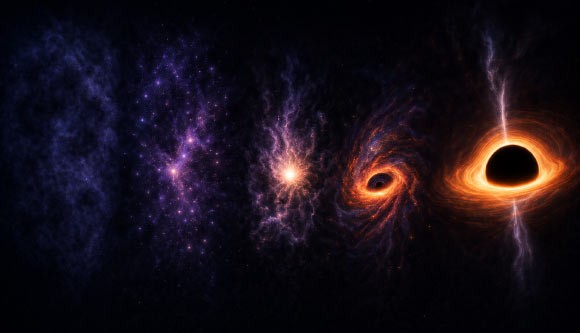
Recent astronomical research suggests that the mysterious substance known as dark matter may have played a pivotal role in the early formation of the universe. A new study indicates that the decay of dark matter particles could have acted as a catalyst, triggering the rapid collapse of gas clouds to form the first supermassive black holes much earlier than previously thought possible.
The Cosmic Mystery: A Gap in the Timeline
For years, astronomers have faced a significant theoretical puzzle: how did supermassive black holes become so large so quickly? Current cosmological models struggle to explain how these giants could exist in the early universe, as the standard process of star formation and gradual accretion usually takes much longer than the timeline observed by modern telescopes.
However, data from the James Webb Space Telescope (JWST) has been revealing more of these massive black holes in the very early stages of the universe, creating a “gap” between what our theories predict and what we actually see through our lenses.
The Mechanism: Energy Injection at an Atomic Scale
The study, conducted by researchers from the University of California, Riverside, Sam Houston State University, and the University of Oklahoma, proposes a solution involving decaying dark matter.
While dark matter makes up roughly 85% of the matter in the universe, its exact nature remains unknown. The researchers modeled a scenario where dark matter particles—specifically candidates like axions —slowly decay, leaking minuscule amounts of energy into surrounding primordial gas clouds.
Key aspects of this mechanism include:
– Extreme Sensitivity: The first galaxies were composed of pristine hydrogen gas, which is incredibly sensitive to even the smallest changes in energy.
– Microscopic Impact, Macroscopic Results: The amount of energy released by a single decaying particle is infinitesimal—roughly a billion trillionth the energy of a single AA battery.
– Supercharging Collapse: Despite the tiny scale of individual energy injections, when applied across vast gas clouds, this energy can alter the thermo-chemical dynamics, “supercharging” the rate at which gas collapses directly into black holes.
Finding the “Sweet Spot”
By modeling these dynamics, the team identified a specific “window” of dark matter masses—between 24 and 27 electronvolts —that could create the ideal conditions for this direct collapse.
This finding suggests that the presence of dark matter isn’t just a backdrop for galactic evolution; it may be an active driver of it. Dr. Flip Tanedo of UC Riverside noted that the supermassive black holes we observe today might actually serve as a “signature” or a natural detector for the properties of dark matter.
The Power of Interdisciplinary Science
The breakthrough was not merely a result of mathematical modeling, but of cross-disciplinary collaboration. The research emerged from workshops that brought together particle physicists, cosmologists, and astrophysicists. By bridging these fields, the scientists were able to connect the microscopic behavior of subatomic particles with the macroscopic evolution of the entire universe.
“The right dark matter environment can help make the ‘coincidence’ of direct collapse black holes much more likely,” the researchers noted, suggesting that what once looked like astronomical anomalies may actually be predictable results of dark matter’s influence.
Conclusion
By proposing that decaying dark matter provides the energy necessary to jump-start early black hole formation, this research offers a potential bridge between existing cosmological theories and the surprising observations made by the James Webb Space Telescope.