


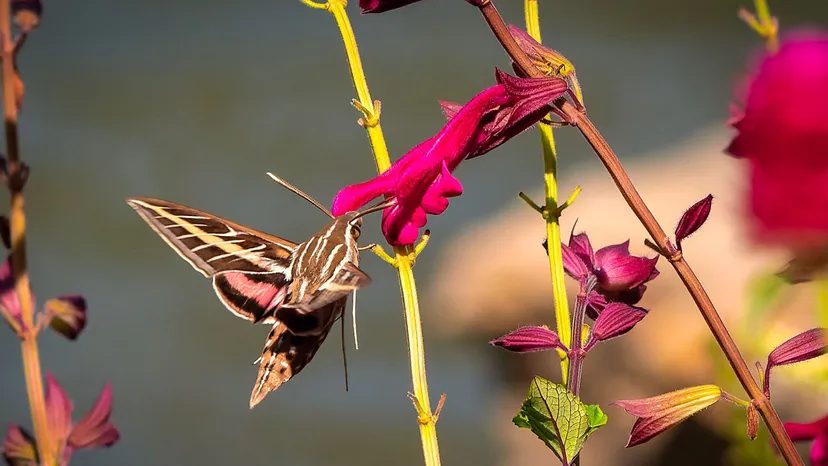
Some moths are masters of invisibility. They blend into bark or leaves, vanishing against the background. Others? They dress boldly. These species aren’t shy about showing off. Their bright hues serve real survival purposes. Let’s look at some of the most stunning examples.
1. Rosy Maple Moth (Dryocampa rubicunda)
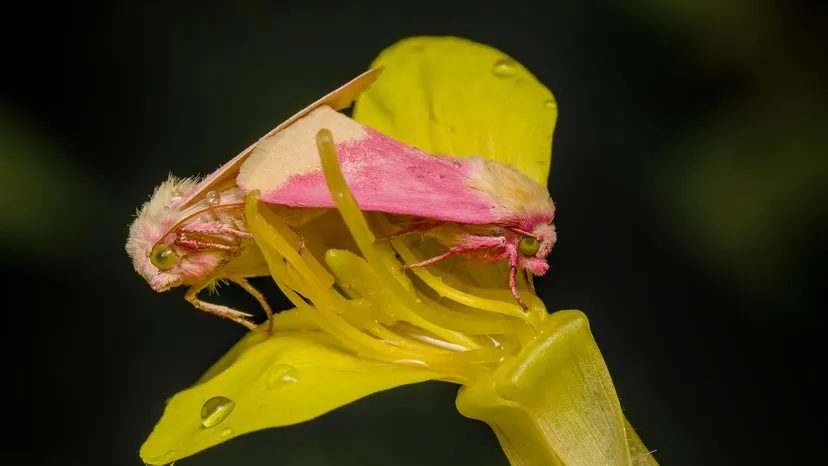

Not every creature wearing high-visibility colors is packing a venomous punch. Take the Garden Tiger Moth, scientifically known as Arctia caja. At first glance, it looks like a mistake made by nature’s artist palette—a fuzzy orb of pink and yellow that resembles a piece of bubblegum granted the gift of flight.
But appearances can be deceiving. This isn’t just a pretty face. It’s a sophisticated defense mechanism playing out in real-time.
Where They Hide and What They Eat
You won’t find these fluffballs just anywhere. They stick to the deciduous forests of eastern North America. Specifically, they hang out on trees. Maples are their favorite host, providing both a resting spot and the eventual food source for their young. Oaks show up on the menu occasionally, but if you’re looking for them, start with the maples.
Adults tend to rest on the bark, blending into the shadows despite their vibrant coloration. It’s a paradox: bright enough to stand out, yet they rely on the forest structure to stay hidden from the casual observer.
The Green Camouflage of Youth
Before they transform into these bold, warning-colored adults, the Garden Tiger Moth starts life as a pale green caterpillar. This color serves a different purpose than its adult counterpart’s bright hues. In the early stages, blending in is the only way to survive. The pale green allows the larvae to vanish among leaves and stems, avoiding detection by birds and other visual hunters.
Mimicry Over Toxicity
Here’s the twist. The bright colors of the adult moth—those striking pinks and yellows—are not a signal that it is poisonous. It is not toxic. Instead, it is a master of mimicry.
The vivid hues mimic species that are poisonous or dangerous. Predators learn quickly to avoid brightly colored insects because, in the wild, bright colors often equal bad taste or toxicity. The Garden Tiger Moth exploits this learned behavior. It gains protection not by producing its own poison, but by borrowing the reputation of others.
Why It Matters
This distinction between actual toxicity and mimicry is critical in understanding ecosystem dynamics. If you assume all bright insects are poisonous, you overlook the complexity of evolutionary strategies at play. The Garden Tiger Moth survives by tricking predators, not by fighting them. It’s a survival strategy built on deception, one that has evolved to keep populations stable in a competitive environment.
So, the next time you see a pink-and-yellow fluffball resting on a maple tree, remember: it’s not dangerous. It’s just really good at looking like it is.
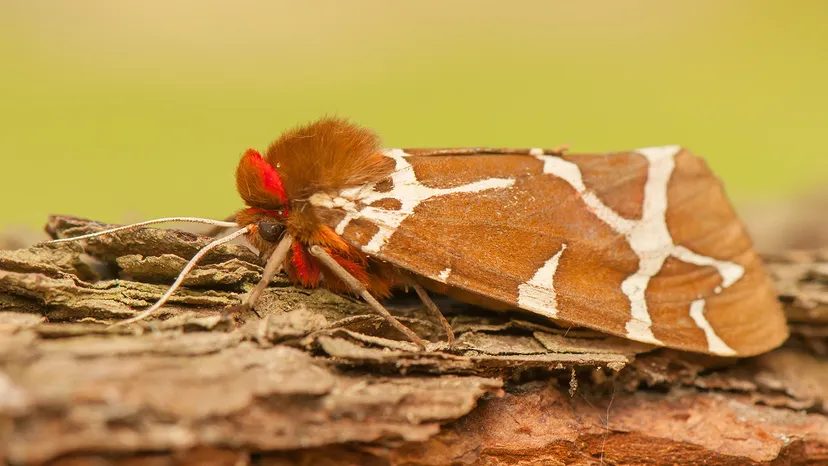
This pop of red is more than just a decoration. It was a desperate, high-stakes bluff. Many European moths rely on fleeting visual tricks rarely seen by predators to survive.
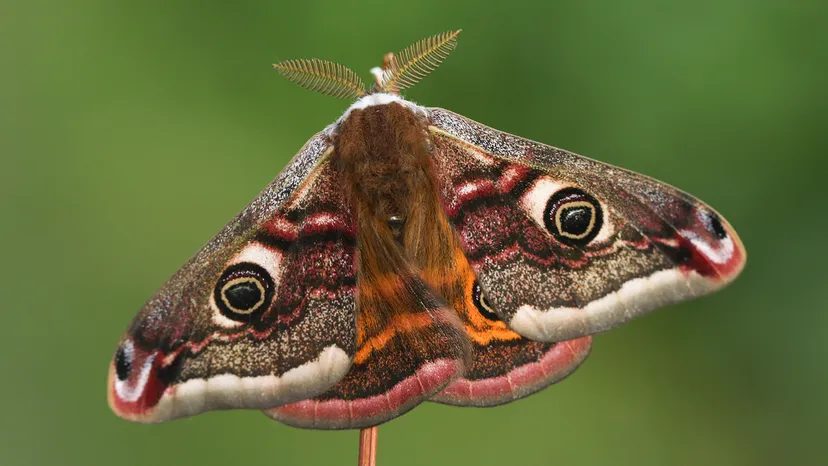
Consider a species often lumped together with the Emperor Moth when talking about local fauna. Saturnia pavonia is best known for its camouflaged brown wings and “eye-like” markings designed to blend into tree bark, but other closely related species in the same subfamily take a different approach.
The Strategy of the Flashing Red Hindwings
Some moths of the Arctiinae subfamily rely on startling displays rather than camouflage. When it takes off, its hidden hindwings are exposed.
In this case, the wings are shockingly bright red.
The biological principle is simple, but effective.
– Predator Puzzle: Birds and bats hunt by sight and sound. The sudden appearance of bright colors can be distracting.
– “Flash” effect: When the moth rests, the red color is usually hidden. It only happens during movement.
– Evolutionary Link: These moths are closely related to the Saturniidae family, but have evolved unique defense mechanisms.
Why Red?
Why red? In the animal kingdom, bright colors often signal toxicity. Even if the moth is not poisonous, the red acts as a mimicry of dangerous species.
“A sudden flash of color can cause a predator to hesitate. That hesitation is the difference between a meal and a missed opportunity.”
这种策略之所以有效,是因为掠食者学得很快。 如果一只鸟试图吃一只鲜红色的飞蛾,却尝到了不好的味道,它会记住。 如果飞蛾无害但看起来很危险,鸟儿就会学会在未来避免类似的模式。
Emperor Moth vs. Red Flasher
It is important to distinguish between these species. Saturnia pavonia (Saturnia pavonia ) is a master of hiding. Its wings look like dead leaves or bark. It relies on remaining undetected.
The moth with the red hindwings rely on being seen, but only when fleeing.
Both strategies have the same goal: survival.
One stays still. The other runs.
Which is more effective depends on the predator. Bats cannot be fooled by colors. However, birds have excellent visual abilities.
The red flash is a gamble. It requires speed. It requires precision.
It requires the predator to be in the right place at the wrong time.
In most cases, the moth will land safely. Red disappears. The cycle starts again.
But what happens when a predator learns this trick?
Do moths change to new colors? Or is it just closer to the ground?
The answer is still written in the air.
Hummingbird moth (Hemaris spp.)
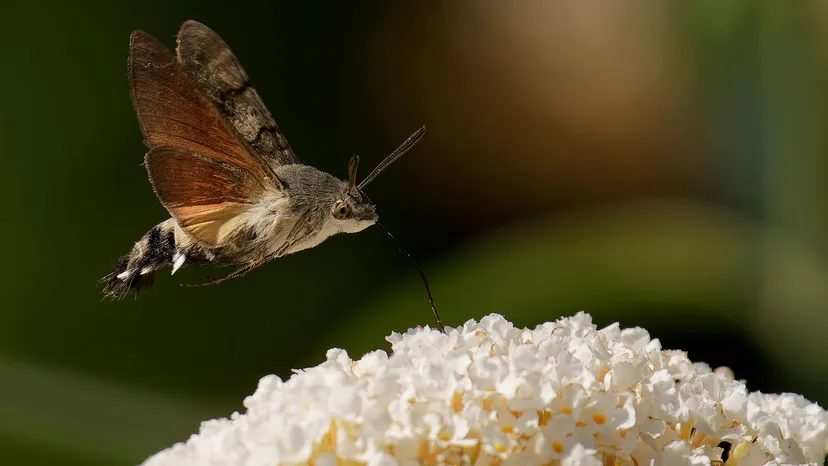
Look closely for blur of wings near the flowers. Is that a hummingbird? Probably not. It is most likely a member of the Hemaris genus, commonly known as the hummingbird moth. These large-winged insects have learned the art of mimicry and confuse pollinators and predators with their fast, silent flight and hovering behavior.
Unlike the heavy moth species mentioned above, Hemaris moths are diurnal, meaning they are active during the day. Because of this, they are often mistaken for birds. Females are usually slightly larger than males, and both have distinctive wing patterns, often a transparent or semi-transparent patches in the center of the forewings. This “glass” effect helps them blend in with the dappled light around them when feeding.
The larvae of these moths are just as specialized as the adults. They typically eat plants of the honeysuckle family, such as honeysuckle, linden and various shrubs. This specialized diet is key to their survival as it provides the nutrients necessary for pupation stage before the adults emerge.
If you want to spot one, go to gardens and forests where they are abundant. During peak summer they can be seen all day, but late afternoon or early evening are the best times. Their presence is a good indicator of a healthy, plant-rich ecosystem.
“They hover like birds, but fly like moths.”
Why is this important? Because Hemaris moths are efficient pollinators. They reach deep into tubular flowers where other insects cannot, ensuring the reproduction of plants such as honeysuckle and phlox. Without them, these gardens would lose an important link in the pollination chain.
Are there other moths that mimic birds? Yes, but Hemaris species are among the most convincing. Their flight pattern is unique, combining the speed of a bee with the hovering ability of a hummingbird. This adaptation allows them to exploit a niche that few other moths can.
The next time you see a hummingbird-sized creature darting around your garden, stop and watch. The way it moves, the sounds it makes, the pattern of its wings, it might be a moth. And that is a good thing.
Madagascar sunset moth (Chrysiridia rhipheus)
It’s easy to assume you’ve come across a hummingbird. You hear a hum. You see floating. The creature flies between honeysuckle and wildflowers, sipping nectar with the same frenzied energy as its cousin the bird.
Then you see the wings.
Transparent. They strike so fast that they produce a distinct humming sound. But it’s not a bird. It’s a moth. And unlike its nocturnal relatives, this moth travels in broad daylight and feeds when the sun is high.
Chrysiridia rhipheus
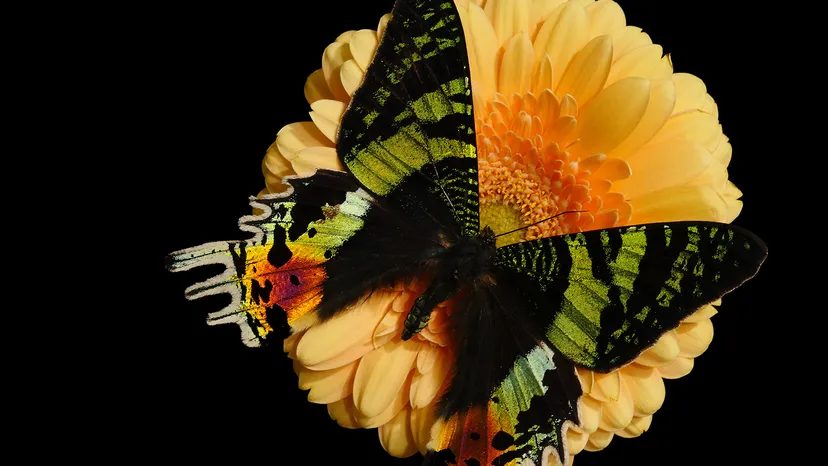
If that’s not weird enough, take a closer look at the color. The Madagascar sunset moth doesn’t just look like a hummingbird. It also behaves like that. But its real claim to fame lies in its wings, which are so vividly colored that they almost look artificial.
Why does it look like that? The answer is not in the pigment. The scales do not contain blue or green chemicals. Instead, colors arise from structure. The microscopic ridges on the wings interfere with light waves and reflect certain wavelengths, producing colorful shades of blue, green and purple. It’s a biological trick of physics, not chemistry.
“Colors are structural, meaning they change depending on the light and viewing angle.”
This structural color makes it one of the most visually striking insects on earth. The native species originate from Madagascar, an island with one of the highest levels of endemism in the world. That means you won’t find it anywhere else.
How does it fare in such a specific niche? Daytime activity helps avoid many bats that feed at night. The glowing wings could act as a warning signal, or perhaps just a way to stand out in the dappled light of the forest. Scientists still debate the exact evolutionary driver.
We know for sure that the Madagascar sunset moth defies easy categorization. It is a day-flying moth. It floats like a bird. It shines with colors that are not in nature’s color palette.
It’s a reminder that evolution doesn’t always follow the rules we expect. Sometimes it borrows from the birds. Sometimes it plays with light. Sometimes it just creates something so beautiful that you have to stop and stare.
And stare you do.
Madagascar’s moths exceed expectations
Most moths are inconspicuous, dusty members of the butterfly world. They hide in the shadows, camouflaged in brown and gray, waiting for dusk. This one doesn’t do shadows. It wears iridescent that are green, blue and orange and changes as he moves. It looks like it was drawn by someone who is overconfident and doesn’t fully understand vulnerability.
It belongs to the Uraniidae family. Living in the lush and isolated ecosystems of Madagascar, these moths are structural marvels. Color is not paint. This is physics. Light is refracted through the fine scales of the wings, creating a metallic sheen. For this reason, it is comparable to any butterfly in terms of color.
But don’t let the beauty fool you. They are strong fliers. They do not fly weakly from flower to flower. They cut the air on purpose.
Their strength is related to their diet. The larval stage depends on poisonous plants. Toxins don’t kill them. They store them. This is a defense mechanism. Predators quickly learn that these bright colors mean bad news. Worse, poison.
We used a combination of artificial intelligence technology to create this article, which has been reviewed and edited by HowStuffWorks editors.
Why This Matters
You might wonder why we care about a moth. It’s small. It’s far away.
这很重要,因为它提醒我们,自然并不遵循我们的分类。 我们把东西放在盒子里。 飞蛾是迟钝的。 蝴蝶是明亮的。 这只飞蛾打破了盒子。 它表明进化可以在同一个包装中产生美丽和毒性。 这提醒我们,在马达加斯加,或许还有其他地方,规则仍然是由生活本身制定的。
我们并不了解这些飞蛾的一切。 我们知道它们飞得很强。 我们知道他们吃毒药。 我们知道它们看起来像珠宝。 其余部分仍在展开。


