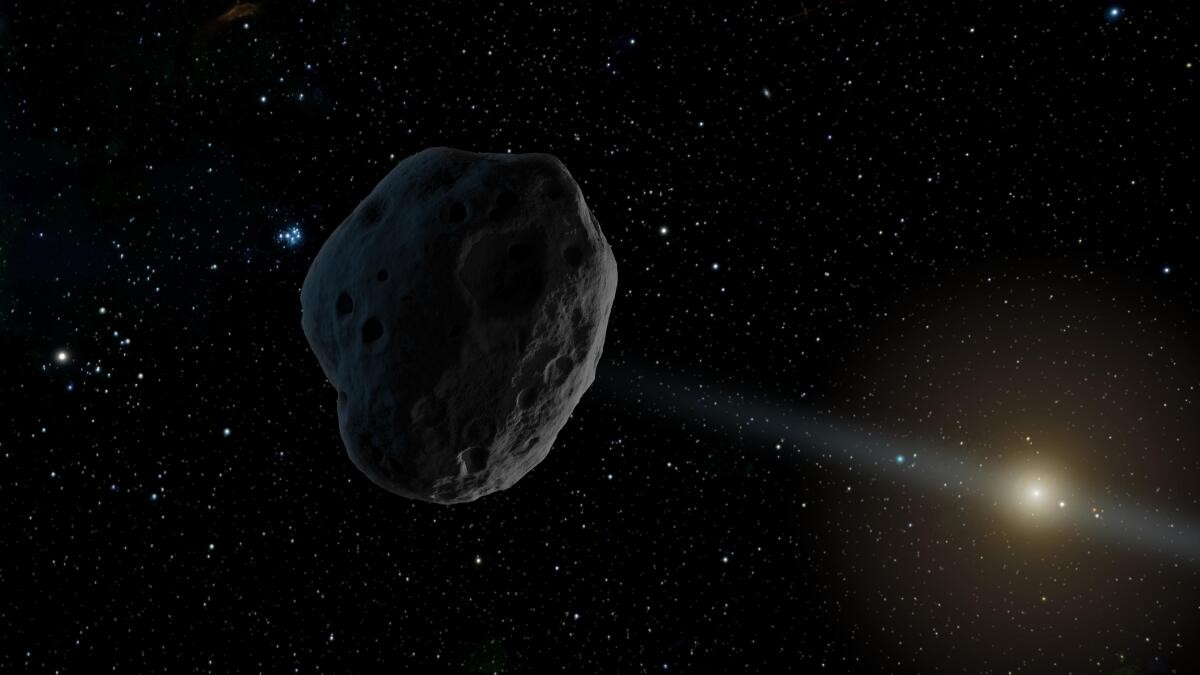
It hid in plain sight. For almost 30 years, astronomers tracked a rock about 1,250 feet across. They thought it was just another asteroid.
It looked like one. It moved like one. Telescopes saw no tail. No glowing cloud of gas or dust sweeping behind it. Just a silent, dark shape drifting through the inner solar system.
Then the math broke.
Object 1998 SH2 started drifting off its predicted path. Gravity alone couldn’t explain it. Something was pushing it. A tiny nudge. A subtle kick. Astronomers scratched their heads. They recalculated orbits. They looked for invisible masses. Nothing.
Until they realized the rock itself was the engine.
Gas was escaping its surface. Faintly. Quietly. The same outgassing process that powers a bright comet. But 1998 SH 2? It was a “dark comet” in disguise.
The evidence was always there
You might ask how they caught it.
When NASA-led researchers pointed their most powerful telescopes at the object, the mask slipped. They found it. A barely visible cloud. A wispy tail so faint it’s easily missed. The object had given up its secret under pressure. It wasn’t an asteroid. It was a weakly active snowball.
This isn’t just about renaming a space rock.
It’s about a definition that might be broken.
For generations, the line was clear. Asteroids looked bare. Rocky. Dead. Comets? They glowed. Ice turned to gas near the sun, creating tails. You knew which was which.
1998 SH2 says that’s not enough.
Some comets are so inactive. So faint. They masquerade as asteroids. If this object is one of many, the solar system is full of hidden comets. Astronomers might be undercounting them by a massive margin.
“Asteroids and comets are classically differentiate based on their orbits… However… a continuum of hybrid objects has become more apparent.”
From appearance to action
Some researchers are arguing it’s time to change how we classify these objects. Stop looking at what they look like. Start looking at what they do.
The study subject—now designated Comet P/1998 SH 2 —is the first case where motion, not visuals, predicted the activity.
The object made a “close” approach in August 2025. Still 2 million miles from Earth. Too far to worry about, but close enough to study.
Davide Farnocchia, the NASA navigation engineer leading the study, put it clearly: the escaping gas acted like a thruster. It propelled the body. It nudged the trajectory. That change gave it away.
Telescopes in Hawaii and Chile confirmed the suspicion. The clues were subtle. Easily missed. That’s why the misidentification lasted decades.
Why the label matters
Why does this distinction matter?
If an object threatens Earth, we might want to deflect it. But asteroids and comets respond differently to deflection attempts. You need to know what you’re dealing with. Understanding the true nature of these objects is critical for planetary defense.
The authors warned that if potentially hazardous asteroids turn out to be comets, the relative impact risk from comets could increase. We can’t defend against what we don’t recognize.
A clue for ‘Oumuamua?
This discovery sheds light on other mysteries.
Remember 1I/’Oumuamua? The interstellar visitor that swept through our solar system in 201? It accelerated slightly. But it showed no tail. No obvious outgassing.
It puzzled everyone.
Local comet 1998 SH2 suggests the answer. An object can release enough gas to alter its motion while remaining nearly invisible. It doesn’t need a blazing tail to prove it’s active.
“The possibility that a number of potentially hazardous objects… could turn out to be comets,” the authors wrote.
Since 2016, only a dozen or so “dark comets” have been designated. This number might be low.
Farnocchia stressed the importance of continuous tracking. Because the next hidden comet isn’t waiting to be seen. It’s moving. Pushing. Waiting to break the models.