We have known about planets outside our solar system for decades. The count is now over 6,000. Moons? Those have remained ghost stories. We suspect they exist. Logic dictates they must. We have never actually seen one.
Not until now. And maybe not even then.
Astronomers using the Very Large Telescope (VLT) found a candidate in the CD-35 2272 system. It is roughly 73 light-years away. It orbits a brown dwarf, not a planet. This complicates things. A lot.
The object might be the first confirmed exomoon. Or it might break our definitions entirely.
A failed star with a companion
CD-35 227 is a small star. It has about half the mass of our sun. Orbiting it is a brown dwarf. Think of these as “failed stars.” They start forming like suns. They fail to ignite hydrogen fusion. They sit in a gray zone.
Too big to be a planet. Too small to be a true star.
Usually 13 to 80 times heavier than Jupiter.
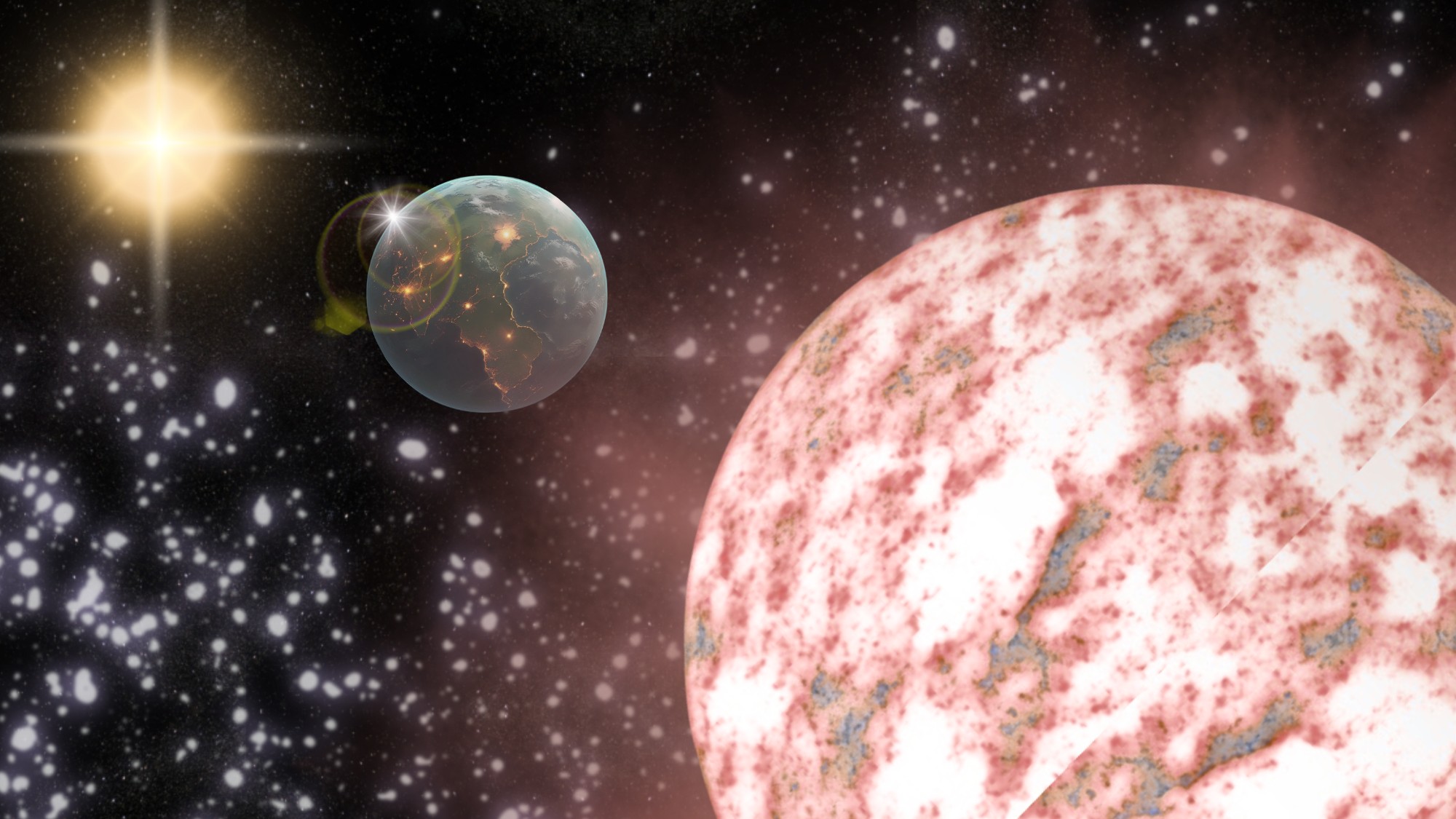
The new discovery orbits this brown dwarf. It is massive. It is gaseous. It looks like a planet. But it isn’t orbiting a star. It orbits something that orbits a star.
“Being the third wheel in this system makes you want to call it a moon.”
Kevin Hoy led the research. He works with the Universidad Diego Portales in Chile. The study dropped July 22 in the journal Nature.
Why the terminology matters
In our solar system, the rules are clear. Jupiter is a planet. Io is a moon. Io orbits Jupiter. Jupiter orbits the sun. Simple.
This system refuses to be simple.
Alice Zurlo, another team member, puts it bluntly. We are blurring the lines. Brown dwarfs, planets, moons. They merge. Defining a moon requires a rigid framework. We do not have that here.
The object is large enough to be classified as a planet on its own merits. It lacks the mass to be a star. Yet, it is tied to the brown dwarf’s gravity. It is a satellite. But is it a moon?
If you define a moon by what it orbits, this is a moon. If you define it by its own physical properties, it is a sub-stellar object.
The “exosatellite” compromise
The team avoids the term exomoon in the paper. They use exosatellite instead.
This is a safer bet. An exosatellite is simply a body orbiting another body in another solar system. It bypasses the semantic minefield.
It acknowledges the detection without forcing a classification that doesn’t fit.
This is still a first. First detection of an exosatellite that isn’t a standard moon. First time we’ve seen such a tight, complex gravitational dance outside our backyard.
Does it matter if we call it a moon?
The science works either way. We are seeing these structures. We are learning they are weirder than we thought. We might need to rewrite the textbook. Or just shrug and accept the chaos.
The object remains. The definitions shift. We keep looking.