Liquid turns to solid. Lava cools into rock. Water freezes into ice. The physics are straightforward. The applications are not.
Take optical fiber. We heat glass preforms until they melt. Then we draw them into strands thinner than a human hair. Light rides inside, zipping across continents at breakneck speed. It’s the backbone of telecommunications. It’s also used in lasers, endoscopes, and sensors. Hollow-core fibers can even hold gases. They act as tiny chemistry labs.
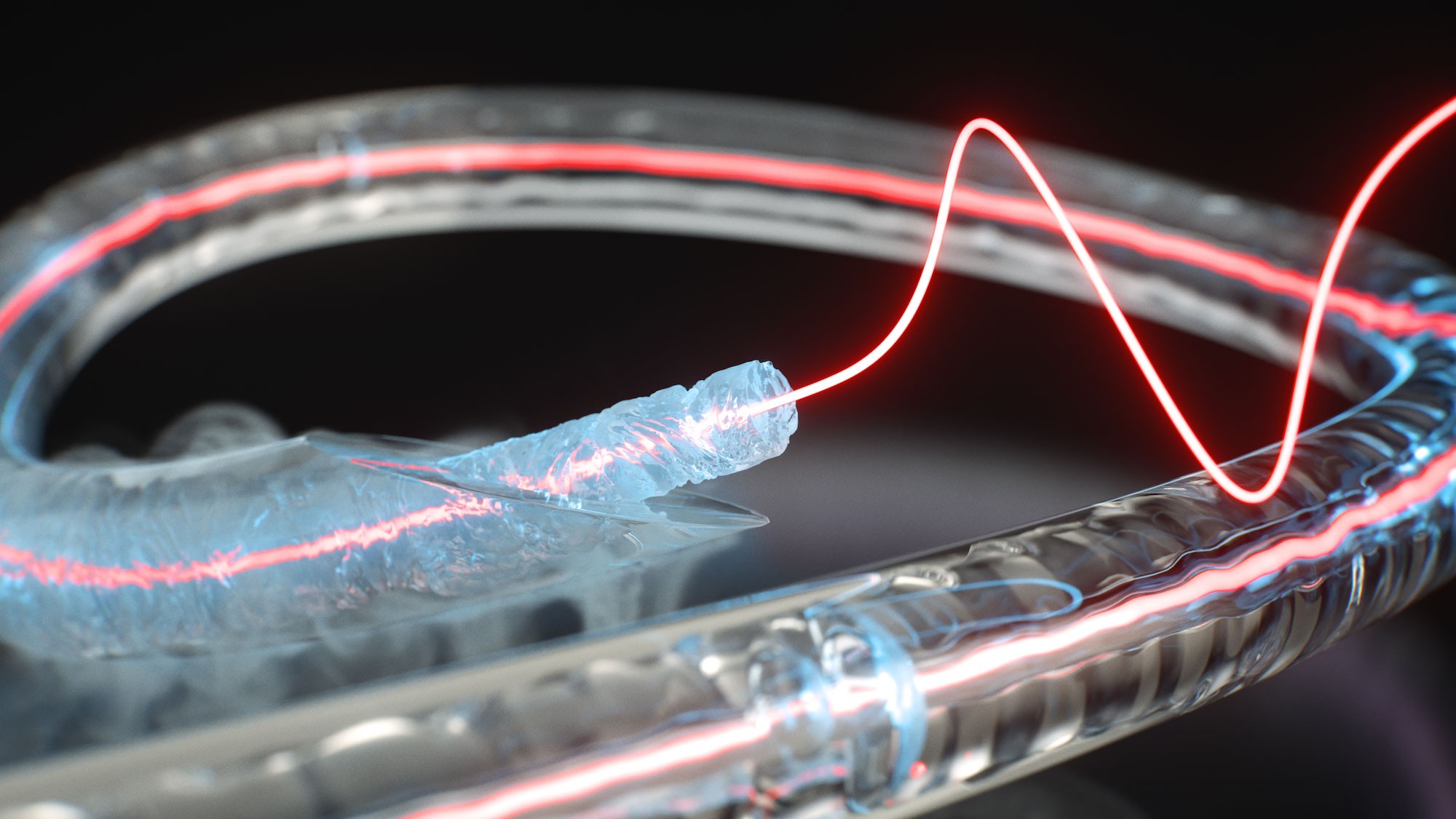
But researchers at the Max Planck Institute of the Science in Light (MPL), Leibniz University Hannover, and the Leibniz Institute for Photonics Technologies (IPHT) decided to take a colder approach. They didn’t just draw the glass. They froze it. And in doing so, they unlocked a new way to store light using frozen-core optical fiber.
The Science Behind Freezing Liquid Cores
The team took liquid-core optical fibers (LiCOF). They plunged them into nitrogen at -196°C. The goal was simple in theory: solidify the core without losing the fiber’s function.
It worked.
“The key point is that the frozen section of the LiCOB retains its ability to guide light,” explains Simon Seiderer. He’s a researcher in Prof. Dr. Birgit Stiller’s “Quantum Optoacoustics” group. Stiller leads the project.
But here is where it gets weird. The fiber didn’t just guide light. Both the liquid and the frozen sections began guiding hypersonic sound waves.
Light moves fast. Sound moves slow. In standard fibers, they barely notice each other. In this frozen LiCOF, they dance together. Intimately.
Why Brillouin Scattering Matters Here
This interaction is driven by Brillouin-Mandelstam scattering*. It’s the same effect found in conventional fibers. But usually, it’s weak. Here? It’s explosive.
Freezing the liquid core created a dense, confined environment. The result? Optoacoustic coupling increased by more than 1,000 times compared to standard fibers.
Think of it as a physical trap for information.
Because light travels faster than sound, data can be dumped from a light wave into a slower sound wave. It sits there. Temporarily stored. Then, it’s converted back into light when needed.
This is optoacoustic memory. And it is essential for photonic neuromorphic computing.
A New Platform for Quantum and AI Hardware
Neuromorphic computing mimics the human brain. It needs to process and store information simultaneously. Current hardware struggles with energy efficiency. Photonic systems offer a solution, but only if the components are small and powerful.
The frozen LiCOF delivers exactly that.
“By freezing the liquid core, we created an entirely new physical platform,” says Stiller. “It provides extreme nonlinearities while remaining easy to handle.”
The implications stretch beyond just memory.
The strong light-sound coupling opens doors to:
- Neuromorphic computing: Brain-like processors that run on light.
- Quantum information processing: Secure, high-speed data transfer.
- Microwave photonics: Better signal processing for 6G and beyond.
- High-precision sensing: Detecting changes too small for current tech to see.
“This level of light-sound coupling… opens up exciting new possibilities,” says Stiller. Not just for memory. But for the entire stack of future technologies.
The Road to Optimization
This research didn’t happen in a vacuum. It built on collaboration with Prof. Markus Schmidt and Prof Mario Chemnitz at IPHT Jena. They pioneered liquid-core fiber work. Freezing added a new variable. One that boosted nonlinear effects significantly.
The findings were published in Optica. The title: “Giant Brillouin gain in frozen CS 2 capillaries.”
Published July 19, 2026.
The work was funded by the European Research Council, the Deutsche Forschungsgemeinschaft, and the Max Planck Society. Funding details aren’t the headline. The physics are.
We used to think of fiber as just a pipe for light. A transparent highway. This study suggests it can also be a memory bank. A processor. A sensor.
Does the future of computing look like a block of ice?
Maybe.
The technology is still young. Scaling this up from lab bench to data center will require more work. The energy savings alone promise a shift in how we power data centers. But the question remains: Can we reliably keep these cores frozen at scale?
Or is this just a brilliant proof-of-concept that will be forgotten when better materials arrive?
The science is solid. The rest is up to the engineers.