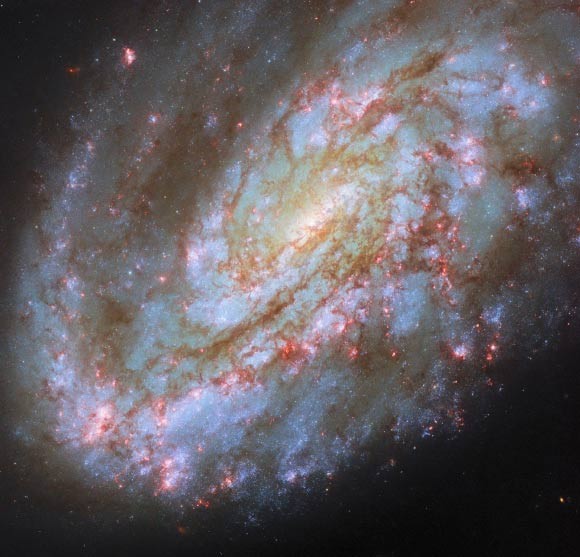
Look at NGC 4654.
It is lopsided. Distorted. A cosmic accident captured in high resolution.
The NASA/ESA Hubble Space Telescope didn’t just snap a picture; it caught a galaxy mid-crash. Not a literal collision, but something violent enough to stretch the laws of physics like taffy. This intermediate spiral galaxy sits 55 million light-years away. It lives in Virgo.
And it has been through hell.
How ram-pressure stripped the galaxy
NGC 4654 isn’t just a pretty face. It is a textbook case of environmental abuse in deep space. Specifically, it’s suffering from ram-pressure stripping.
Here is the mechanic: The Virgo Cluster is a massive supergroup of up to 2,001 galaxies. Between them? A hot, thin gas. The intracluster medium.
When a galaxy moves fast enough through this medium, it hits the gas like a hand out of a car window. But at 55 million light-years’ worth of gravity-driven speed? It is less like a hand and more like a bulldozer.
“NGC 4654 moves with so much velocity that it sweeps up and rams into the hot gas.”
The result? The pressure compresses the front. It drags the gas back. It creates a tail. A long, trailing wake of hydrogen stretching out behind the galaxy. The leading edge is round, tight, and defined. The opposite side is messy. The gas trail is so long it actually extends beyond the frame of this specific Hubble image.
Was it a ghost or a ghost-buster?
You might think ram pressure is the only culprit.
You would be wrong.
If it were just the gas, NGC 4654 might look asymmetrical, sure. But the distribution of its stars? That tells a darker story. The spiral arm on the leading edge is packed with matter. The opposite arm? Starved. Bare.
This shape is unusual for spirals. Why?
Because NGC 4654 also had a run-in with a neighbor. Specifically, another Virgo Cluster member named NGC 4639.
The two galaxies are far apart now. But roughly 500 million years ago, they passed each other. Close. Dangerously close. The gravitational pull from that fly-by didn’t just nudge the gas; it ripped it away. One side. All of it.
This tidal interaction limited star formation on that stripped side. It carved out the void you see today. So, what we see is a double whammy: a gravitational rip followed by a gas bath.
Star formation keeps going (barely)
Logic says that if you strip a galaxy of its gas—the fuel for stars—the lights should go out.
Most galaxies undergoing ram-pressure stripping see their star formation rates drop like a stone. They get quiescent. Boring.
NGC 4654 refused.
It still births two suns worth of new stars every year. That is not insignificant. It is comparable to other galaxies of its size. The galaxy is still hungry.
This active birth is visible in the data. Hubble picked up red light emissions. Specifically, energized gas clouds. And in those clouds? Pink bubbles. Bright, glowing clusters where newborn stars are just waking up.
You can see them across the forward spiral arm. Around the weak central bar. Out to the disk’s edge.
The galaxy is damaged. It is twisted by forces invisible to the naked eye but devastatingly powerful in aggregate. And yet, it is still making stars.
Why do galaxies keep trying when the universe keeps pulling them apart?
Maybe it is just stubbornness. Maybe it is gravity. Maybe it is that even in the vacuum between clusters, matter insists on becoming something else.
The tail stretches out. The stars burn pink. The galaxy keeps rotating, unevenly, imperfectly, alive.