


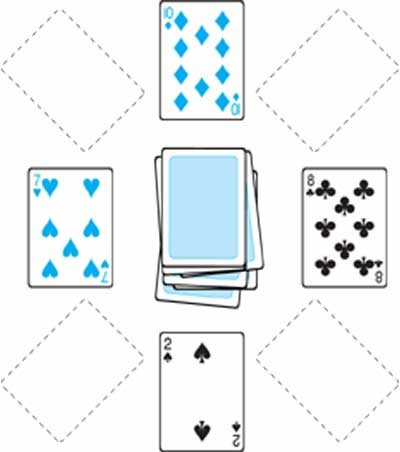
It looks like a solo activity. You see four piles. You see cards. You think you’re just building up, like in Solitaire. But you aren’t alone.
Kings in the Corner is a multiplayer card game. It tricks you. It feels like everyone is playing their own private game. There isn’t.
There is one winner. Everyone else loses.
The setup is simple. You need a standard 52-card deck. That’s it. No special cards. No wild jokers. Just one deck. You also need some way to keep score. Pennies work. Poker chips work. Whatever you have lying around.
How to start
The game works best with four players. It can handle two to six. Six gets messy. Two is lonely. Four is the sweet spot.
Deal seven cards to each person. That’s a lot of cards to hold. It creates pressure. You have to decide what to discard early.
Then look at the table. Turn over four cards. Place them face up. These are your starting piles.
One king goes in each corner.
If the first card turned isn’t a king, don’t panic. The game still works. You just start with whatever is there. The king goes in the corner space. It anchors the pile.
Place the rest of the deck face down in the middle. This is your draw pile.
“It feels like everybody’s playing a single solitaire game — but there is only one winner.”
Now you’re ready. Pick up your hand. Look at the four cards on the table. Think about who might block you.
The goal is simple. Go out. Play all your cards. Be the last one holding cards when the game ends.
Why do people play this? It’s fast. A game takes twenty minutes. It’s snappy. You can play it in a bar. You can play it at a dinner party. You don’t need a table. You don’t need much space.
But it’s also ruthless.
Watch your opponents. They aren’t helping you. They’re waiting for you to make a mistake.
Deal the cards. Flip the kings. Start playing.
The corner is set.
The four corners of the board aren’t just empty space. They’re reserved. Specifically, they’re the final resting places for the four kings. Until a king lands there, the game is far from over.
Play starts with the person sitting to the dealer’s left. From there, the action moves clockwise around the table. You don’t have to play every turn. But if you skip? You pay a chip into the pool. It’s a simple penalty for passivity. If you do make a move, you can play as many cards as you want. Just make sure the sequence is valid. Once your turn ends—whether you played cards or not—you must draw a new card. There is only one exception to this rule: if you go out, the game ends. You stop drawing. You stop playing. You win.
The Basic Vocabulary
Before you dive into the mechanics, you need to speak the language. The rules rely on a few specific terms that define the flow of the game.
- Deal : This is both the act of handing out cards and the period of play between one deal and the next. It’s the heartbeat of the session.
- Draw : To take a new card from the deck. Simple.
- Lay off : To play one or more cards onto the existing piles.
For a complete listing of card terminology, click here.
Valid Moves: The Rules of Engagement
The game is built on strict hierarchy and color alternation. You aren’t just throwing cards anywhere. Every move must follow one of three specific rules.
- Place a King in a Corner : As mentioned, the corners are king-sized slots. If you have a king, put it in a corner. It’s the only way to clear those spaces.
- Alternate Rank and Color : You can place a card on top of another pile if it is one rank lower and of the opposite color. Think of it as a zigzag pattern. Red on black, black on red. The ace is the lowest card, so it sits at the bottom of any sequence.
- Move Entire Piles : This is where strategy gets interesting. You can move an entire stack of laid-off cards onto another pile. The catch? The bottom card of the moving stack must be one rank lower and of the opposite color compared to the card it’s landing on.
This move doesn’t just happen during your turn. Sometimes, the initial deal itself triggers a move. If the cards are dealt in such a way that a lower, opposite-colored card sits beneath a higher one, you can move the whole stack immediately.
For example, in the layout shown, the first player can move the…
A king dealt to the layout can be moved into the corner by the first player. If you play your last card during your turn, you win.
Playing any card onto a layoff space that has become empty during play is also a valid move. These specific mechanics define the flow of Kings in the Corner, a game that balances solitaire-like patience with cutthroat competition.
Scoring and Penalties
The endgame matters just as much as the opening deal. Losers pay 10 chips for each king they hold at the finish line. Every other card costs one chip. The winner collects all the chips.
If paper scoring suits you better, omit the penalty chips paid for passes. This simplifies the math but keeps the stakes real. You are still trying to get rid of those high-value kings before the final hand.
Strategy Tips
Having several plays available in a single turn creates a tactical dilemma. It may be wise to save some plays for a later round.
First, saving a move might spare you from paying a chip to the pool. That single chip adds up over multiple hands.
Second, holding back a card can disrupt your opponents. By keeping a card in your hand, you may prevent the next players from making plays they might otherwise make. It is a small act of sabotage that pays off.
Frequently Asked Questions
What do you need to play Kings in the Corner?
You need one standard 52-card deck. Add a supply of pennies or chips for betting. That is the only equipment required for a full session.
How do you win Kings in the Corner?
The game feels like everybody is playing a single solitaire game. Only one winner exists. The objective is to go out by playing off all your cards. Empty your hand. Empty the competition.
How many cards do you start with?
Deal each player seven cards. Then turn four cards face up to start layoff piles. This initial setup dictates your early options.
Do you have to play a card in Kings in the Corner?
Not necessarily every turn, but passing has a cost. Playing a king in a corner is one of the valid moves you can execute. It is often the best way to clear the board.
What else is required?
Repeat the equipment check. One deck. Some tokens. No more.


