


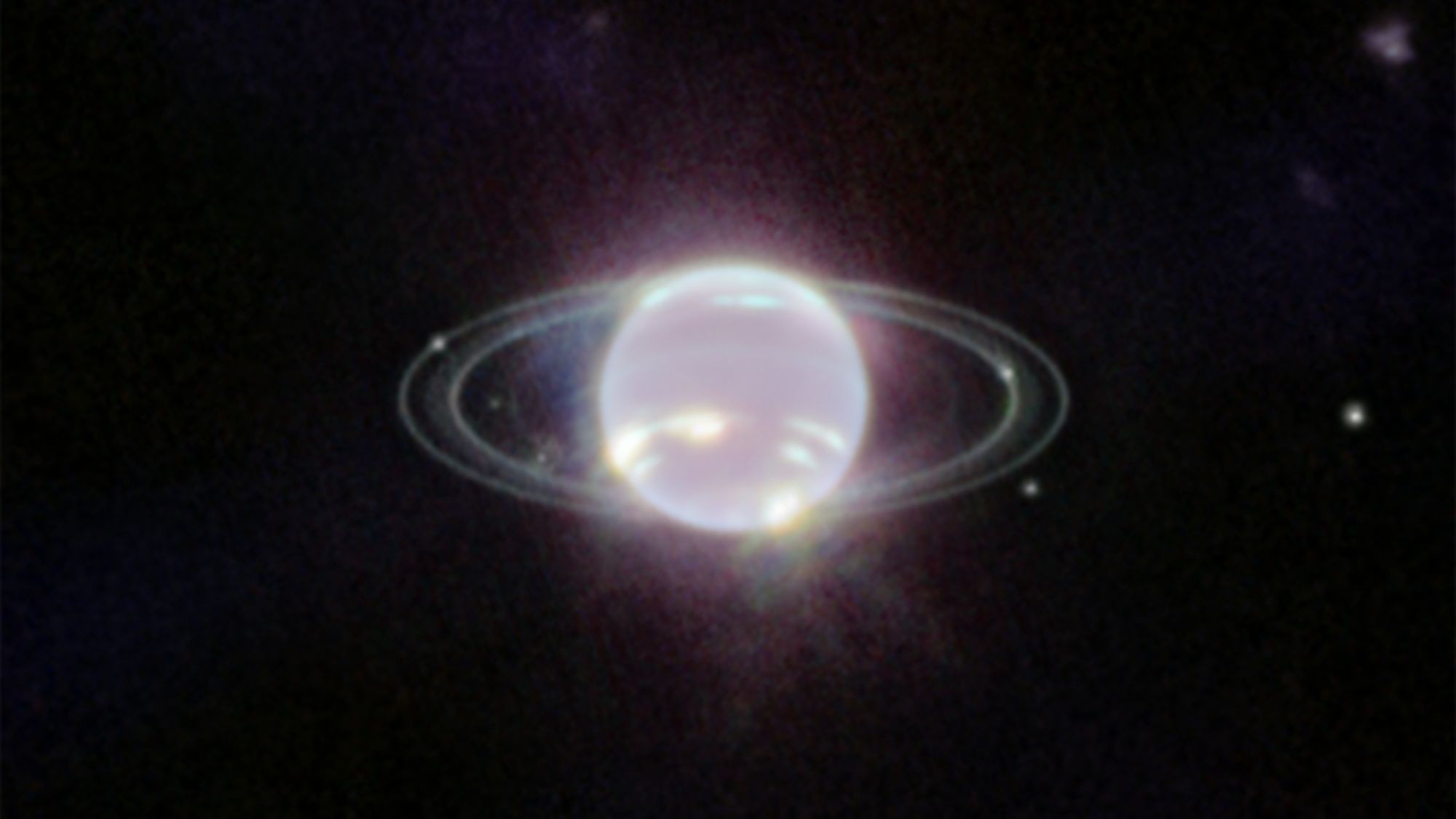
Three moons orbiting Neptune might be the crushed remains of ancient icy bodies that collided violently. A new study suggests these fragments could hold the key to understanding what lies inside ice worlds we can’t see.
“The interiors of large icy moons are normally permanentlyhidden from us, buried beneath thick shells ofata of water ice,” study lead author Ryleigh Davis told Space.com. “Neptune’s inner moons may be the only place in the solar system where we can observe that material. A catastrophic event essentially turned those ancient worlds inside.”
The wrecking ball effect of Triton
Triton is the giant in the room. It accounts for over 99 percent of Neptune’s total moon mass. Roughly the size of Pluto, it orbits in the opposite direction of Neptune’s rotation. That backward path implies Triton didn’t form with the planet. It was likely captured from the Kuiper Belt or similar outer regions.
When Neptune’s gravity snared Triton, chaos followed.
As Triton settled into orbit, its tidal forces would have acted like a wrecking ball. It likely smashed up whatever moons Neptune originally held. Davis and her team investigated the aftermath. They focused on Neptune’s rings and three small inner moons: Larissa, Galatea, and Proteos.
Discovered by Voyager 2 in 1980, these moons sit close to the planet, just outside the main rings. Their proximity to Neptune’s glare has made them hard to study from Earth.
Clay where no one expected it
The researchers used the James Webb Space Telescope to analyze near-infrared light from these bodies. This revealed their chemical makeup.
Clay minerals appeared on the rings and two moons: Larissa and Galatea. Specifically, magnesium-rich phyllosilicates. These are common in asteroids and carbonaceous chondrites near Jupiter. They are not expected in the outer solar system.
“The most surprising thing is simply that we found clays at all,” Davis said. “That was genuinely not on our list.”
Clay minerals require heat to form. Prolonged, major heating is needed. This likely happened deep inside a large icy body. Radioactive decay and other internal heat sources could have melted ice, creating liquid water conditions necessary for clays.
This supports the theory that Triton destroyed original moons. The debris reformed into the inner moons we see today. The clay minerals, buried deep inside those original moons, were exposed on the surface after the shattering.
Another theory? A dwarf planet.
Perhaps a Pluto-sized object strayed too close to Neptune. The planet’s gravity may have shredded it apart. The resulting debris formed the current moons. Either way, the source of the clay is the interior of a large, heated body.
The missing water mystery
Clays need liquid water to exist. Yet, no water ice was detected on the three studied moons or the rings.
“That’s really surprising,” Davis said. “Everything out in this part of the solar is really icy. So, we’re fairly confident they had to come from deep inside.”
Something big enough to melt its own water ice must have provided the materials. The source seems to be the original system of icy moons. But where did the ice go? The mystery remains.
Proteus, the largest of the three studied, shows no clay minerals. It might have formed from debris lacking clays. Or, subsequent heating might have destroyed them.
An unknown hydrated mineral
All three moons and the rings showed signs of a hydrated mineral the team couldn’t identify. It’s a ghost in the data.
“Identifying it will likely require new lab measurements under outer solar system conditions,” Davis said. It’s technically challenging. But it is doable.
One flyby in 1989 isn’t enough. We need a dedicated mission to Neptune. The Planetary Science Decadal Survey has listed an ice giant mission as high priority. Development takes decades, however. Time and resources are the main hurdles.
But the data from Webb is clear. There is much more to learn. And the clues are right here, in the shattered remains of a lost world.


