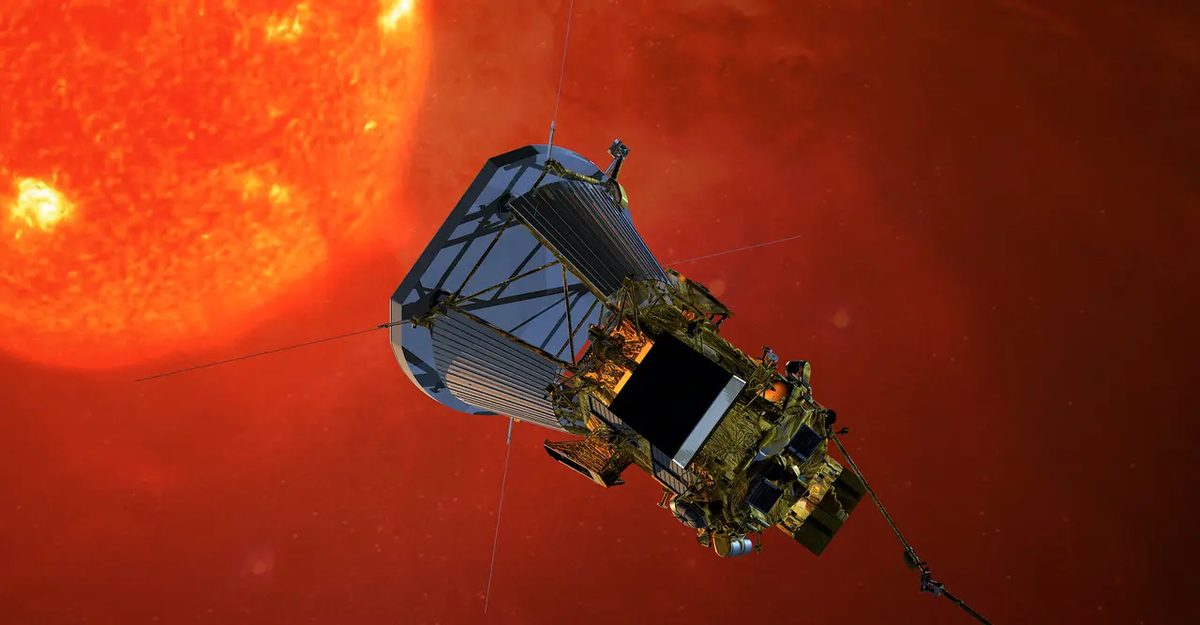
The fastest object humans have ever built isn’t a rocket blasting off from Earth. It’s not even a spaceship currently sitting on a launchpad. It’s the Parker Solar Probe.
Launched by NASA in August 2018, this pioneering mission is rewriting the textbooks on solar physics. But for engineers and physicists, its most headline-grabbing achievement is mechanical. The probe has become the fastest human-made object in history. And it didn’t get there by firing its main engines harder. It got there by cheating with gravity.
How Gravity Assist Creates the Ultimate Speed Record
To understand how Parker Solar Probe breaks records without constant propulsion, you have to look at its dance with Venus.
The mission’s goal is ambitious: get close enough to the Sun’s corona to study the solar wind and understand why our star’s outer atmosphere is hotter than its surface. To do that, the probe needs to dive deep into the Sun’s gravity well. But dropping into a tighter orbit requires slowing down relative to the Sun. Spacecraft do this by swinging past planets.
Each time Parker Solar Probe flies by Venus, it uses the planet’s gravitational field to steal a tiny fraction of its orbital energy. This gravity assist shifts the probe’s trajectory, pulling it closer to the Sun. The closer it gets, the faster it must travel to avoid falling in, much like a figure skater pulling in their arms to spin faster.
The results are staggering.
During a recent flyby this summer, the gravity assist from Venus boosted Parker Solar Probe to a blistering 635,266 kilometers per hour. This shattered its own previous record of 586,863 km/h, set in November 2021.
Think about that speed. 148 kilometers per second. If you could board a ship traveling at this pace, you could leave Earth and hit the Moon in just 43 minutes. Mars? Four and a half days.
This isn’t a fluke. It’s a calculated progression. NASA has scheduled multiple Venus flybys through the end of the mission’s initial phase in late 2024. Each pass tightens the orbit. The next speed record isn’t just possible; it’s guaranteed. By late 2025, the probe is expected to hit 692,000 km/h (192 km/s) at its closest approach.
The Thermal Challenge Behind the Speed
Speed is impressive. Survival is the real engineering marvel.
As Parker Solar Probe closes the distance, the environment becomes hostile. At its closest approaches, the probe will suffer temperatures reaching 1,400 °C. For context, earlier in the mission, during its fourth solar encounter in January 2020, the probe recorded a speed of 393,044 km/h while its heat shield endured 612 °C. The instruments behind that shield stayed a manageable 30 °C.
But the heat load is increasing. Future passes will expose the thermal protection system to nearly 1,370 °C. The probe is essentially flying into an oven, protected by a 11.5-centimeter-thick carbon-composite shield.
Why go through such trouble? Because the corona—the Sun’s outer atmosphere—is where the solar wind originates. This wind is a stream of charged particles that affects space weather, which can disrupt satellites, power grids, and communications on Earth. By measuring the magnetic fields and particle speeds right at the source, scientists hope to predict solar storms with greater accuracy.
Closing In on the Star
The distance records are falling just as fast as the speed benchmarks.
After its latest Venus flyby, Parker Solar Probe set a new record for proximity, coming within 7.26 million kilometers of the Sun’s surface. That is significantly closer than Mercury’s average orbit.
But the probe isn’t done. The mission profile aims for a closest approach of just 6.16 million kilometers. This milestone is expected around late 2024 or early 2025. At that point, the probe will be traveling so fast and so close that it will solidify its status as the undisputed champion of human velocity.
The data coming back from these extreme conditions is changing our understanding of heliophysics. We are learning how the solar wind accelerates and how magnetic fields reconfigure in the corona. It’s messy, violent, and incredibly fast.
And we’re just getting started. As each Venus flyby brings the probe deeper into the Sun’s grip, the numbers will climb. The speed will increase. The heat will intensify. The question isn’t really if the records will break. It’s how much our understanding of the Sun will transform while the probe survives to tell the tale.
The sun burns. The probe endures. And the numbers keep rising.


The Subscription Trap
It’s a familiar script. You get a notification. A blue bubble. A link that feels urgent, even if it isn’t. The message is simple: Follow us on WhatsApp. Or Google News. The promise is seductive. Never miss a beat. Stay ahead of the curve. Be in the know.
But look closer at the mechanism. It’s not just about convenience. It’s about retention.
Digital magazines are bleeding traditional revenue models. Ads don’t pay the bills the way they used to. Subscribers are the lifeblood. But getting someone to click “Subscribe” is hard. It requires trust. It requires vulnerability. It requires handing over credit card details to a company you barely know.
Getting someone to join a WhatsApp broadcast list is easy. It takes seconds. It feels like a favor. A quick tap. A small concession of attention. But once you’re in that digital silo, the friction to leave is higher. The algorithm knows you’re there. The message lands. The open rate is nearly one hundred percent.
This is the new real estate. Not the webpage you visit once a month. The chat window that lives in your pocket.
Why This Shift Matters
The move toward messaging apps isn’t just a trend. It’s a structural change in how information is consumed. We are moving from the open web to closed gardens. Facebook. WhatsApp. WeChat. Signal. These platforms control the gate. They control the feed. They control the metrics.
For the reader, this means fragmentation. The shared public square is shrinking. You are seeing what your specific list sends you. You are seeing what the algorithm predicts you’ll click. The serendipity of discovery is being replaced by the efficiency of curation.
Is this bad? Not necessarily. Curation can be a lifeline in an age of information overload. If the right people are filtering the noise, you save hours every week. But who are those people? And what is their incentive?
The magazine you’re reading doesn’t just want your ad revenue. They want your attention. And attention is the most expensive commodity on the internet.
The Cost of “Free” Access
When you follow on WhatsApp, you aren’t paying money. You’re paying attention. You’re giving up a portion of your autonomy. You agree to receive updates when they choose to send them. You agree to a channel that is difficult to unsubscribe from quietly. It’s often buried in settings. It’s often unclear.
This is the trade-off. Convenience for control.
The tech giants profit from this data. They know who is interested in science. Who is interested in technology. Who clicks on which links. This data is valuable. It shapes advertising. It shapes content. It shapes what you see next.
If you value independent journalism, ask yourself what you’re giving up for that easy access. Is the quick link worth the long-term dependency? Is the instant notification worth the loss of the open web’s unpredictability?
There’s no easy answer. The landscape is shifting beneath our feet. The tools are changing. The incentives are aligning toward consolidation. We are trading the wild west of the internet for the paved streets of the app store.
It’s faster. It’s smoother. It’s quieter.
But it’s also smaller.
You have a choice. You can stay in the loop.