


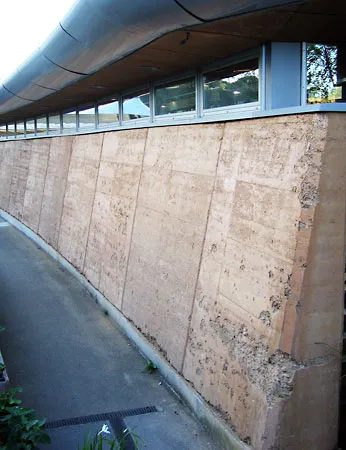
It’s not just dirt. It’s engineering.
Rammed earth stands as the heavyweight champion of earthen construction. It’s durable enough to survive centuries, used by civilizations from the ancient Near East to modern sustainable architects. Unlike simple mud bricks that crumble, rammed earth is compacted soil. Densely packed. Layer by layer.
You can make blocks. Or you can build walls in place.
For blocks, you shove soil into a box-shaped mold. You ram it. You dump it out. Done. For walls, it’s more like pouring concrete, but slower and earthier. Two wooden planks sit side-by-side, held apart by a spacer bolt. You fill the gap with soil. You pack it down. Then you move the form up. Repeat. Until the wall hits the desired height.
The tools have evolved. Iron-headed rammers were the original choice. Then came roller-mounted forms. Pneumatic rammers. Hydraulic presses for mass production. But the recipe remains stubbornly simple. The soil needs to be roughly 70% sand and 30% clay. Too much clay, and it cracks when it dries. Too little, and it won’t hold together. Modern builders add about 10% water to the mix. Sometimes they add stabilizers. Portland cement helps. Bitumen helps. These additives boost weather resistance and strength.
Why bother with such an ancient technique?
Because it works.
Rammed earth walls are thick. Usually at least 12 inches (30 cm). That mass does something magic: thermal capacity. It absorbs heat during the day and releases it at night. In climates where the sun blisters your back by noon and freezes your bones by midnight, rammed earth keeps the inside uniform. Stable. Comfortable.
But dirt hates water.
To protect the surface, builders often slap on plaster, bitumen, or linseed oil. It’s a shield against rain and erosion. Without it, the wall slowly washes away. With it, the structure lasts.
Good compressive strength is the hallmark of this method. It holds up. It stands tall. It doesn’t need steel rebar or concrete mixes. Just soil, water, and pressure.
Is it the future of housing? Maybe. Or maybe it’s just the past, relearning itself. Either way, the walls remain. Solid. Heavy. Real.


