


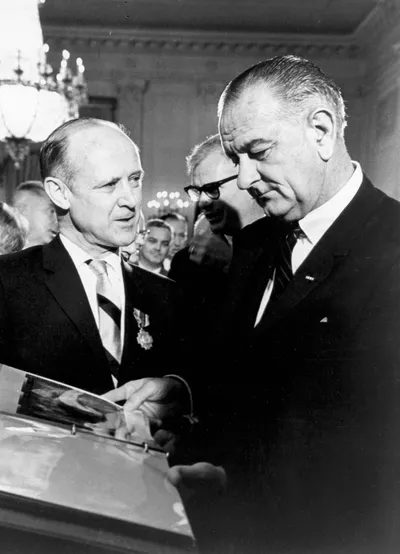
He was born on the other side of the world. December 24, 1910. Wellington, New Zealand. But his legacy is etched into the American sky. William Hayward Pickering didn’t just watch the space race; he helped build the engine that drove it.
Pickering is best known for one thing: leading the team that launched Explorer 1. That was 1958. It was the first U.S. satellite. Before that, the Soviets had beaten America into orbit with Sputnik. The pressure was immense. Pickering, an engineer and physicist, cut through the noise. He delivered.
From Balloons to Ballistics
His path wasn’t straight. He studied at Canterbury University in New Zealand before moving to the U.S. in 1929. He became a citizen in 1941. By then, he was already deep into the science. He earned his B.S., M.S., and Ph.D. from the California Institute of Technology (Caltech) in Pasadena, finishing his doctorate in 1936.
He joined the faculty there. He worked under Robert A. Millikan. The mission? Build gear to detect cosmic radiation. But not for ground labs. For high-altitude balloon flights. This was 1930s tech. The balloons went high. The air got thin. The detectors had to work when everything else failed. Pickering figured out how to make them work.
The Telemetry Pioneer
World War II changed the focus. 1944. Pickering became a section chief at the Jet Propulsion Laboratory (JPL). This is where things got real. Rockets weren’t just firecrackers anymore. They needed to talk back.
He developed the first telemetry system used in U.S. rockets. Telemetry. Remote measurement. It allowed engineers on the ground to see what the rocket was doing while it was still in the air. Without that, you’re shooting blind. Pickering made it possible to guide the blind.
He also managed the Corporal rocket project. This was a guided missile. It forced early advances in guidance and communication techniques. The military wanted range. Pickering gave them precision.
Director of the Moon Shooters
- He became chief of the division of guided-missile electronics. Three years later, he was director of JPL.
The Cold War was heating up. The U.S. needed a win. Pickering took charge of the Explorer 1 satellite. He oversaw the modification of the Jupiter C launch vehicle. It wasn’t just about putting metal in space. It was about proving capability.
And then there was the rest of the solar system.
JPL, under Pickering’s tenure, didn’t stop at orbit. They built the Ranger spacecraft. For unmanned flights to the Moon. They built the Surveyors. For lunar landings. They built the Mariners. For survey flights to Venus and Mars.
These weren’t just experiments. They were probes. Unmanned probes into the solar system. Pickering’s team was mapping the unknown. They were sending eyes and ears into the void.
The Man Behind the Machine
He retired from JPL in 1976. Old school retirement. Two years later, he


